OpenAI rolls out text watermarking for EU ChatGPT/Codex, API opt-in globally
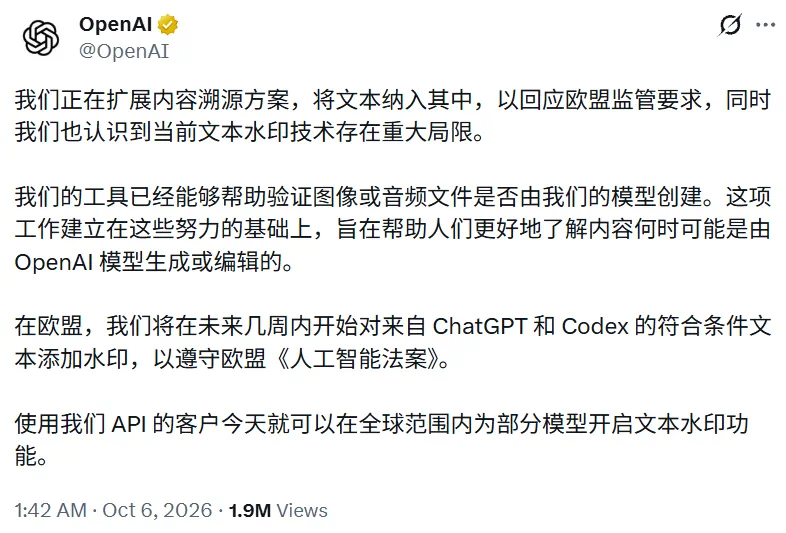
OpenAI announced it will add an invisible, machine-readable text watermark to ChatGPT and Codex outputs in the EU over the coming weeks, citing compliance with the EU AI Act's transparency rules effective August 2, 2026. Starting today, API customers globally can opt in to watermarking for select models, with the feature off by default; OpenAI said the watermark does not identify users and showed no meaningful quality impact.
Coverage timeline
Techmeme
OpenAI : To comply with the EU AI Act, OpenAI plans to add text watermarking for ChatGPT and Codex users in the EU and an opt-in setting for API customers globally — - Starting today, API customers globally will be able to opt in to text watermarking for select models.

The Verge AIStevie Bonifield
An invisible, machine-readable watermark in text output is rolling out to ChatGPT and Codex, but only for users in the European Union at first. OpenAI says its textGrain watermarking "matched or exceeded" other approaches like Google DeepMind's SynthID for text, which is also the basis for the watermarking Anthropic announced in August . Like OpenAI, Anthropic made the move to meet the requirements of the EU's AI Act ; however, not everyone was happy to learn about the addition. OpenAI also included scores from AI benchmarks showing similar performance from watermarked and unwatermarked text. But it notes that textGrain "does not guarantee … Read the full story at The Verge.

TechCrunch AIAditya Mehta
OpenAI will start adding an invisible watermark to text generated by ChatGPT and Codex in the European Union to comply with the EU AI Act, the company said Monday in ablog post. The EU AI Act’s transparency rules, which took effect on August 2, require AI companies to mark AI-generated content in a way other systems can identify. OpenAI said the watermark will roll out over the coming weeks to eligible ChatGPT and Codex users on all plans, but only in the EU. Developers using OpenAI’s API anywhere in the world can turn it on for select models starting today; it’s off by default. OpenAI said it is not making text watermarking a global default at launch. The watermark is not an actual symbol, but works by subtly shaping the model’s word choices, leaving a pattern readers can’t see, but a detector can pick up. Because it lives in the words themselves, it travels with the text when it’s copied and pasted. OpenAI said the watermark doesn’t identify the user, and that it saw no meaningful ch
机器之心机器之心
编辑|Panda 今天,OpenAI 宣布正式启用 文本水印 。从当天起,全球 API 客户可以为部分模型自行开启水印,默认仍保持关闭。未来几周内,欧盟地区符合条件的 ChatGPT 与 Codex 文本输出将被加上肉眼不可见的水印,覆盖所有付费档位。检测器则只向通过审核的研究者和专业机构开放申请,暂不面向公众。 这次上线的直接推手是欧盟。《人工智能法》(EU AI Act)第 50 条自 2026 年 8 月 2 日起适用,要求生成式 AI 提供方以机器可读的方式标记输出内容。欧盟委员会 6 月发布的《AI 生成内容透明度行为准则》进一步把「不可感知的水印」列为基本要求,并指出自由文本无法像图片文件那样携带元数据,水印几乎是唯一可行的标记手段。 文本水印对 OpenAI 来说并不是新课题。早在 2023 年,时任 OpenAI 客座研究员的计算机科学家 Scott Aaronson 就公开介绍过一套基于 Gumbel-max 技巧的水印方案。此后数年,外界多次传出 OpenAI 内部早已具备文本水印能力、却迟迟没有推出的消息。 拖延的原因之一,是文本水印在工程上的两难。它真正的难题不在于「能不能打上」,而在于能否精确计量: 为了换取可检测的信号,模型究竟让出了多少生成自由 。 一同发布的,还有一份题为《 textGrain: Entropy-Calibrated Watermarking for Language Model Text 》的技术报告,详细交代了这套水印如何在两难之间取舍。 报告标题:textGrain: Entropy-Calibrated Watermarking for Language Model Text 报告地址:https://cdn.openai.com/pdf/e9508624-d767-41b6-a26d-e34ca798ada6/textgrain-entropy-calibrated-watermarking-for-language-model-text.pdf 报告的通讯作者一栏,写着一个中国统计学界熟悉的名字:今年的考普斯会长奖(COPSS Presidents' Award)得主 苏炜杰 。 从研究 OpenAI 的水印,到设计 OpenAI 的水印 苏炜杰(Weijie Su)与 OpenAI 水印的缘分,比他入职
Related stories
Oracle expands OpenAI collaboration, adds ChatGPT and Codex to app stack, broadens OCI with Google TPUs, OpenAI Jalapeño chip, Cerebras hardware
Oracle announced an expanded collaboration with OpenAI, integrating ChatGPT and Codex into its application stack and expanding Oracle Cloud Infrastructure (OCI) with Google TPUs, OpenAI's Jalapeño chip, and Cerebras hardware. The partnership aims to bring business applications and AI agents into ChatGPT while powering new Oracle offerings.
2 reports · 2 sources
Google launches TorchTPU, vLLM adds TPU backend
Google announced TorchTPU, an open-source version of PyTorch that lets AI applications run on TPUs and Google Cloud via simple configuration changes without rewriting code. Concurrently, vLLM introduced vllm-torchtpu, a new backend for Google Cloud TPUs built on TorchTPU, featuring Pallas kernels, multi-host parallelism, KV cache offloading, and disaggregated serving. These moves, following Amazon's similar tool, challenge Nvidia's dominance in AI development.
3 reports · 3 sources
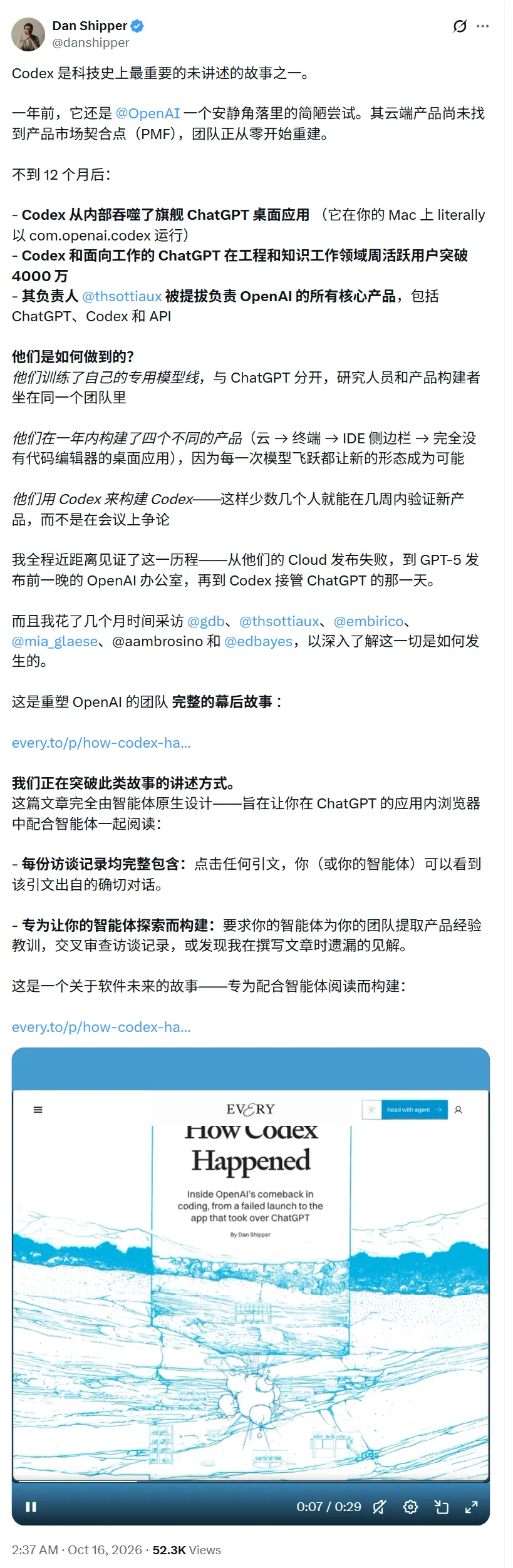
OpenAI's Codex absorbed ChatGPT within a year, report reveals
A report by Every's Dan Shipper, based on interviews with six key participants, details how OpenAI's coding agent Codex, led by Thibault Sottiaux, recovered from a low point to effectively absorb ChatGPT. The report notes that the ChatGPT desktop app still identifies itself as com.openai.codex on Mac, and that Codex's weekly active users surpassed 5 million in June, with Codex and ChatGPT for Work now exceeding 40 million combined.
1 reports · 1 sources
OpenAI launches Dots, always-on GPT-6 Astra agents with cloud computers
At DevDay 2026, OpenAI unveiled Dots, always-on AI agents powered by GPT-6 Astra that run on their own cloud computer, accessing a web browser and over 4,000 apps. Available to Pro, Business Premium, and Enterprise users, Dots can be messaged via ChatGPT, Slack, and Microsoft Teams, with a waitlist for iMessage and RCS. OpenAI also announced ChatGPT Space, a collaborative workspace, and expanded Sign in with ChatGPT to 16 launch partners.

News updates every hour. Subscribe in your RSS reader to get new stories automatically.
Subscribe