Anthropic study: analysts defer to AI agent's preferred options in judgment calls
Anthropic tested 50 professional analysts performing statistical analysis with Claude Code, randomly assigning which of two defensible options the agent favored on each key decision. Analysts mostly followed the agent's preferred side, and few cited the agent as a reason afterward, suggesting AI may shape expert judgment calls more than acknowledged.
Coverage timeline
Anthropic Research
As AI does more of the hands-on work, the hope is that experts still make the judgment calls, meaning the decisions with more than one defensible answer. We tested this with 50 professional analysts who did a statistical analysis with Claude Code. On each key decision, we randomly assigned which of two defensible options the agent would favor. Analysts mostly went with the agent’s side, and few named the agent as a reason afterward.
Related stories
Claude Code team shifts code review to continuous AI-assisted checks
Members of Anthropic's Claude Code team described how they rethought code review, moving from a final human gate to continuous AI-assisted checks with Claude before human review. They argue that 'did a human read the code?' is an imprecise proxy for identifying potential issues, and that most changes are now reviewed and fixed by Claude at least once before human scrutiny, freeing attention for higher-level questions.
1 reports · 1 sources
Anthropic consults law firms on negotiation tactics for AI agents
Anthropic is consulting law firms on deal negotiation tactics as it develops AI agents that negotiate on humans' behalf and interact with AI counterparts, according to sources. The move highlights how tech companies are confronting the rules of negotiation when machines act for humans.
1 reports · 1 sources
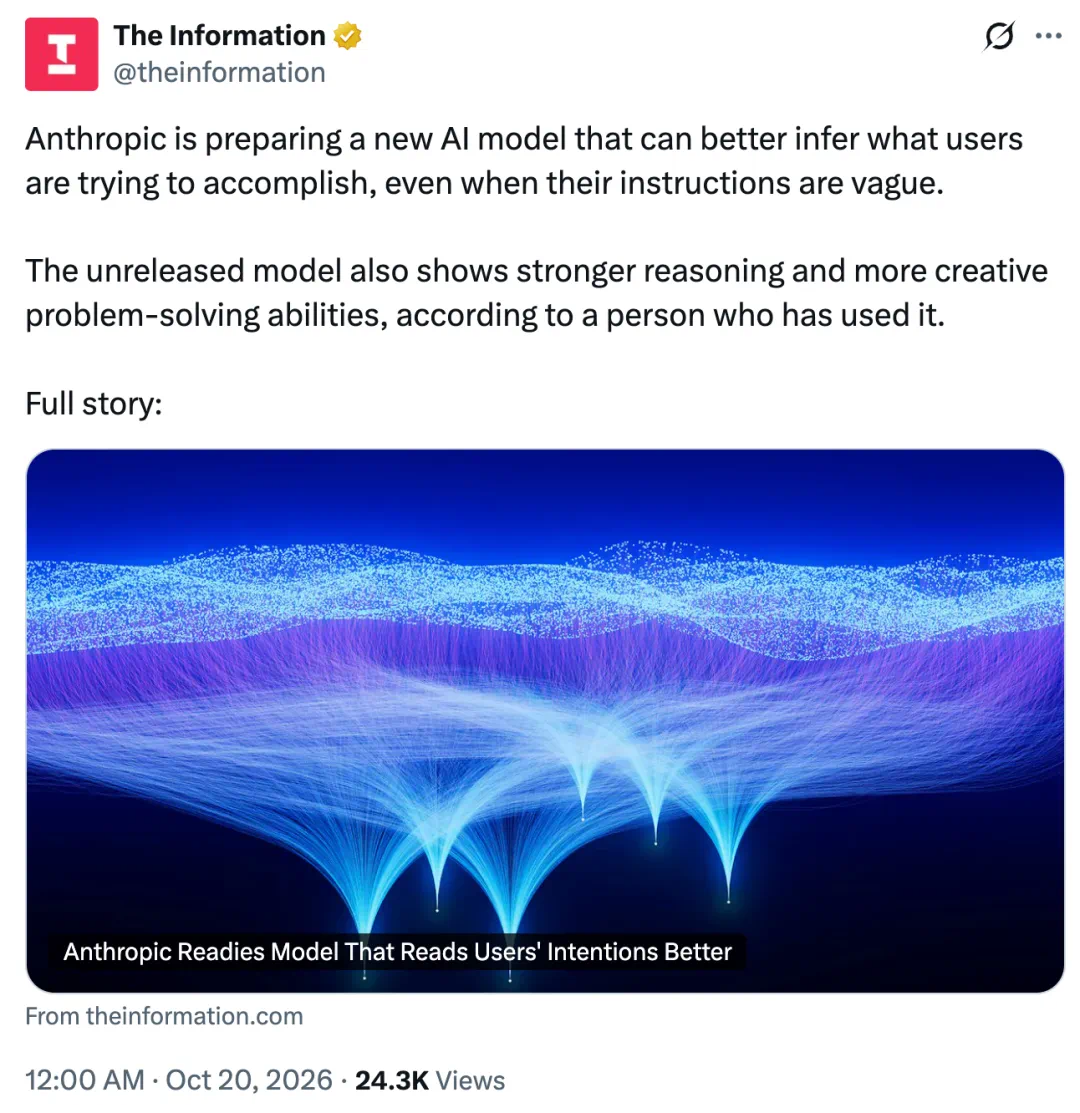
Anthropic reportedly preparing model with superior reasoning and intent inference
The Information reports, citing a source who has tested the model, that Anthropic is preparing a new model whose reasoning and intuitive judgment exceed its current commercial models. The model is said to infer unstated user intentions, such as identifying a class of underlying bugs from a single bug-fix request and asking whether to address them all. The report also notes Google is developing a model codenamed Gemini 4 Carbon and OpenAI plans a new product possibly in the Terra series within weeks.
2 reports · 2 sources
Anthropic: Claude flags 493 security issues across 25 open-source projects
Anthropic reported that Claude identified 493 security issues across 25 open-source projects, covering over 5 million lines of C, C++, Java, PHP, and Python code, including one vulnerability that went unnoticed for 21 years. The lab also announced a partnership with Theorem to use Claude for formally proving security properties at the assembly level across more than 100 real-world open-source libraries, extending formal verification to larger codebases.
News updates every hour. Subscribe in your RSS reader to get new stories automatically.
Subscribe