Google launches Gemini 3.8 Flash TTS and Flash-Lite TTS with 2,000+ voices, 100+ languages
Google released two new text-to-speech models, Gemini 3.8 Flash TTS and Gemini 3.8 Flash-Lite TTS, described as its most expressive audio generation models yet, supporting over 100 languages. The models offer a library of over 2,000 voices and allow custom voice creation from a 30-second audio sample, with an API that supports multi-character conversations with distinct voices and style instructions.
Coverage timeline
Techmeme
Google : Google releases Gemini 3.8 Flash TTS and Gemini 3.8 Flash-Lite TTS, its “most expressive audio generation models yet”, with support for more than 100 languages — Gemini 3.8 Flash TTS and Gemini 3.8 Flash-Lite TTS are our most expressive audio generation models yet.

Simon Willison
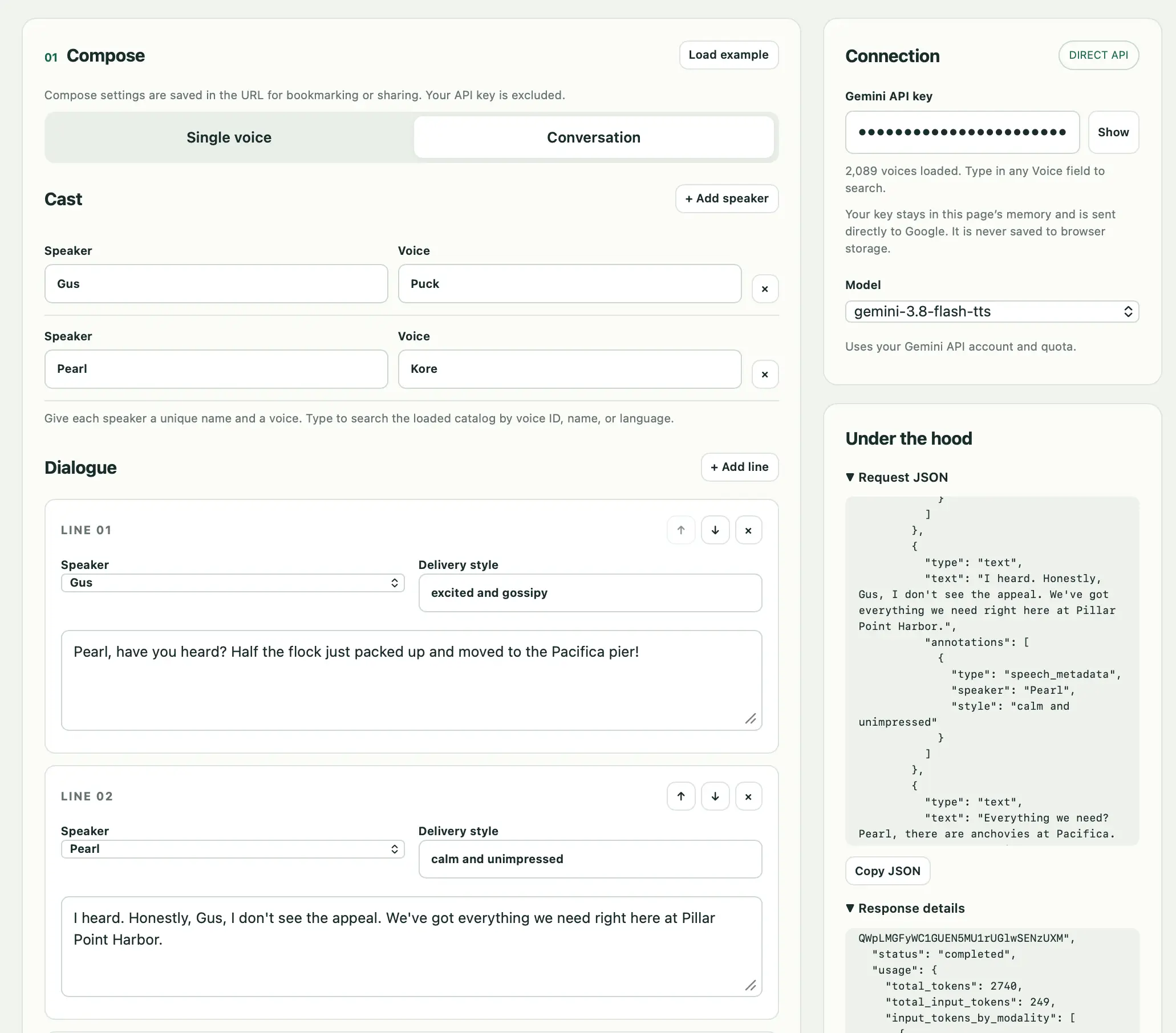
Tool: Gemini 3.8 TTS Playground Google released two new Gemini text-to-speech models today - gemini-3.8-flash-tts and gemini-3.8-flash-lite-tts . They come with a library of over 2,000 voices, plus the ability to create a custom voice with "just a 30-second audio sample of your voice or a voice you have the rights to use". I vibe coded this bring-your-own-key playground interface with GPT-6 Astra, taking advantage of the open CORS policy of the underlying Gemini API. A notable feature of the API is that it makes it easy to define a full conversation between multiple characters, each with different voices and voice style instructions. Here's a short demo clip of a conversation between two pelicans debating if they should move to the Pacifica Pier . I had Claude 4.5 Opus write the script and generate a URL to render it using the tool . Your browser does not support the audio element. It took ~20 seconds to generate 1m 18s of audio using Gemini 3.8 Flash TTS (not the cheaper Flash-Lite),
Related stories
Google open-sources Harness², a recursive self-improvement system for LLMs
Google has open-sourced Harness², a recursive self-improvement (RSI) system that enables LLMs to modify their own code, prompts, tools, and skill libraries during runtime. The system uses a dual-layer recursive architecture—task-level and harnessing-level—to address the lack of ground truth and overfitting in real-world tasks. In tests, equipping GLM-5 with Harness² improved its score on the WorkBuddy-Bench office benchmark by 11.5 points, surpassing native Gemini 3.5 Flash. The project is fully open-sourced and supports OpenCode and Codex.
1 reports · 1 sources
Hugging Face Blog Announces Granite Switch 4.1 with Unified Endpoint
Hugging Face's blog announced Granite Switch 4.1, a model that supports chat, decisions, and speech from a single endpoint. The announcement highlights the model's versatility in handling multiple interaction modes without requiring separate deployments.
1 reports · 1 sources
Google launches SynthID Detector website for AI media detection
Google launched SynthID Detector, a website that allows users to verify whether images, videos, or audio clips are AI-generated, supporting dozens of common file formats. The tool aims to help people identify AI-generated media across multiple content types.
1 reports · 1 sources
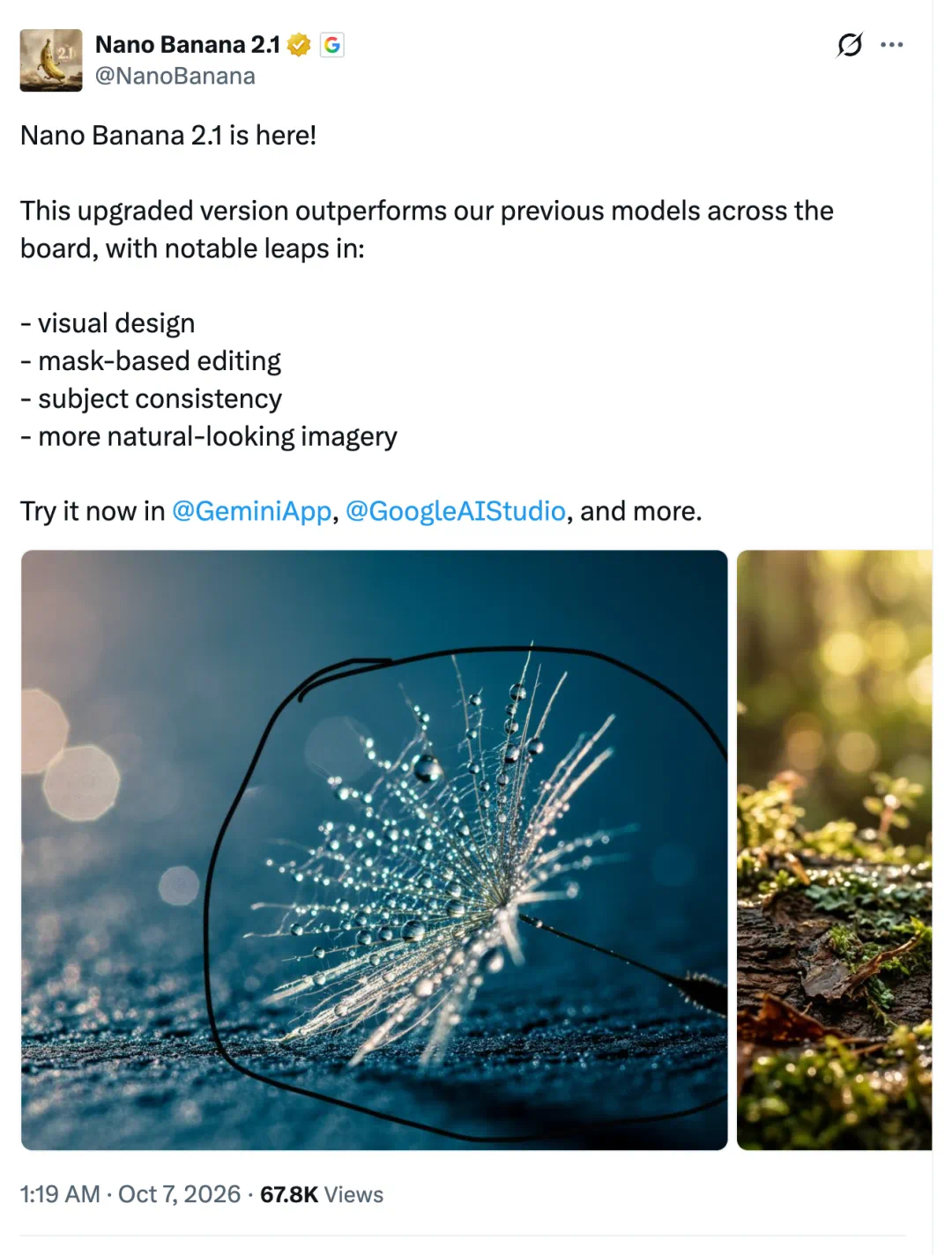
Google DeepMind releases Nano Banana 2.1 image model based on Gemini 3.6 Flash
Google DeepMind has released Nano Banana 2.1, an efficient image generation and editing model based on Gemini 3.6 Flash, now stable in the Gemini API. The update claims broad improvements in visual design, mask editing, subject consistency, and image naturalness, with pricing about 50% lower than Nano Banana 2. The model supports 1K, 2K, and 4K outputs, handles up to 14 reference images for multi-image fusion, and is distributed across Gemini App, Google AI Studio, Gemini API, Google Search AI Mode, Google Ads, Flow, and Stitch.
2 reports · 2 sources
News updates every hour. Subscribe in your RSS reader to get new stories automatically.
Subscribe