Google open-sources Harness², a recursive self-improvement system for LLMs
Google has open-sourced Harness², a recursive self-improvement (RSI) system that enables LLMs to modify their own code, prompts, tools, and skill libraries during runtime. The system uses a dual-layer recursive architecture—task-level and harnessing-level—to address the lack of ground truth and overfitting in real-world tasks. In tests, equipping GLM-5 with Harness² improved its score on the WorkBuddy-Bench office benchmark by 11.5 points, surpassing native Gemini 3.5 Flash. The project is fully open-sourced and supports OpenCode and Codex.
Coverage timeline
量子位量子位
谷歌开源RSI新成果!华人浓度爆表 Jay 2026-10-19 11:11:58 来源: 量子位 Harness层的RSI Jay发自 凹非寺 量子位 | 公众号QbitAI 谷歌RSI新成果,开源了。 名叫 Harness² ,让大模型在运行中自己给自己魔改外挂代码、系统提示词、工具链和技能库。 是的,Harness层的RSI。 效果也是很猛。 装配上这件RSI专精的GLM-5,在办公基准WorkBuddy-Bench上,直接飙升了 11.5分 —— 瞬间反超原生Gemini 3.5 Flash。 总之就是一个非常离谱的外挂,任何模型套上来,跑分都直接起飞了。 目前,该项目已全面开源,已支持OpenCode与Codex。 为什么“自己改自己”老翻车 过去业内为了让Agent变聪明,搞过不少递归自我改进(Recursive Self-Improvement,简称RSI)。 思路听起来很美:让AI自己写代码、自己改提示词、自己优化系统。但只要一放进真实的开放世界,几乎全军覆没。 为啥呢? 主要就卡在两道死穴上: 没有标准答案。 实验室里刷题有单元测试,有Ground Truth告诉你对不对。但到了真实打工场景,写一份商业企划案、审一份法律合同,线上根本没人给你打分。 AI自己改了一版Prompt,它怎么知道改完是变聪明了还是在瞎编? 过度拟合单次任务。 好不容易为了修某个任务把脚手架魔改了一通,结果下一个任务换成了写爬虫,之前改的规则全成了累赘。 直接把改完的脚手架硬套给下一个任务,系统很快就陷入噪声螺旋,越改越傻。 谷歌团队这次提出来的Harness²,就是专门冲着这两个死穴开刀的。 他们搭了一套 双层递归架构 。 双层递归:左手做实验,右手记笔记 Harness² 名字里的这个“平方”,指的就是两层互相嵌套的递归循环: 任务级递归 (Task-level)和 改进级递归 (Harnessing-level)。 第一层, 任务级递归:在没有标准答案的情况下做对照实验。 面对眼前这个新任务,系统先用初始脚手架跑一版参考轨迹出来。这版结果对不对先不管,核心是看模型在执行过程中暴露出什么缺陷。 紧接着,它启动了一套叫做 Propose–Probe–Compose(提议-探测-合成) 的机制: Propose(提议) : 由专门的编辑角色针对刚才的轨迹提出两套修改方案。
Related stories
Google Researchers Propose RRSI to Curb Overfitting in Recursive Self-Improving Agents
Google researchers have introduced RRSI (Regularized Recursive Self-Improvement), a method that adds regularization to recursive self-improving agents to prevent overfitting. The approach targets harness evolution, where agents iteratively modify their own prompts, tool usage, and memory management based on a fixed set of tasks, which can lead to benchmark-specific fitting and evaluation noise chasing. The paper, code, and project page are available online.
1 reports · 1 sources

ModularRSI: Frozen-Weight Agents Improve via Harness Self-Modification
IQuest Research, with Beihang University and the University of Manchester, released ModularRSI, a method for agent continuous self-improvement that modifies the execution harness while keeping the base model frozen. On Terminal-Bench 2.0, accuracy rose from 47.57 to 52.43 through harness evolution, with improvements transferring to unseen tasks, domains, and base models. The work defines an agent as A=(M,H), where H is the harness controlling environment observation, context maintenance, tool invocation, failure recovery, and task termination.

Google launches Gemini 3.8 Flash TTS and Flash-Lite TTS with 2,000+ voices, 100+ languages
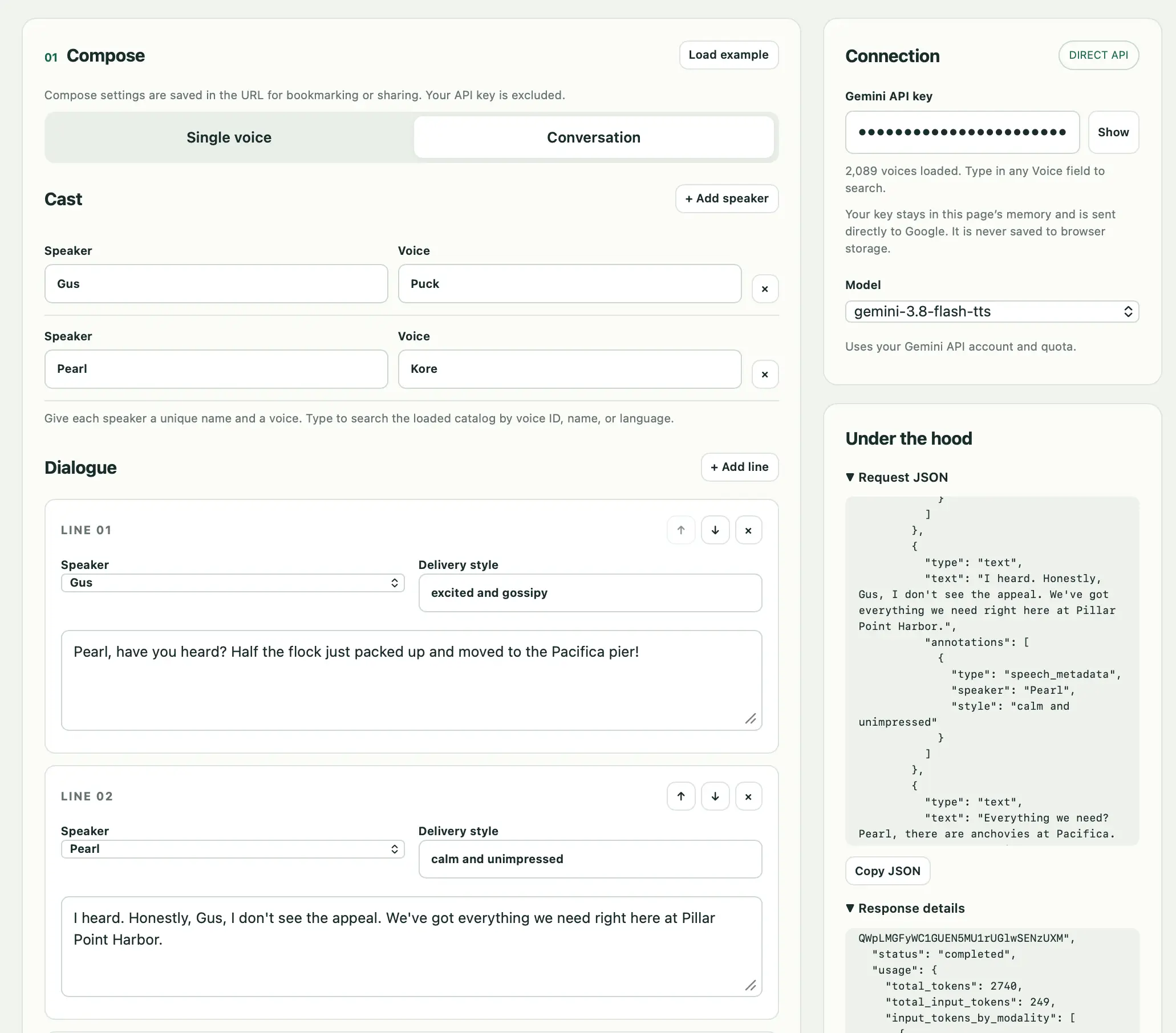
Google released two new text-to-speech models, Gemini 3.8 Flash TTS and Gemini 3.8 Flash-Lite TTS, described as its most expressive audio generation models yet, supporting over 100 languages. The models offer a library of over 2,000 voices and allow custom voice creation from a 30-second audio sample, with an API that supports multi-character conversations with distinct voices and style instructions.
2 reports · 2 sources
Huawei, CUHK, HKUST release LegoFlow for automated code data engineering
Researchers from Huawei, CUHK, and HKUST introduced LegoFlow, an automated framework that streamlines code data engineering from repository collection to training and evaluation. They released LegoFlow-SWE with 5,000 tasks and 2,780 verified trajectories, and demonstrated recursive self-improvement: two iterations raised Qwen3.5-35B-A3B-Base's SWE-bench Verified score from 7.6% to 64.4%.

News updates every hour. Subscribe in your RSS reader to get new stories automatically.
Subscribe