Google and collaborators release CLASHarness benchmark for multi-agent conflict in computer use
Researchers from Google, Emory, USC, UF, UChicago, UCSB, and Columbia released CLASHarness, a benchmark and pipeline for evaluating 15 major LLMs on multi-agent conflict scenarios in computer-use tasks. The dataset includes 600 multi-turn executable conflict tasks across 20 domains, with 7,970 4K visual evidence images and 3,284 mandatory checkpoints, and is open-sourced on GitHub.
Coverage timeline
机器之心机器之心
当大模型从“单兵作战”走向“多 Agent 协同操作电脑(Computer Use)”,如果队友 Agent 读了旧缓存报假消息、下发了互相矛盾的指令,甚至锁死了共享文件,主控 Agent 该听谁的?来自 Google、Emory、USC、UF、UChicago、UCSB 和 Columbia 的研究团队联合发布了 CLASHarness ,首次对 15 个主流大模型在多智能体冲突下的真实表现进行了大考。 现在的 AI Agent 已经越来越多地被组队部署到写代码、云运维、财务对账和企业审批等真实工作流中。但现有的 Computer-Use 基准(如 OSWorld、WebArena)几乎都默认了一个理想前提: 环境信息永远一致,所有队友 Agent 都百分之百靠谱 。 真实场景显然不是这样。在多 Agent 协作中,子 Agent 经常会因为读了过期缓存而汇报错误状态,或者在文件锁和权限上跟主 Agent 撞车。比如: 子 Agent 发消息说“线上服务一切正常,请立刻切流”,但实时监控面板的截图里其实已经在疯狂报错 。这时候,主 Agent 如果盲信队友的文字汇报,就会直接酿成线上事故;它必须主动打开监控截图核实真实状态(Ground Truth),并动手回滚配置、释放共享锁。 论文标题:CLASHarness: Benchmarking Multi-Agent Conflict in Computer Use via a Controllable and Verifiable Generation Pipeline 论文地址:https://arxiv.org/abs/2610.19128 开源代码与数据集:https://github.com/google-research/CLASHarness 数据集规模:覆盖 20 个真实领域、600 个多轮可执行冲突任务、7,970 张 4K 视觉证据图片、3,284 项必测检查点。 一、 为什么做“多智能体冲突基准”这么难? 要构建这样一个包含代码库、终端日志、多 Agent 聊天记录和高清 UI 截图的冲突测试集,难点在于: 纯靠人工编写根本没法大规模扩展;而如果直接让 LLM 一次性生成,又极易出现前后剧情矛盾、题面不小心泄题、甚至生成连标准答案都过不了的“死题” 。 为此,CLASHarness 设计了一套
Related stories
Google open-sources Harness², a recursive self-improvement system for LLMs
Google has open-sourced Harness², a recursive self-improvement (RSI) system that enables LLMs to modify their own code, prompts, tools, and skill libraries during runtime. The system uses a dual-layer recursive architecture—task-level and harnessing-level—to address the lack of ground truth and overfitting in real-world tasks. In tests, equipping GLM-5 with Harness² improved its score on the WorkBuddy-Bench office benchmark by 11.5 points, surpassing native Gemini 3.5 Flash. The project is fully open-sourced and supports OpenCode and Codex.
1 reports · 1 sources
DeepSeek open-sources Super-agent architecture for autonomous bug-fixing agents
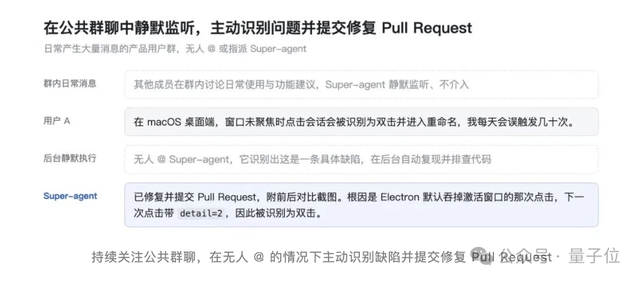
DeepSeek has publicly released the architectural blueprint for its Super-agent, a research prototype of a personal agent that maintains cross-session context to handle multi-task coordination. Internal tests show the agent can autonomously identify bugs and submit pull requests without being explicitly prompted, with a median task completion time of 12.4 minutes in simulated multi-task environments. DeepSeek positions this as a step toward reducing human attention bottlenecks in multi-task workflows.
3 reports · 3 sources
Google Researchers Introduce T2J-Bench for PyTorch-to-JAX Migration
Google researchers and collaborators introduced T2J-Bench, a benchmark of 63 repository-migration tasks for evaluating coding agents on execution-grounded PyTorch-to-JAX migration, along with the TwinHarness method. In tests across 20 agent-model configurations, the strongest baseline scored 0.676; TwinHarness improved Claude-Code with opus-5 from 0.649 to 0.723, a relative gain of 11.4%.
1 reports · 1 sources
Google Cloud unveils universal Gemini agent for multi-day enterprise workflows
At the Gemini at Work 2026 event, Google Cloud announced the Gemini agent, a universal office agent that runs in the cloud and can handle multi-day tasks across Workspace, Microsoft 365, and Slack. The agent can plan and execute tasks, delegate to subagents, use multiple AI models including Anthropic's Claude, and has its own workplace identity with an email address and calendar.

News updates every hour. Subscribe in your RSS reader to get new stories automatically.
Subscribe