Attention Sinks Induce Gradient Sinks; Massive Activations Regulate Gradients via RMSNorm
In a NeurIPS 2026 paper, researchers from Tsinghua and Peking University show that attention sinks concentrate training signals on a few tokens during backpropagation, forming 'gradient sinks.' They find that massive activations can attenuate these locally concentrated gradients through RMSNorm, suggesting that large activations may act as gradient regulators.
Coverage timeline
机器之心机器之心
大语言模型中有一个反复出现的现象。序列开头的少数 Token,往往吸引大量注意力。即使它们没有多少实际语义,模型仍然会频繁地看向它们。这就是 注意力汇聚(Attention Sinks) 。 同一个位置还常出现另一件怪事。模型内部计算产生的部分数值会变得非常大,形成 巨大激活(Massive Activations) 。两种现象常常一起出现,但它们究竟是怎么联系起来的? 已有研究主要从前向计算出发观察模型如何处理输入、形成输出,而在一项被 NeurIPS 2026 接收的工作中,来自清华大学、北京大学的研究团队把目光转向了模型的另一半: 反向传播 。 他们发现,注意力汇聚也会把训练信号集中到少数 Token 上,形成「梯度汇聚」(Gradient Sinks)。而 巨大激活可以通过 RMSNorm 衰减这些局部集中的梯度 。 换句话说, 看起来异常的大激活,可能承担着梯度调节的作用 。 论文题目:Attention Sinks Induce Gradient Sinks: Massive Activations as Gradient Regulators in Transformers 作者:Yihong Chen、Zhouchen Lin、Quanming Yao 论文地址:https://arxiv.org/abs/2603.17771 项目代码:https://github.com/LARS-research/GradientSink 01 被归一化的激活 为什么会被训练得那么大? 要理解研究者的动机,需要先看看现代 Transformer 大模型里的 归一化层 。在采用 pre-norm 的模型中,一个 Token 的隐藏状态进入注意力或者前馈网络(MLP)子层之前,会先经过 RMSNorm 完成归一化。这意味着如果保持向量方向不变,只把它整体放大,归一化后交给子层的输入几乎不变。 一个疑问也就随之而生: 既然前向计算要先归一化,那巨大的激活范数为什么会被训练出来呢? 答案可能藏在归一化的反向传播里。前向计算中被消去的尺度,仍然会影响梯度的反向传递。 02 注意力既是前向的 Value 路由 也是反向的梯度路由 注意力机制的前向计算,是对不同位置的 Value 向量加权求和。反向传播时,同一组注意力权重,也决定了梯度如何分配回这些位置。如果许多后续 Tok

Related stories
PKU Researchers Propose MapFlow to Reuse Attention Maps Across LLMs, Cutting Prefill Latency 15-20%
Researchers at Peking University's PKU-DAIR lab propose MapFlow, a method that reuses attention maps as intermediate states across different LLMs to avoid recomputing context when switching models. In evaluations, MapFlow reduces prefill latency by 15-20% and boosts throughput by up to 25% under a P90 first-token latency constraint in multi-turn routing scenarios, while maintaining generation quality. The paper has been accepted at SIGMOD 2027 and the code is open-sourced.
1 reports · 1 sources

Tsinghua's SkillMaster Trains LLM Agents to Create and Refine Skills via RL
Researchers from Tsinghua University and collaborators present SkillMaster, a NeurIPS 2026 paper that trains LLM agents to autonomously create, update, and retain skills through reinforcement learning, integrating skill management into the agent's own policy. The method uses two learning signals—making previously failed similar tasks easier and previously successful tasks more efficient—to drive skill editing, enabling skill evolution and task execution to be learned jointly.

Forward-only LLM adaptation via SVD rank selection proposed at NeurIPS 2026
A NeurIPS 2026 paper from Lund University and Google DeepMind introduces an efficient LLM adaptation method that uses only forward passes, avoiding backpropagation. The approach leverages SVD rank selection based on activation angle concentration to identify and prune weight matrices during inference, enabling task-specific adaptation without extra resource overhead. Experiments show lower peak memory and higher speedup compared to gradient-based methods like LASER-Grad.

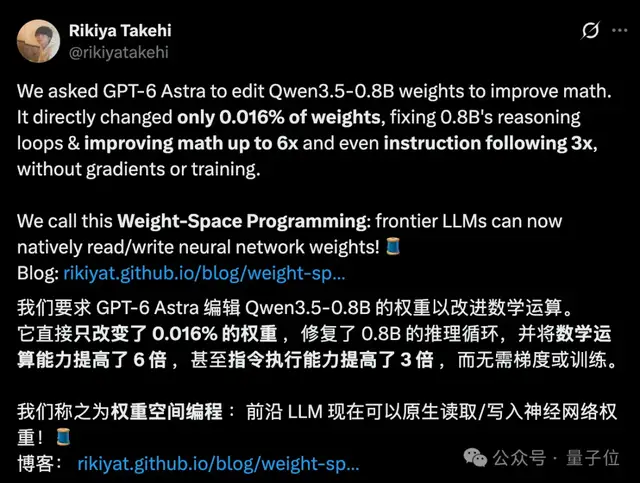
MIT: GPT-6 Astra edits Qwen weights, boosting MATH-500 from 7.9% to 48.1%
MIT CSAIL researchers demonstrated that GPT-6 Astra can directly read and modify the weights of Qwen3.5-0.8B, improving its MATH-500 score from 7.9% to 48.1% by altering only 0.016% of parameters, without training or gradient descent. The team named this capability Weight-Space Programming. However, spaCy author Matthew Honnibal publicly challenged the paper, arguing that the experimental conditions across the three claimed abilities differ significantly and that the presentation is misleading.
6 reports · 5 sources2949 points · 892 comments
News updates every hour. Subscribe in your RSS reader to get new stories automatically.
Subscribe