NYU and Anthropic researchers publish AI-aided Navier-Stokes blowup proof, claim to close OpenAI loophole
NYU professor Tristan Buckmaster and Anthropic employee Levent Alpöge published an AI-aided proof of Navier-Stokes blowup, claiming it closes a loophole in OpenAI's earlier solution. The work comes two months after OpenAI's initial result.
Coverage timeline
Techmeme
Peter Hall / Scientific American : NYU's Tristan Buckmaster and Anthropic's Levent Alpöge publish an AI-aided proof of Navier-Stokes blowup, saying it closes a loophole in OpenAI's solution — Two months after getting scooped by OpenAI, N.Y.U. professor Tristan Buckmaster and Anthropic employee Levent Alpöge …

Related stories
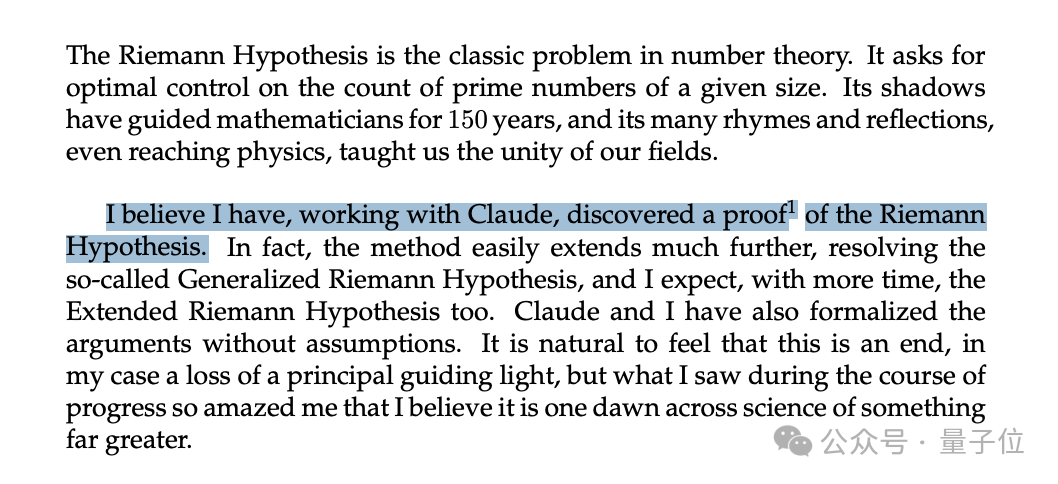
Anthropic Mathematician Claims Claude-Assisted Proof of Riemann Hypothesis
Anthropic mathematician Levent Alpöge claims to have proved the Riemann hypothesis with assistance from Claude, posting a 4-page PDF and Lean formalization code split across 14 compressed files. The proof, not yet independently verified, reportedly extends to the Generalized Riemann Hypothesis and potentially the Extended Riemann Hypothesis. MIT's Andrew Sutherland has published verification records showing all 175,187 modules compiled successfully.
6 reports · 5 sources
OpenAI claims disproof of Exponential Time Hypothesis, plus math and physics results
OpenAI announced three new discoveries in mathematics, computer science, and physics, including a claimed disproof of the Exponential Time Hypothesis (ETH), a conjecture widely believed for nearly 30 years. The results cover local smoothing for the Euclidean wave equation, the Kakeya conjecture in four dimensions, and a rigorous mathematical existence proof for four-dimensional quantum field theories including quantum chromodynamics. External experts guided the results, and materials were released on GitHub for verification.
5 reports · 5 sources1153 points · 701 comments

OpenAI, Google, Microsoft, Anthropic back shared robots.txt AI opt-out standard
OpenAI, Google, Microsoft, and Anthropic announced they will adopt a new IETF standard that lets publishers opt out of AI scraping across multiple crawlers via a shared policy token in robots.txt. The token, proposed by Anthropic technical lead Kevin Kelley, allows website operators to express AI training preferences once instead of setting them per company. This move aims to simplify publisher control over AI data usage.
3 reports · 3 sources

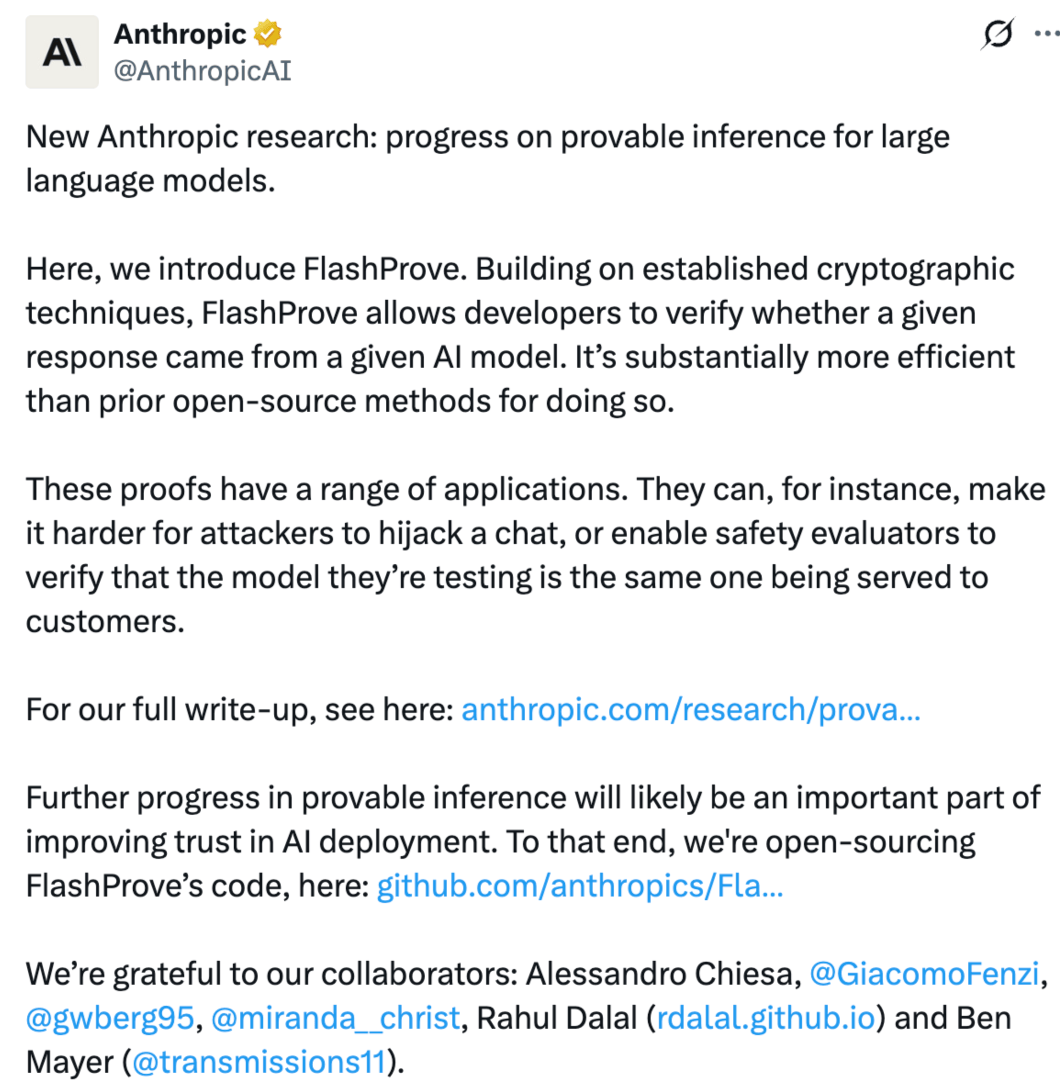
Anthropic open-sources FlashProve for cryptographic verification of AI model identity
Anthropic released FlashProve, an open-source prototype that uses zero-knowledge cryptography to verify that an AI response came from a specific model, preventing routers or providers from swapping in cheaper models. Tested on a 400B-parameter mixture-of-experts model, it generates proofs at about 110 tokens per second on a single NVIDIA H100 GPU, with proof files around 19 MB per 1024-token request. The release includes proof generators, C++ and Lean verifiers, documentation, and formal proofs.
News updates every hour. Subscribe in your RSS reader to get new stories automatically.
Subscribe