Google DeepMind releases Mass Spec Skills for Antigravity to identify unknown molecules
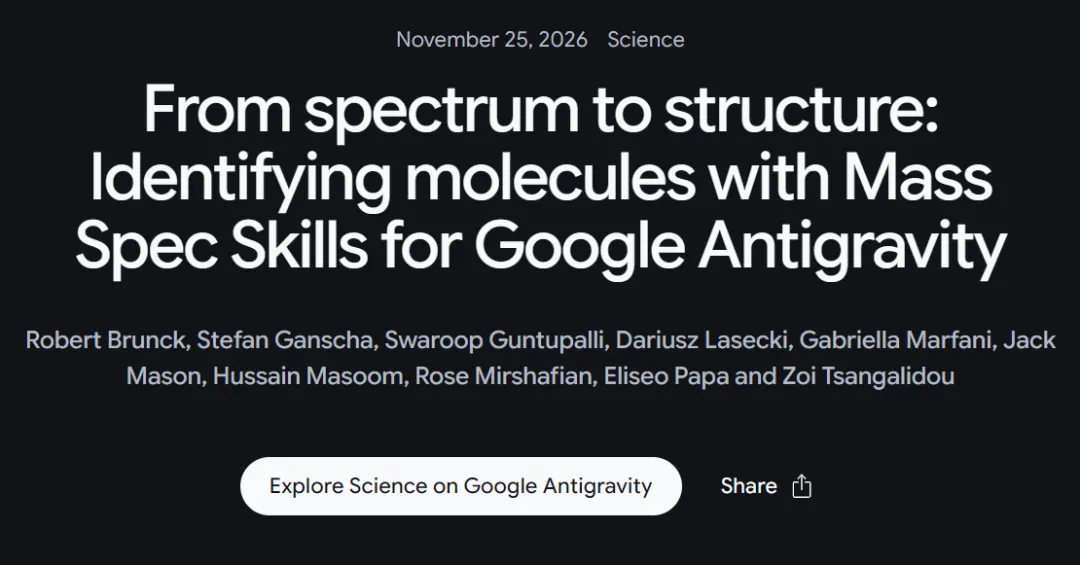
On November 25, 2026, Google DeepMind released Mass Spec Skills for Google Antigravity, an agentic tool that combines Gemini's chemical reasoning with mass spectrometry software and public databases to identify unknown molecules from MS/MS data. The tool addresses the long-standing problem that existing spectral libraries annotate only about 5% of measured spectra on average, and about 10% for human samples, by enabling agents to process tandem mass spectrometry data, infer candidate structures, and generate evidence reports for chemists.
Coverage timeline
机器之心ScienceAI
编辑丨& 一滴血液、一份土壤提取物,甚至一片植物组织,都可能包含成千上万种小分子。它们可能是激素、药物及其代谢产物,也可能是污染物或具有潜在药用价值的天然产物。现代质谱仪已经能够从微量样本中检测出大量分子信号,但仪器测到的质量峰并不会直接告诉研究者:这些信号究竟来自什么分子。 11 月 25 日,Google DeepMind 发布了面向 Google Antigravity 的 Mass Spec Skills 。这套领域技能将 Gemini 的化学推理能力与成熟的质谱分析软件、公共化学数据库连接起来,使智能体能够处理串联质谱数据,逐步推断候选分子结构,并整理出供化学家审查的证据报告。 这项工作深入探索了质谱研究中长期存在的一个问题:仪器所能发现的大量分子,研究者仍然无法为其中绝大多数信号确定身份。 原文链接: https://deepmind.google/blog/interpreting-mass-spectra-with-google-antigravity/ 扩张的质谱 在串联质谱(MS/MS)中,仪器先测量带电分子的质荷比,再使选定的母离子发生碰撞,记录其断裂形成的碎片离子。不同分子具有不同的碎裂特征,研究者可以据此推断原始结构。 传统分析通常依赖实验谱图与参考谱图库匹配。但 Google DeepMind 指出,现有谱图库平均只能为约 5% 的测量谱图提供注释,在人类样本中这一比例约为 10%。 其中一些分子其实已经存在于公共化学数据库,只是缺少对应的实验参考谱图。研究人员需要进一步推断分子式、检索候选结构,并判断这些结构能否通过合理的化学断裂产生观测到的碎片峰。每一步都有相应工具,但完整流程往往需要专业人员逐项操作,难以应对大规模实验产生的海量数据。 图 1:从串联质谱中识别分子的方式。 Mass Spec Skills 是一种用智能体去组织和调用专业工具的方法。在研究人员通过自然语言描述任务后,Antigravity 会调用相应技能。首先,matchms 对质谱数据进行预处理;随后查询 GNPS 和 MoNA 等实验谱图库,通过碎片峰与参考谱图的余弦相似度寻找已知分子。 如果无法获得可靠匹配,流程便转向结构推断:SIRIUS 根据母离子质量和碎裂树评分推断分子式;MAGMa、MetFrag 分析碎片结构及中性丢失;再通过 PubChem 检索具有
Related stories
DeepMind uses Gemini 4 agent teams and Lean to discover verified quantum algorithms
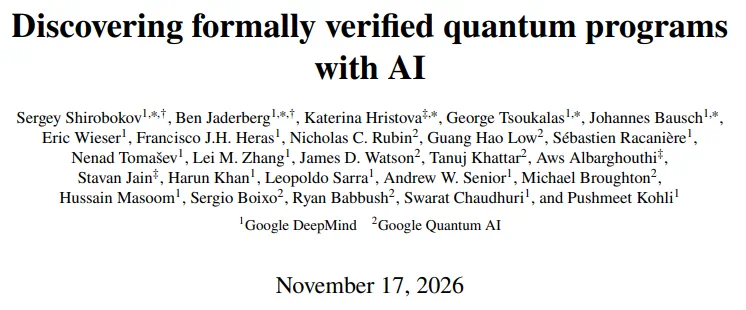
Google DeepMind and Google Quantum AI published research on November 23, 2026, using Gemini 4 agent teams to optimize quantum algorithms across five problem classes, including quantum search, arithmetic, fusion simulation, photochemistry, and drug metabolism. The agents use the Lean theorem prover for formal verification of correctness and resource costs, with independent verifiers to prevent false optimizations. The paper, titled 'Discovering formally verified quantum programs with AI', was posted on arXiv on November 6 and updated to a third version on November 16.
2 reports · 2 sources
Google launches Gemini 4 Carbon to public, adds swarm feature in Antigravity
Google DeepMind has made Gemini 4 Carbon, its self-described strongest model, available to the general public via consumer, developer, and enterprise channels, two weeks after an initial release to cybersecurity defenders. The model is priced at $2 per million input tokens and $10 per million output tokens, with a scheduled increase to $4/$20 on December 1st. Google also previewed a 'swarm' feature in its Antigravity IDE, and highlighted a research case where Carbon-powered agents formally verified Signal's encryption code.
6 reports · 6 sources295 points · 165 comments

Google launches Gemini 4 Hydrogen, a low-cost agentic model, across products
Google announced Gemini 4 Hydrogen, a new Flash-level multimodal model with a 1M token window, priced at $1.50/1M input and $7.50/1M output tokens. It is available across AI Studio, the Gemini API, Search, the Gemini app, and Antigravity, and introduces an xhigh reasoning level. Benchmarks show it nearly ties Claude Sonnet 5.5 and GPT-6.1 Sol on the Artificial Analysis Intelligence Index at lower cost, and it powers an upgraded AI Mode in Search.
9 reports · 6 sources570 points · 352 comments

Google DeepMind unveils AlphaGenome 2, predicting DNA activity per cell type to study disease
Google DeepMind has unveiled AlphaGenome 2, a successor to its genome-predicting model AlphaGenome, designed to predict how DNA changes affect different cell types and states. The conditional model incorporates biological conditions such as tissue, cell type, or state as inputs at every network stage, aiming to link genetic variants to disease causes and potential treatments.

News updates every hour. Subscribe in your RSS reader to get new stories automatically.
Subscribe