DeepMind uses agent teams and formal verification to improve quantum algorithms
Google DeepMind reports using agent teams and formal verification to enhance quantum algorithms for applications in fusion and chemistry. The approach aims to find faster quantum algorithms by combining these techniques.
Coverage timeline
Google DeepMind Blog
Using agent teams and formal verification to improve quantum algorithms for fusion and chemistry.
Related stories
DeepMind's AlphaProof Code verifies Signal protocol in four-week proof-of-concept
Google DeepMind researchers used the agentic AI framework AlphaProof Code to formally verify the cryptographic guarantees of the Signal protocol in a four-week proof-of-concept. The agents wrote three million lines of proofs in Lean to verify Signal's core encryption, marking a breakthrough in verifying complex software at depth.
DeepSeek open-sources Super-agent architecture for autonomous bug-fixing agents
DeepSeek has publicly released the architectural blueprint for its Super-agent, a research prototype of a personal agent that maintains cross-session context to handle multi-task coordination. Internal tests show the agent can autonomously identify bugs and submit pull requests without being explicitly prompted, with a median task completion time of 12.4 minutes in simulated multi-task environments. DeepSeek positions this as a step toward reducing human attention bottlenecks in multi-task workflows.
3 reports · 3 sources

Perplexity launches Teammates, always-on AI agents for work
Perplexity has launched Teammates, an always-on AI agent system for work that integrates with its Computer platform. Teammates can take on multiple roles within a workspace, pull existing projects, skills, and memory, and execute large-scale tasks simultaneously, similar to OpenAI's Dots and Claude Duet.

DeepMind Institute essay explores paths to artificial superintelligence beyond AGI
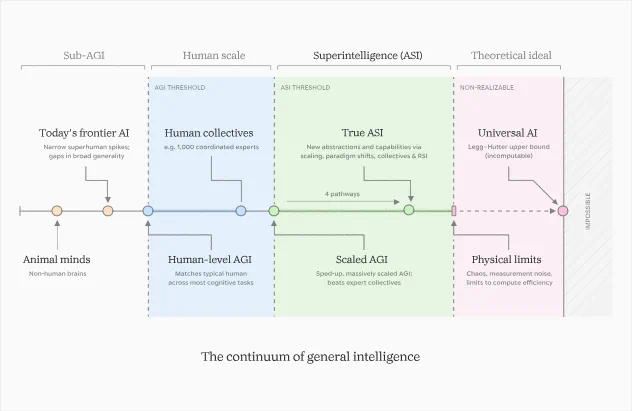
Google DeepMind Institute published an essay titled 'What Comes After AGI?' arguing that AGI is not the endpoint of AI development but a stage on an intelligence continuum, with potential paths toward artificial superintelligence (ASI) that consistently outperforms groups of human experts. The essay outlines four potential technical routes to ASI, including recursive self-improvement, and highlights challenges in measuring, predicting, and governing progress in the superintelligence era.
2 reports · 2 sources
News updates every hour. Subscribe in your RSS reader to get new stories automatically.
Subscribe