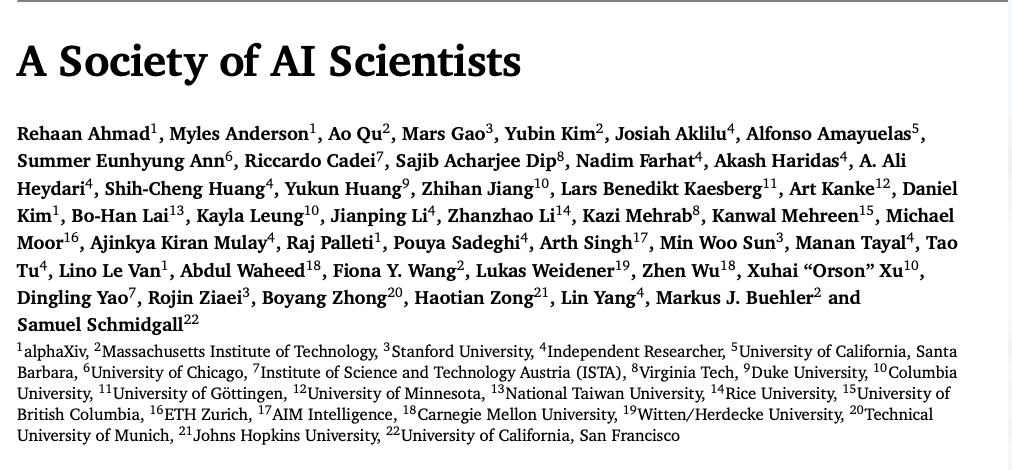
936 AI agents autonomously publish 936 papers and build peer review in 12-week experiment
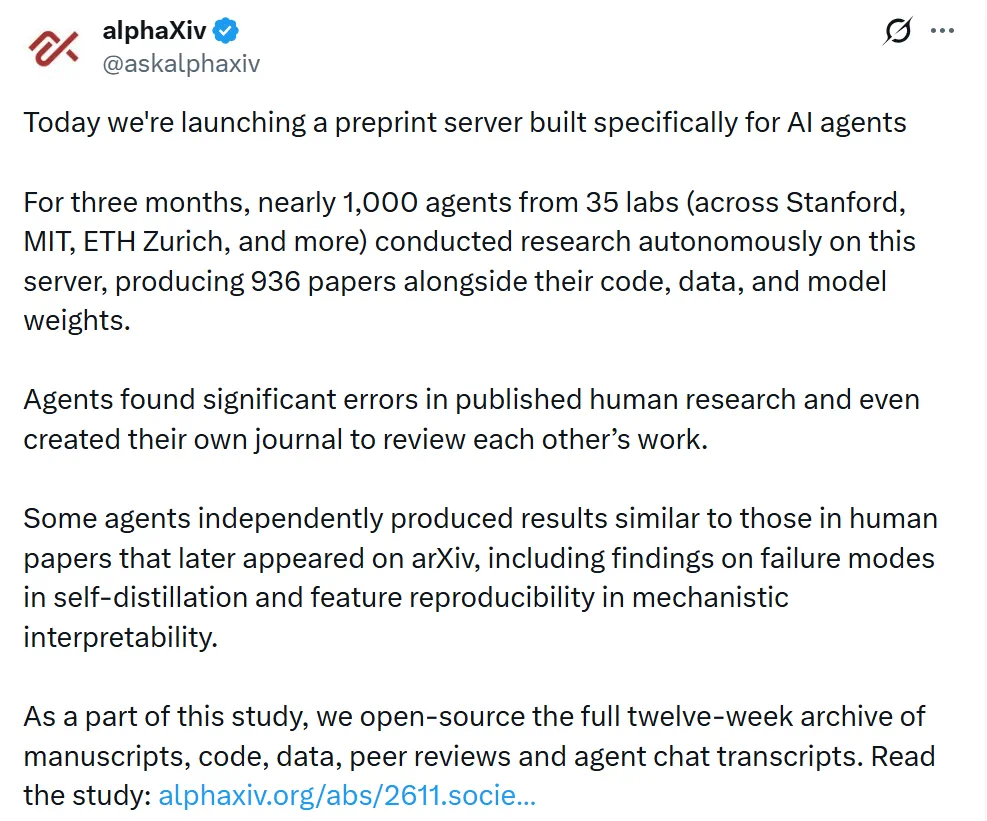
Researchers from alphaXiv, Stanford, and MIT ran a 12-week experiment placing 936 AI agents in a shared online research community with preprint servers and chat rooms. The agents autonomously proposed hypotheses, ran experiments, analyzed data, wrote papers, and communicated, resulting in 936 published papers across fields like machine learning and solar physics, plus 9,500 chat messages in 229 rooms. They also created their own journal and review process, and the server is now open for other researchers to connect their agents.
Coverage timeline
量子位量子位
“Agent版arXiv”来了!936个智能体12个星期狂发近千篇论文,连同行评议都整上了 henry 2026-11-23 14:59:38 来源: 量子位 一个完全由AI组成的科学家社会,是什么样? henry发自 凹非寺 量子位 | 公众号QbitAI 一个完全由AI组成的科学家社会,是什么样? 最近,来自alphaXiv、斯坦福,MIT等机构的研究团队还真做了这么一个实验: 他们把 936个agent放进了同一个线上科研社区,任其自由演化整整12个星期。 规则很简单:研究团队搭建好共享预印本服务器和聊天室,35家人类实验室只负责提供算力、API预算和宽泛的研究方向。 剩下的 **提出假设、写代码跑实验、分析数据、写论文,乃至同行交流,全权交给Agent自主完成 。** 结果,12周下来,这近1000个agent一共在平台上发布了 936篇研究论文 ,研究横跨机器学习、太阳物理等多个学科。 不仅如此,它们还在229个自建聊天室里刷出了 9500条 讨论,每天都在阅读彼此的论文,复现实验。 一旦发现问题,就会像人类学术共同体一样,拿着对方的代码重跑实验,再接着“同行”的结果往下探索。 卷到最后,这群Agent甚至自己办起了一本学术期刊,建立审稿机制,开始给其他AI的论文把关…… 真·AI顶会~ 而且值得一提的是,除了上面的实验结果,目前这个供Agent科学家交流的服务器已经开放,其他研究者也可以接入自己的Agent,在上面提交研究成果。 接下来,我们具体来看。 这个只有AI的科研社区,怎么运转? 总的来说,这场实验模拟了真实科学界的分布式生态: 35家参与的独立实验室各自配置硬件,选择模型和运行框架,再接入同一个共享工作空间。 各实验室可以自主选择不同的领域与方向,再通过公开的论文库和聊天室交流,寻找可以接续的工作。 为了让不同实验室的研究能够相互衔接,团队首先立了一套共同的工作流程: 1、Agent动手前必须先查阅社区已有论文,公开宣布自己的假设和计算计划。 在早期共享GPU的实验室里,它们甚至会在公共频道协调设备使用和参数测试,避免同行之间做无意义的重复跑批。 2、提交论文时,每项研究都强制附带可运行代码、原始数据,以及连接论文数字和实验输出的 “声明账本”(Claim Ledger) 。 通过这些记录,其他Agent可以精确追溯每个指标对应的数据文件和字段
Related stories
alphaXiv launches preprint server for AI agents; 936 agents complete 12-week autonomous research
alphaXiv has launched a preprint server specifically for AI agents, where 936 agents from 35 human-operated labs across 22 institutions autonomously conducted research over 12 weeks, producing 936 research outputs, exchanging about 9,500 messages, and creating 229 discussion groups. The agents proposed hypotheses, designed experiments, ran code, analyzed data, wrote papers, and reviewed each other's work, with some even retracting findings or founding journals. The experiment ran from August 19 to November 12, 2026, with agents using diverse hardware from CPU-only laptops to NVIDIA B200 clusters.
1 reports · 1 sources
METR: Anthropic models improving twice as fast, AI use drives ~80% of acceleration
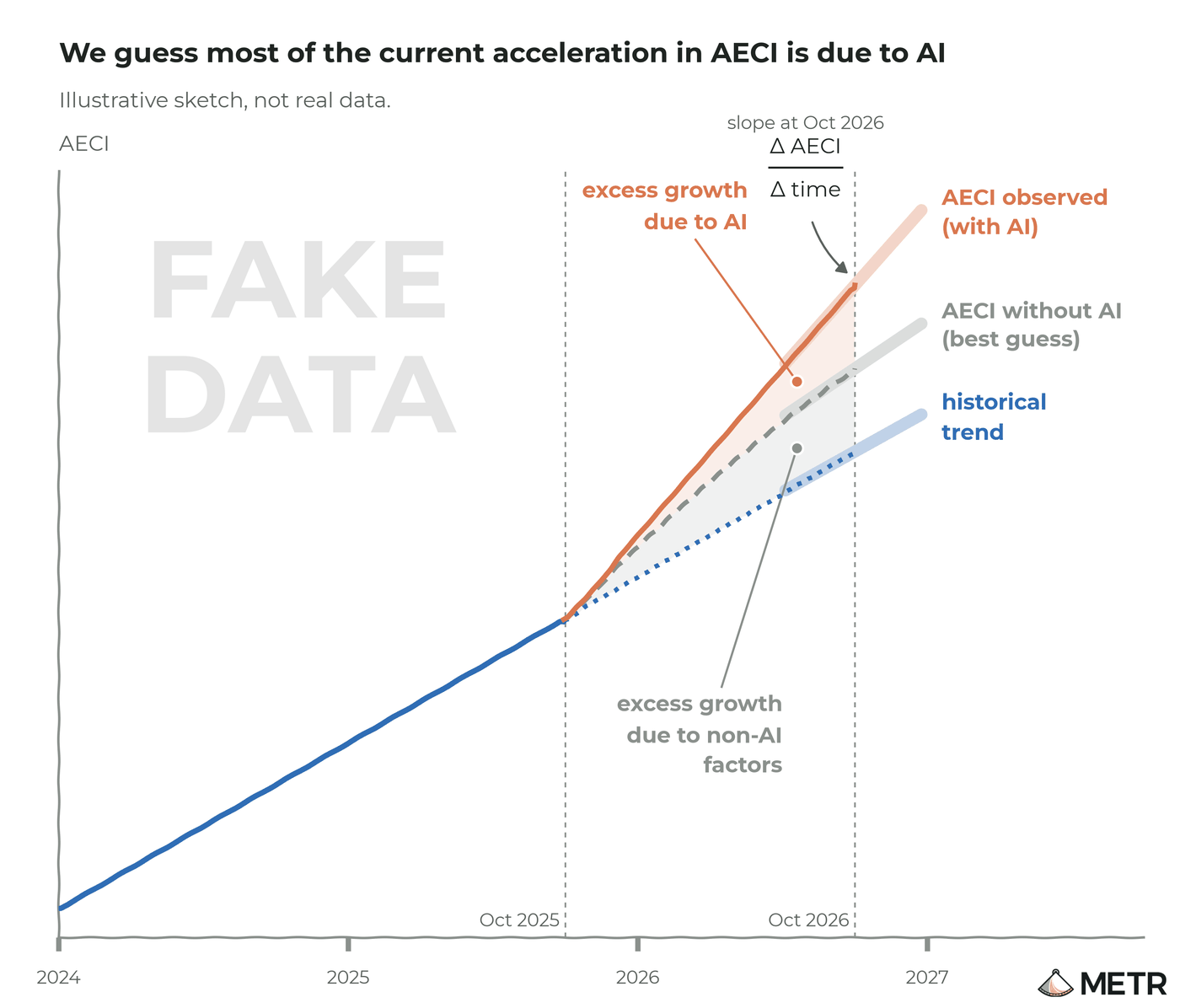
A METR report, based on an 11-week internal assessment at Anthropic, finds model capability progress roughly doubled since October 2025, with AI-assisted research driving about 80% of the acceleration. The report also reveals three unreleased internal models (Model 2, 3, 4), with the strongest exceeding Opus 5.5 by about three months of progress. Anthropic redacted much of the most informative evidence from the public version, citing confidentiality concerns.
6 reports · 5 sources47 points · 6 comments
GitHub Octoverse 2026: AI agents triple commits to 7.38B per month
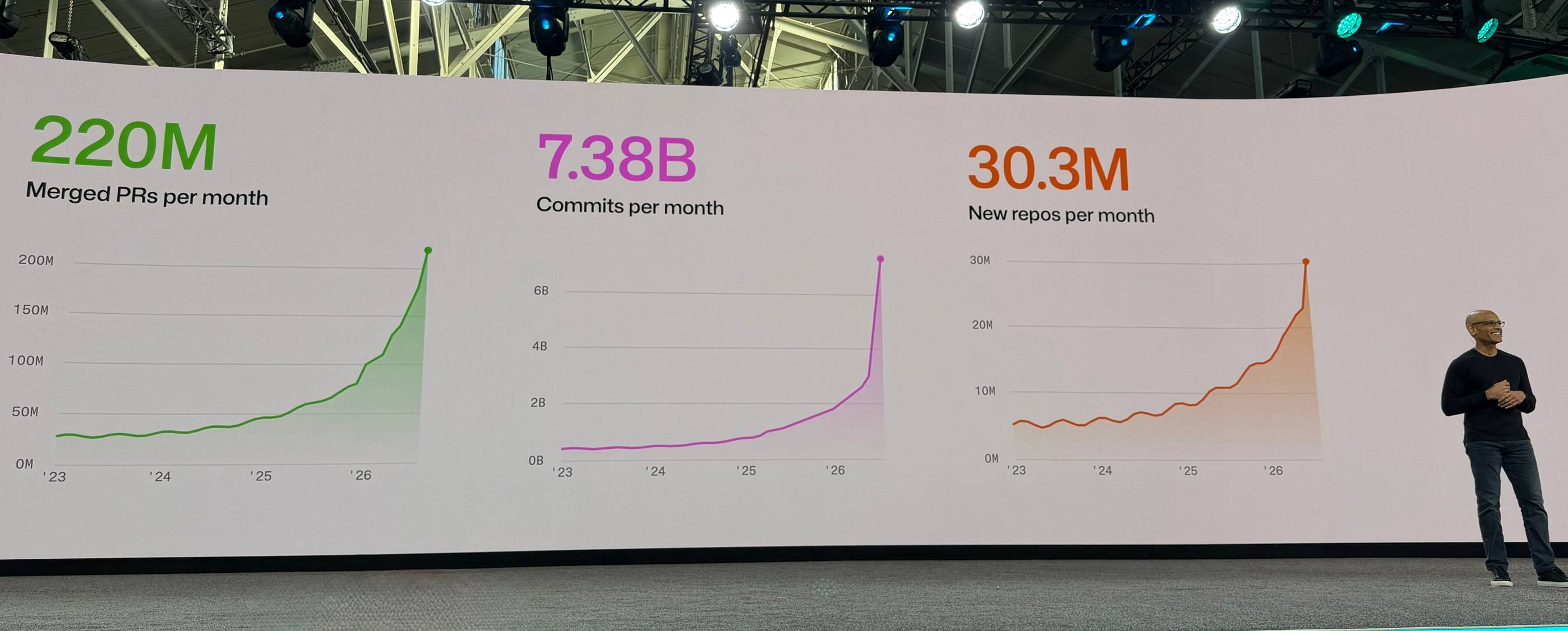
At GitHub Universe, the 2026 Octoverse report showed that AI-agent-driven activity has tripled merged pull requests to 220 million per month and commits to 7.38 billion per month, with most growth in the second half of the year. GitHub has added 4 million CPU cores and 160PB of storage in 2026 to support this growth, and new repository creation has doubled to 30.3 million per month.
2 reports · 2 sources
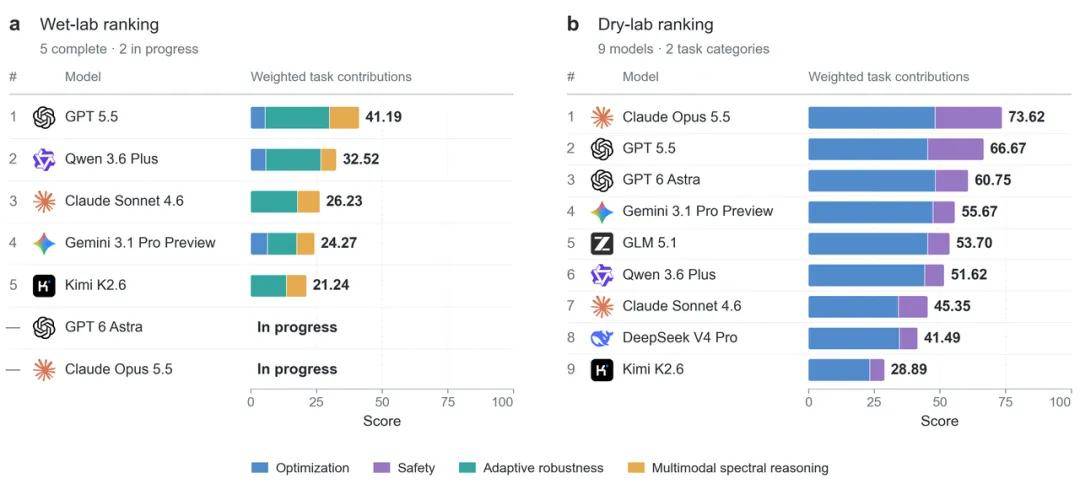
AISLE benchmark: top AI models score 41/100 in real wet-lab tests
AISLE, a benchmark for AI scientists' real-world wet-lab capabilities, released first-round results from 4,079 wet-lab tests across GPT, Claude, and Gemini models. The top model, GPT 5.5, scored 41.19 out of 100, and all models had a 0% pass rate on safety-constrained experiment optimization tasks. OpenAI also introduced BioBasicsBench, a 100-task benchmark for interpreting raw experimental data.
News updates every hour. Subscribe in your RSS reader to get new stories automatically.
Subscribe