UCL team unveils Large Discovery Models for experiment design
Researchers at University College London led by Wang Jun released Large Discovery Models (LDMs), a recursive foundation-model architecture that combines generative foundation models with Gaussian process reward models to design next experiments in scientific discovery. Validated on neural-network training, antibody design, and molecular optimization, LDM v0.1 reportedly outperforms pure LLM reflection baselines, with antibody binding energy reduced by 18.2% on average and molecular multi-objective hypervolume improved by over 60%.
Coverage timeline
机器之心机器之心
许多科学发现问题,本质上是在开放空间中面向特定奖励的决策问题。近期,伦敦大学学院汪军老师领导的团队发布了 大发现模型(Large Discovery Models, LDMs) ,专门用于解决科学发现领域中 “如何设计下一个实验” 的问题。 LDM 是一套递归式的基础模型架构,核心是将生成式基础模型与高斯过程奖励模型相结合:基础模型依托历史信息与上下文,在开放空间中持续拓展、重塑当前的有效搜索空间;高斯过程则在该搜索空间内,基于实验历史构建贝叶斯奖励信号,评估各个候选方案用于下一轮实验的价值。LDM 能够依据实验数据与基础模型的上下文更新完成实时迭代,奖励信号也可以通过后训练融入基础模型参数,由此形成快、慢两套学习闭环。 论文:https://arxiv.org/abs/2608.15669 Large Discovery Models: Empirically-grounded Model-Based Open-Ended Search. 项目网站: https://largediscovery.net/ 项目 GitHub: https://github.com/yzailab/Large-Discovery-Models Hugging Face: https://huggingface.co/collections/Yangtze-ailab/large-discovery-model-v01 提供反馈:https://largediscovery.net/feedback/ LDM v0.1 在 Auto-Research(神经网络训练)、抗体设计、多目标分子优化三个场景取得初步验证: Auto-Research BPB 下降幅度是纯大模型反思的 2.4 倍 ; 抗体设计结合能相对纯大模型反思平均降幅达 18.2% ; 分子多目标超体积相对纯大模型反思和贝叶斯搜索提升 >60%。 为什么科学发现需要另一种大模型 近年来,大语言模型已经从对话、文本生成,拓展到数学、代码等领域的复杂推理与问题求解。其中一项关键技术,是依托可高效验证的奖励信号开展测试时搜索(Test‑time search)或强化学习。但在科学研究场景下,实验反馈对应的真实奖励来源于机理复杂且尚未探明的高成本实验,同时设计或假设空间往往规模庞大,甚至具备开放性。 纯大语言模型拥有丰富的结构先验

Related stories
LAMA Framework Auctions Ads Token-by-Token During LLM Generation
Researchers from Renmin University and Stanford propose LAMA, a large-model-native advertising framework that auctions ads per generated token, integrating ad allocation into the generation process. This shifts from traditional pre-defined ad slots to dynamic allocation where each token influences both content continuation and ad exposure.
1 reports · 1 sources

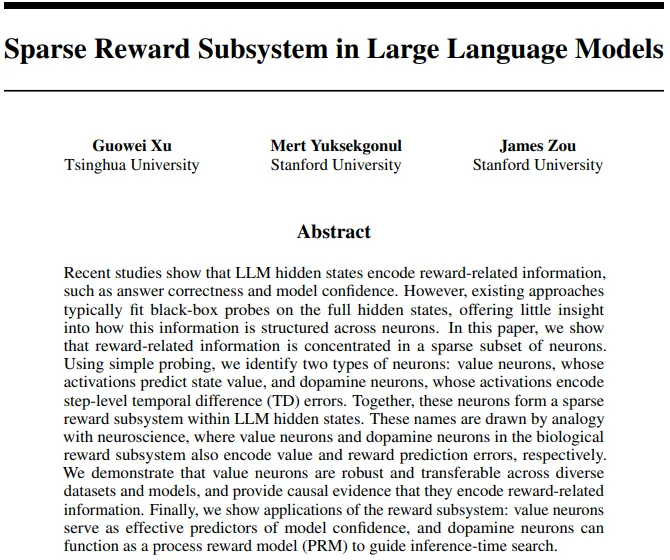
Stanford and Tsinghua researchers find sparse value and dopamine neurons in LLMs, mapping a reward subsystem
Researchers from Stanford and Tsinghua University identified two types of neurons in large language models that encode a reward subsystem: value neurons, which predict the expected value of the current state, and dopamine neurons, which encode stepwise temporal difference errors. Intervention experiments on Qwen models showed that zeroing the top 1% of value neurons in a layer dropped MATH500 accuracy from 75.2% to 20.3%, while random zeroing had little effect, providing causal evidence for their role.
Peking University and YIXIN AI Lab identify 'readout bottleneck' in LLM reasoning at EMNLP 2026
Researchers from Peking University and YIXIN AI Lab presented a paper at EMNLP 2026 introducing the 'readout bottleneck' phenomenon, where LLMs may encode correct answers in hidden states but fail to express them due to systematic biases in the output layer. They propose a staged diagnostic method to distinguish between genuine capability deficits and expression failures. The paper, titled 'Wrong Prediction, Right Answer: Recovering Evidence from Collapsed LLM Sequence Scores', was accepted to the main conference with a 15.4% acceptance rate.

Samsung, Oxford, Peking University propose TrOPD for on-policy LLM distillation
Researchers from Samsung, Oxford, and Peking University propose TrOPD (Trust Region On-Policy Distillation), a method to compress frontier LLM capabilities into edge devices. The work first systematically benchmarks existing OPD methods under a unified setup, identifying that reliable token-level supervision from the teacher, rather than divergence formula choice, determines training success. TrOPD addresses supervision distortion when teacher-student gaps are large, offering a path for lower-cost edge deployment.

News updates every hour. Subscribe in your RSS reader to get new stories automatically.
Subscribe