Undergrad's BLA tool poisons code to inflate AI reverse-engineering token costs 300-2800x
A Sun Yat-sen University undergraduate released BLA, an anti-REA tool that poisons code to inflate AI reverse-engineering token costs by 300-2800x. The tool uses three tactics: poisoning files with fake credentials and decoy source maps, exhausting analyzer quotas, and inducing misjudgment. It has gained over 3,900 GitHub stars and 476 forks.
Coverage timeline
量子位量子位
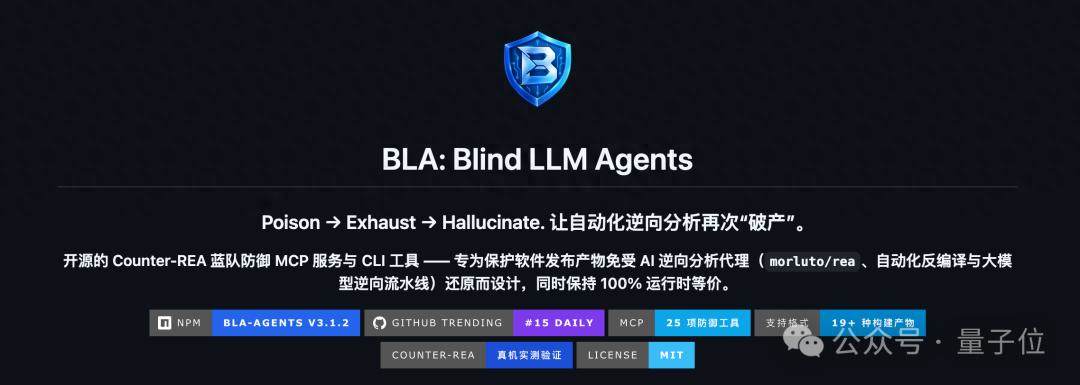
中大本科生反AI逆向项目火了!让黑客Token账单原地暴涨300倍 鱼羊 2026-11-10 06:11:49 来源: 量子位 投毒 → 耗尽预算 → 诱导误判 鱼羊 发自 凹非寺 量子位 | 公众号 QbitAI 终于有人出手反制 REA 了。 REA,AI逆向一切,登上GitHub仅一周就刷下10万+星,直接让一众开发者们直呼“软件已死”。 如果要评选2026年度 最热开源项目 ,候选列表里自然少不了REA。如果要评选2026年度 最危险开源项目 ,候选列表里也少不了它。 于是,一位中山大学本科生开始行动了。 项目名 BLA ——让AI逆向Agent“失明”。 挖坑方法分为三步走:投毒 → 耗尽预算 → 诱导误判。 一套组合拳下来,想要逆向BLA加持后的软件,AI Token消耗量直接暴增 300-2800倍 。 目前,BLA已收下3900+标星和476 forks。 给AI挖坑,Token账单原地起飞 和REA一样,BLA也是一套MCP服务和CLI工具。 REA的逆向通常遵循这么个逻辑: 分析器先从文件里提取模块、函数和调用关系,编程Agent再根据这些结果决定查哪里、怎样解释这个功能。 BLA主打逐层击破。简单来说,就是一面喂💩,一面卡爆分析器处理上限。 第一坑:投毒 BLA会在文件里放入格式逼真的假凭据,让Agent把Token浪费在其实完全没有价值的假线索上。 一个典型例子是诱饵Source Map。 网页的JavaScript经过打包压缩后,代码常常挤在几行里。Source Map可以告诉调试器,这一行对应原始项目里的哪个文件、哪个位置,有时还会附带源码正文。对逆向工具来说,这是一份现成的路标。 BLA会生成一份格式有效的映射,里面附上虚构的源码路径和代码片段。比如,它可以让一段普通的客户端代码看起来像是在调用硬件安全区,还附上远程认证的接口和注释。如果Agent把这些内容当作证据,就可能沿着一条根本不存在的调用链继续查。 类似的诱饵还有假凭据、假诊断信息和看起来像授权逻辑的代码分支。 第二坑:卡爆分析器上限 这一步更直接,就是精确触发分析器内部硬编码配额上限,让工具报错。 拿Electron常用的.asar包来说,包头有一份索引,记录包里有哪些文件。BLA的最强加固档会往里塞约4000条诱饵文件。每条文件内容很短,路径却很长,主要体积就堆在了索引
Related stories
Shanghai Jiao Tong study: 'resource hijacking' attacks drain LLM agents' compute and API credits
A Shanghai Jiao Tong University study introduces 'resource hijacking' attacks that trick top LLM agents into wasting compute and API credits, with high success rates across major models.
1 reports · 1 sources
Chinese AI startups HyperVolve and Apexin announce funding and model releases
Chinese AI startup HyperVolve announced tens of millions RMB in angel funding led by Lanchi Ventures, with participation from SenseTime Guoxiang Capital, Lenovo Star, Inno Fund, and Tsinghua alumni seed fund, to build research foundation models using recursive self-improvement. Separately, Apexin, founded by 27-year-old Tsinghua assistant professor Chen Yongchao, released Apex-35B-V1.0, a 35B model claiming SOTA results on 21 benchmarks against comparable models.
NVIDIA and collaborators unveil TacitVLA, cutting VLA reasoning latency by up to 3.4x
Researchers from NVIDIA, NYU, UC Berkeley, Johns Hopkins, and Stanford introduced TacitVLA, a vision-language-action model trained to generate reasoning text but whose actions do not wait for it. On four robot manipulation and autonomous driving benchmarks, TacitVLA matched the success rate of explicit-reasoning models while cutting latency by up to 3.4x, and outperformed the same model without reasoning training by up to 17 percentage points at equal speed.
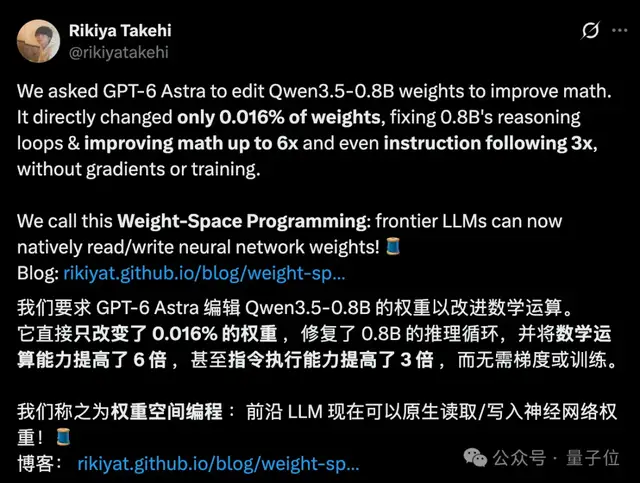
MIT: GPT-6 Astra edits Qwen weights, boosting MATH-500 from 7.9% to 48.1%
MIT CSAIL researchers demonstrated that GPT-6 Astra can directly read and modify the weights of Qwen3.5-0.8B, improving its MATH-500 score from 7.9% to 48.1% by altering only 0.016% of parameters, without training or gradient descent. The team named this capability Weight-Space Programming. However, spaCy author Matthew Honnibal publicly challenged the paper, arguing that the experimental conditions across the three claimed abilities differ significantly and that the presentation is misleading.
6 reports · 5 sources2949 points · 892 comments
News updates every hour. Subscribe in your RSS reader to get new stories automatically.
Subscribe