Agnes optimizes SGLang to cut long-context prefill time by 3.54x without extra GPUs
Agnes published a technical report detailing targeted optimizations to the open-source SGLang inference engine. In controlled tests on a dual-GPU PCIe server with a 64-layer hybrid attention model, prefill time for a 512K-token cold input dropped from 231.71 to 65.54 seconds (3.54x faster) without adding GPUs or changing interconnect. The optimizations also raised single-instance concurrency from 8 to 16, boosted average output throughput by about 73%, and cut first-token latency P90 from 2.42 to 1.26 seconds.
Coverage timeline
机器之心机器之心
编辑|冷猫、杜伟 「使用额度已达上限。」 和 DeepSeek 聊到一半,对话突然停在了这行提示上。 11 月中旬,部分用户发现,在免费版 App 或网页端使用一段时间后,自己开始遇到这样的提醒。过去习惯了有事就打开 DeepSeek,如今,聊得正投入时,也得停下来等一等。 DeepSeek 使用限额相关话题登上知乎热榜。 对用户来说,额度提示打断的是一场对话。对推理服务团队来说,背后则是一个越来越紧迫的问题:手里的 GPU,还能接住多少请求?用户只发出了一条指令,服务器上的计算却未必只跑一轮。长上下文、多轮对话以及 Agent 工作流普及,让这种压力不断累积。 增加算力需要时间。从芯片供应到数据中心建设,再到电力配套,任何一个环节都无法按下按钮就立刻就绪。 那有没有一种可能,让目前已经部署的 GPU,迸发出更多潜能? Agnes 最近展示了这样一次尝试。 在常规 PCIe 服务器上,针对一个 64 层混合注意力模型,对开源推理引擎 SGLang 进行了定向优化,并同步公开了技术报告仓库。 结果颇为亮眼:在双 GPU 通过 PCIe 互联的受控测试中,同样一份 512K Token 的冷输入,预填充时间从 231.71 秒缩短至 65.54 秒,速度达到原来的 3.54 倍。过程中没有增加 GPU,也没有更换卡间互联方式。 优化后, 单实例并发上限从 8 路提升至 16 路 。在 Agnes 提供的业务池前后监控中,总输出吞吐均值提升约 73%,用户感知强烈的首字等待时间 P90 也从 2.42 秒降至 1.26 秒,下降约 47.9%。 这说明,一台已经装好 GPU 的服务器仍有可能通过推理系统的改造,腾出更多服务能力。Agnes 的这次工程实践从追踪一条请求的处理过程、找出其中的资源开销入手。 技术报告:https://github.com/AgnesAI-Labs/Inference-Framework-Specialization 推理引擎里的「定向手术」 一条请求发到服务器上,GPU 并不总是在埋头计算。 以双卡部署为实例,一部分计算需要等另一张卡传来中间结果,才能继续往下执行。即使计算单元还有余力,显存也可能已经被模型权重和历史状态占满,容不下更多请求。 芯片的计算能力要经过数据读取、跨卡通信和显存管理等环节,才能转化为用户实际感受到的响应速度。其中一个

Related stories
Tsinghua and CUHK propose Cache Engineering, open-source AKV to cut inference costs
Researchers from Tsinghua University and the Chinese University of Hong Kong proposed Cache Engineering, an approach that lets agents directly manage KV cache instead of compressing context, and open-sourced the inference system AKV. In evaluations across three models and four agent tasks, Cache Engineering reduced average inference costs by 27.7% and improved average task success by 1.7% compared to Context Engineering.
1 reports · 1 sources

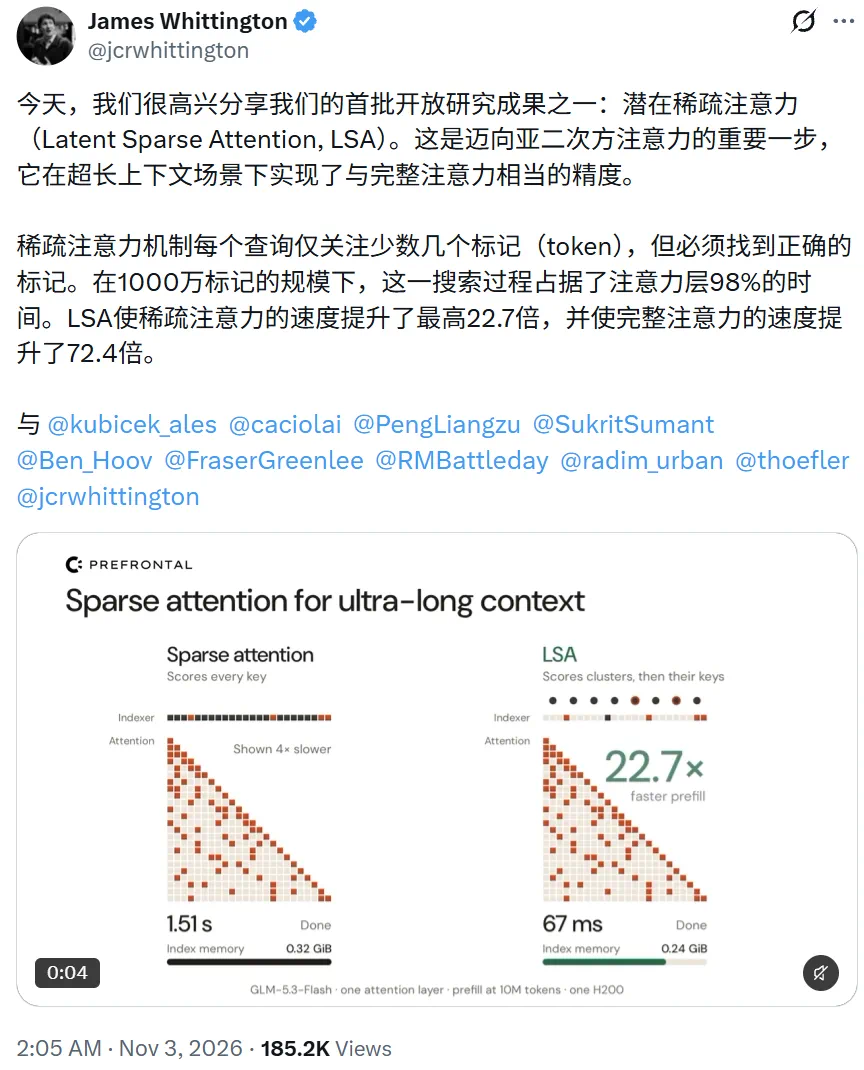
Prefrontal AI and ETH Zurich unveil Latent Sparse Attention, speeding up 10M-token prefill by up to 72x
Prefrontal AI and ETH Zurich published a paper introducing Latent Sparse Attention (LSA), a method that accelerates prefill for ultra-long contexts by up to 72.4x at 10 million tokens. The approach addresses the quadratic growth of the indexing cost in sparse attention, which dominates prefill time at such scales. LSA speeds up a single attention layer of GLM-5.3-Flash by 22.7x and Qwen3.8-27B by 72.4x while maintaining accuracy.
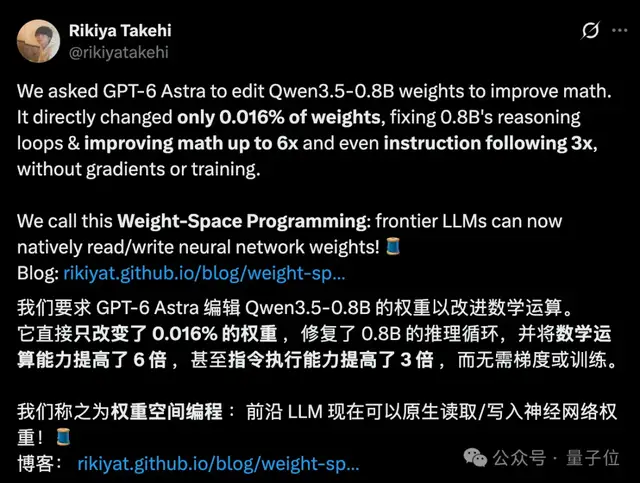
MIT: GPT-6 Astra edits Qwen weights, boosting MATH-500 from 7.9% to 48.1%
MIT CSAIL researchers demonstrated that GPT-6 Astra can directly read and modify the weights of Qwen3.5-0.8B, improving its MATH-500 score from 7.9% to 48.1% by altering only 0.016% of parameters, without training or gradient descent. The team named this capability Weight-Space Programming. However, spaCy author Matthew Honnibal publicly challenged the paper, arguing that the experimental conditions across the three claimed abilities differ significantly and that the presentation is misleading.
6 reports · 5 sources2949 points · 892 comments
NVIDIA and collaborators unveil TacitVLA, cutting VLA reasoning latency by up to 3.4x
Researchers from NVIDIA, NYU, UC Berkeley, Johns Hopkins, and Stanford introduced TacitVLA, a vision-language-action model trained to generate reasoning text but whose actions do not wait for it. On four robot manipulation and autonomous driving benchmarks, TacitVLA matched the success rate of explicit-reasoning models while cutting latency by up to 3.4x, and outperformed the same model without reasoning training by up to 17 percentage points at equal speed.

News updates every hour. Subscribe in your RSS reader to get new stories automatically.
Subscribe