Mathematician Daniel Litt argues AI can deepen human math understanding
In a blog post titled 'A beginning for mathematics', University of Toronto mathematician Daniel Litt responds to OpenAI's announcement of an internal model that solved over 100 open math problems, arguing that even if AI surpasses humans in proving theorems, it can deepen human mathematical understanding. He accepts the premise that AI may soon stably outperform humans on most math tasks, and focuses on how the profession and training should adapt, concluding optimistically that high-quality math will become less dependent on human production while human understanding can grow deeper.
Coverage timeline
机器之心机器之心
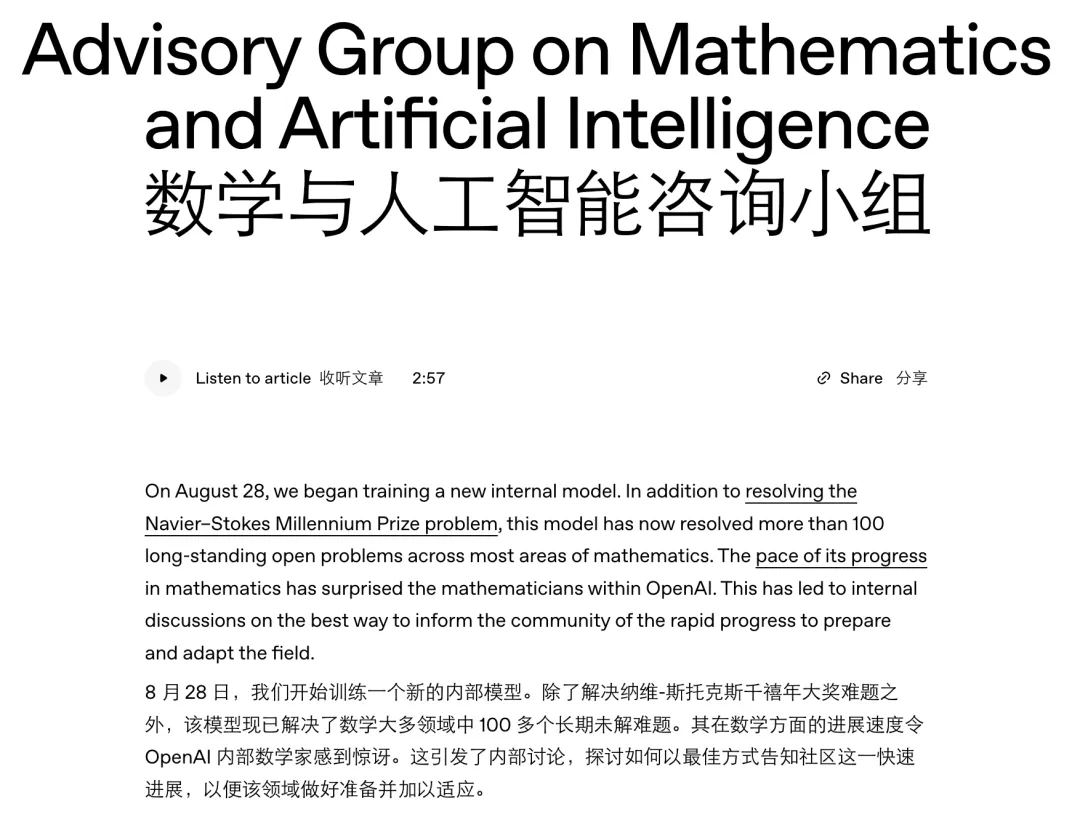
9 月 21 日,OpenAI 扔出一则 公告 :一款 8 月 28 日才开始训练的内部模型,已经攻克了 100 多道世界级数学难题,范围横跨数学的大部分领域。 可以说,数学圈的情绪,在这半个月里一路往下沉。读博的担心学位贬值,教书的担心期刊崩盘,写了半辈子证明的人开始怀疑,这门手艺还剩几年。 就在这片低气压中间,多伦多大学数学家 Daniel Litt 在个人博客上发了一篇长文,标题叫《A beginning for mathematics》—— 数学的开端。 这个标题多少带点自我纠正的意味。几周前,Litt 刚做过一次名为《The End of Mathematics》的演讲,讨论 AI 可能如何冲击数学研究。新文章里,他给出了一个明显更积极的版本。 Litt 直接接受一个很激进的前提:能够在大部分数学任务上稳定超过人类的 AI,可能很快就会出现。 他真正想讨论的是, 到了那一天,数学这门职业该怎么改,学生还该怎么培养,人类数学家又该把精力放在哪里。 他的结论其实很乐观:AI 可以让高质量数学越来越不依赖人类亲手生产,但人类对数学的理解,反而可以变得更深。 如果一只猴子也能「证明定理」,那我们到底在追求什么? Litt 在文章开头先摆了一组时间线:三年前,AI 连两个数相加都经常算错;一年前,OpenAI 和 DeepMind 的内部模型拿到了 IMO 金牌水平的成绩;现在,这些系统开始自主解决重要的公开问题。 然后他戳破了一层窗户纸:数学共同体对「我们的目标是什么」根本没有共识。 有人搞数学是为了解题,有人觉得数学是游戏、是诗;有人信奉希尔伯特那句「我们必须知道,我们终将知道」,有人觉得在勘探柏拉图世界的奥秘,还有人认为这份工作的意义在于把对数学的热爱传给下一代。这个群体其实从来没有一个统一答案。 Litt 自己把目标压缩成两条。一是生产并理解高质量的数学;二是培养高质量的数学家。这里的「高质量」并没有固定定义,它一直由数学共同体自己慢慢形成。 问题是, 过去很长时间里,数学界用来实现这两个目标的办法都差不多:证明定理 。论文要有主定理,博士论文要有主定理,解决一个扛住了多年猛攻的公开猜想更是头等大功。 但 Litt 认为,这个评价方式其实漏掉了关键的一层。 他举了一个很荒诞、却非常直观的例子:假设给一台计算机或一只猴子一套 ZFC 公理,再让它不断机械地应用
Related stories
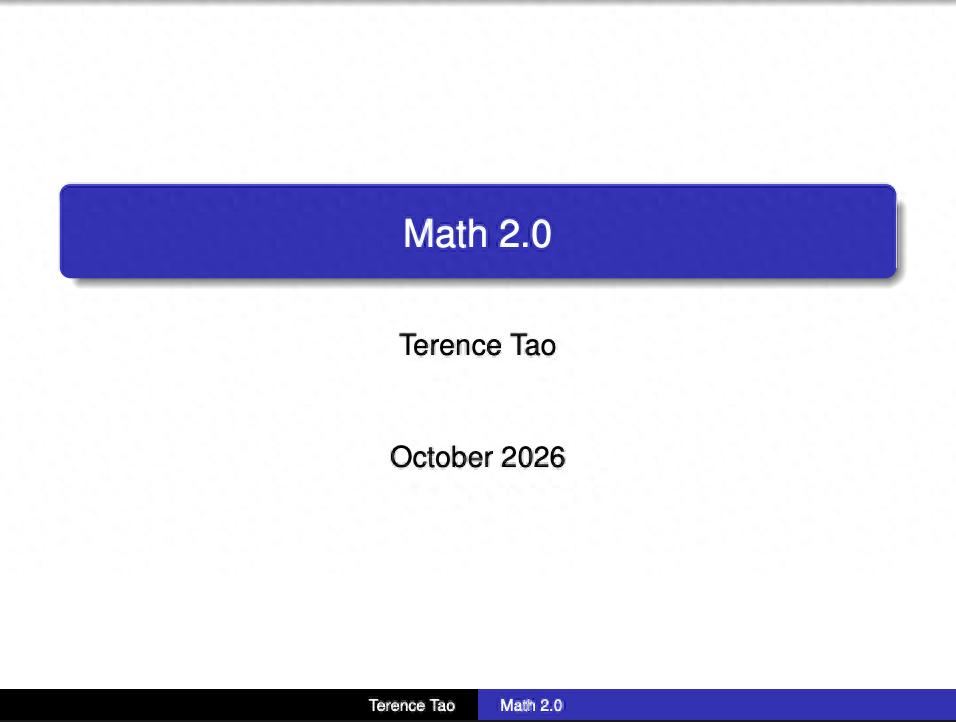
Terence Tao: AI Ends Proof Scarcity, Ushering in Math 2.0
Fields Medalist Terence Tao published a post and gave a Caltech talk titled 'Math 2.0', arguing that AI is making mathematical proofs abundant, ending the 'proof scarcity' premise of traditional Math 1.0. He calls for new skills for mathematicians, such as evaluating correctness and integrating AI-generated proofs, to ensure they contribute to understanding and real-world applications.
2 reports · 2 sources
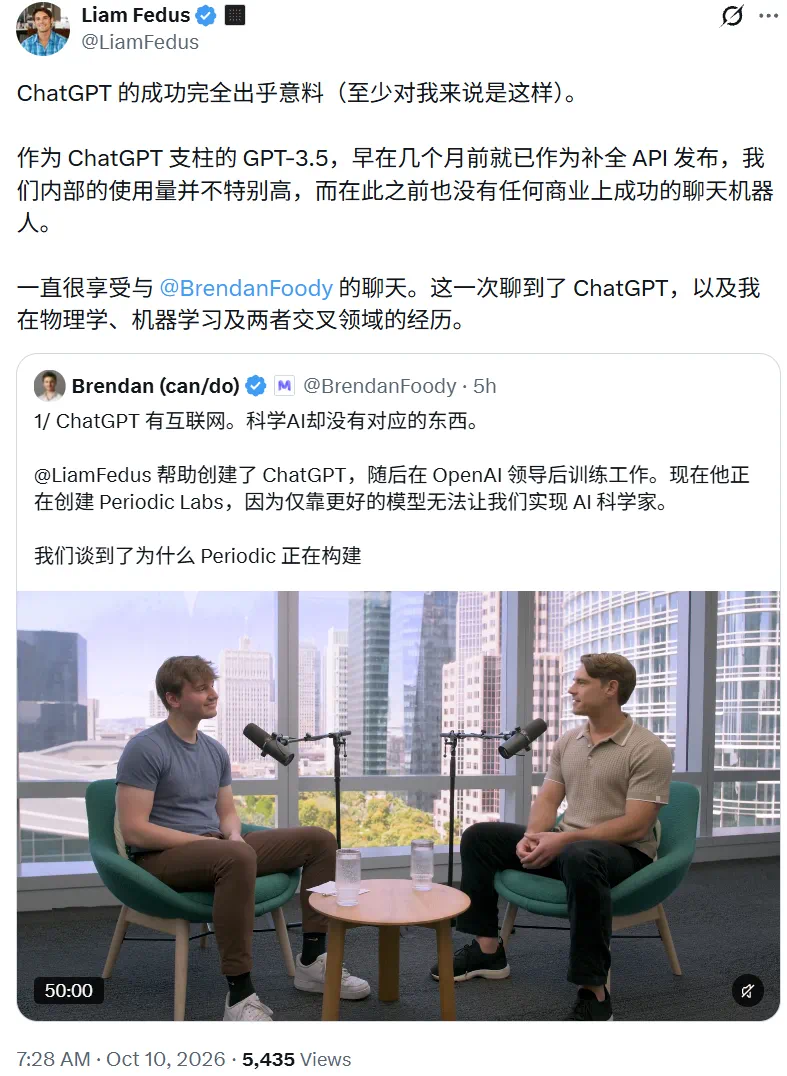
OpenAI Co-creator Liam Fedus: After Math, AI Should Move to Physical Labs
In a podcast, OpenAI co-creator and former VP Liam Fedus argued that AI's next frontier is physical labs, not just math, because real-world experiments cannot be replaced by formal systems. He discussed his new venture Periodic Labs, which is building a physical lab in Menlo Park to provide real-world data for AI scientists, filling a gap that the internet cannot supply.
OpenAI denies seeing math prompts, admits possible use of de-identified data
OpenAI has denied that its researchers or models saw prompts from mathematicians Buckmaster and Alpöge, but stated it cannot rule out that de-identified data from their product use helped improve its models. The denial follows accusations from mathematicians, including Andreas Thom, who publicly questioned the transparency of OpenAI's training data origins and whether researchers can trust the lab with unpublished results.
5 reports · 3 sources865 points · 813 comments

OpenAI forms independent math advisory group for AI results
OpenAI announced it is working with an independent Advisory Group on Mathematics and Artificial Intelligence (AGMAI) to guide the review and communication of emerging AI mathematical results. The group will advise on the evaluation and publication of internal models' results, including over 100 claimed solved open problems, though the group won't have authority to slow or redirect research. The move follows a reputational crisis over OpenAI's mathematical results and caught many mathematicians by surprise.
4 reports · 4 sources77 points · 67 comments

News updates every hour. Subscribe in your RSS reader to get new stories automatically.
Subscribe