MIT Han Lab's PEAR Trains Qwen3.8-27B for Real Robot Arms via Sim RL, Open-Sourced
MIT Han Lab introduced PEAR (Post-training Engine for Agentic Robotics), a post-training project that uses reinforcement learning in simulation to train the open-source Qwen3.8-27B model to operate a real dual-arm robot, requiring no human teleoperation demonstrations or real-robot data. On an unseen YAM robot, PEAR achieved 18 successes in 30 tests (up from 0 before training), runs at over 220 tokens per second on an RTX 5090, and maintains performance on nine general benchmarks. The project is open-sourced with code, model weights, and a paper available online.
Coverage timeline
机器之心机器之心
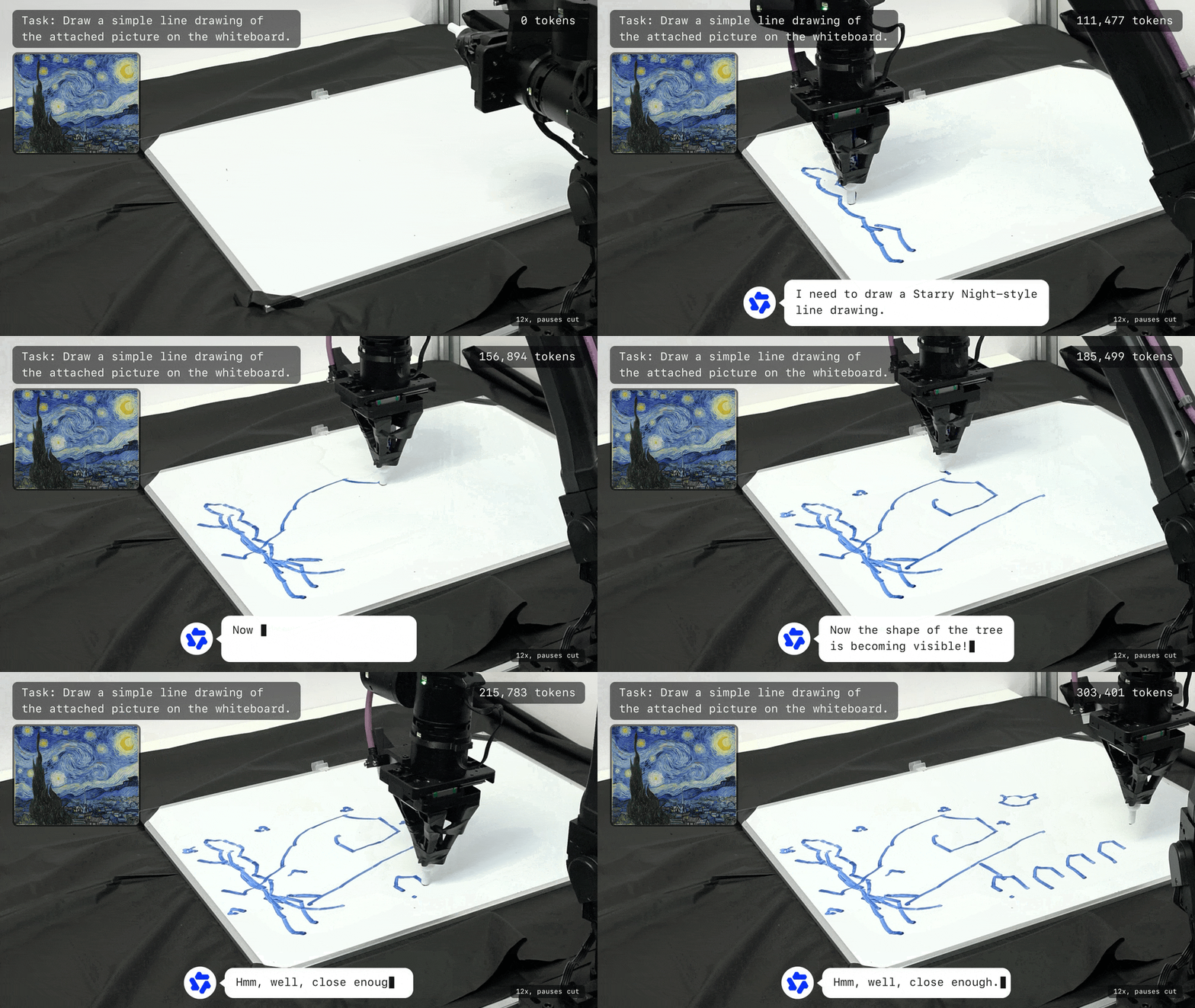
随着 Fable 和 GPT-6 Astra 相继问世,具身智能领域受到巨大冲击,甚至掀起了一股「通用大模型能搞定机器人一切」的热潮。 开发者们争相将这两个模型接入机器人,尝试完成各种复杂任务。但随着探索深入,模型规模庞大的问题也逐渐显现:高昂的推理成本、难以满足实时控制需求的响应延迟,以及端侧算力、功耗和散热限制,都让这些强大的模型难以直接落地。 如何让通用大模型能够让机器人用得起、跑得动,成了新的难题。 但这一切都将开始改变。 MIT 韩松团队公布了机器人后训练项目 PEAR (Post-training Engine for Agentic Robotics),把一个 27B 参数的千问模型接上一台真实的双臂机器人。 让我们看两个实机演示效果。研究者给它一张梵高《星空》,它在白板上用夹爪画出了线稿。桌上摆碘水、酚酞、乙醇三瓶试剂,问它怎么验证溶液是否呈碱性,它挑了酚酞滴进去,溶液变粉。 PEAR 基于开源的 Qwen3.8-27B,不需要一帧人类遥操演示,不需要一条真机数据, 只在仿真环境里做强化学习 。训完之后直接拉到一台它从未见过的双臂 YAM 真机上, 30 次测试成功 18 次,而训练前是 0 次 。通用性更强,执行指令的能力也比 π0.5 要好。在 LIBERO 模式下,它的表现几乎可以 与 Astra Max 相媲美 。 在 RTX 5090 显卡上,它的运行速度可以达到 220 以上 tok/s 的水平,完全可以本地运行。 值得注意的一点是,它相比 Qwen3.8-27B 在 AIME、GPQA、LiveCodeBench 等九项通用 benchmark 上的分数几乎不变,模型不会失去数学和编程等通用能力。 论文链接:https://mit-han-lab.github.io/pear-blog/paper.pdf Github 链接:https://github.com/mit-han-lab/pear 模型权重链接:https://huggingface.co/collections/mit-han-lab/pear 博客链接:https://mit-han-lab.github.io/pear-blog/ 用电脑的方式,就是用机械臂的方式 这很巧妙,机械臂的操作本质上和电脑的操作很相似,只不过是二维与三维的区别。 智能体的 Compu
Related stories
MIT: GPT-6 Astra edits Qwen weights, boosting MATH-500 from 7.9% to 48.1%
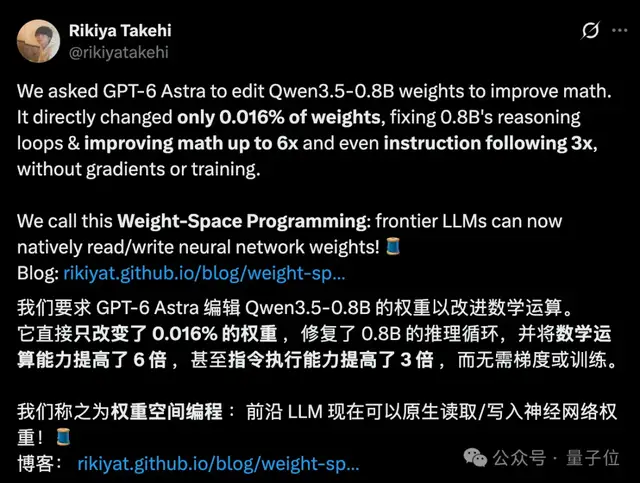
MIT CSAIL researchers demonstrated that GPT-6 Astra can directly read and modify the weights of Qwen3.5-0.8B, improving its MATH-500 score from 7.9% to 48.1% by altering only 0.016% of parameters, without training or gradient descent. The team named this capability Weight-Space Programming. However, spaCy author Matthew Honnibal publicly challenged the paper, arguing that the experimental conditions across the three claimed abilities differ significantly and that the presentation is misleading.
6 reports · 5 sources2949 points · 892 comments
OpenAI releases GPT-6.1 Terra with computer-use focus, API price halved
OpenAI announced GPT-6.1 Terra, a fast, efficient model emphasizing visual reasoning and computer use, priced at $1 per million input tokens and $5 per million output tokens. The standard API price is 50% lower than GPT-5.6 Terra and GPT-6.1 Sol, and the model is available in ChatGPT Work, Codex, and via API (gpt-6.1-terra) for Plus, Pro, Enterprise, and Edu users. In the Agents' Last Exam benchmark, Terra scored 15 points higher than GPT-5.6 Terra at medium reasoning intensity, with about one-third the cost, and matched GPT-6 Astra's performance at one-tenth the token price.
4 reports · 4 sources

UCLA and Adobe open-source Tev-27B long-horizon agent model, matching GPT-6 Astra and Claude Opus 5 on ALE-CM
Researchers from UCLA and Adobe Research released a paper and open-sourced Tev-27B, a long-horizon agent model trained on their new Tev-Gym benchmark with dense, verifiable, progressive rewards via progress potential reward shaping (PPRS). On the Agents' Last Exam computation and mathematics subset (ALE-CM), Tev-27B achieves Pass@5 of 0.28, matching GPT-6 Astra and Claude Opus 5; the same recipe applied to Tev-320B makes it the strongest open-source model on Terminal-Bench 4.0's computation and mathematics subset.
1 reports · 1 sources
Moonshot unveils Kimi K3.1 Pro, 3T open-weight model with 1M context, weights due Nov 4
Moonshot AI announced Kimi K3.1 Pro, a 3-trillion-parameter open-weight reasoning model with a 1M-token context window, alongside a faster Highspeed variant. Full weights are promised by November 4, 2026. The model scores 55 on the Artificial Analysis Intelligence Index, ranking 4th overall and first among open-weight models, with API pricing at $2/M input and $10/M output tokens.
6 reports · 4 sources

News updates every hour. Subscribe in your RSS reader to get new stories automatically.
Subscribe