Google TIG reports first autonomous AI framework used by attackers to weaponize patches
Google's Threat Intelligence Group (TIG) reported the first observed instance of attackers using an autonomous AI framework with no human in the loop to convert security patches into exploits. The report, published on November 16, 2026, marks a milestone in AI-driven cyberattacks, highlighting the potential for fully automated exploitation of vulnerabilities.
Coverage timeline
Techmeme
Duncan Riley / SiliconANGLE : Google's TIG reports the first observed instance of attackers using an autonomous AI framework with no human in the loop to turn security patches into exploits — A new report out today from Google LLC's Google Threat Intelligence Group finds that for the first time, attackers have used …

Related stories
Researchers Earn $5K for ChatGPT Bug Allowing Code Execution via Share Link
Researchers at Parameter Labs reported a ChatGPT vulnerability that allowed attackers to execute code in the logged-in sessions of users who opened a malicious share link. OpenAI paid them $5,000 for the report. The exploit chain involved ChatGPT's sandboxed HTML previews and the MathLive library's postMessage handler, which could be abused to inject HTML into the parent page.
3 reports · 3 sources362 points · 176 comments
Google launches TorchTPU, vLLM adds TPU backend
Google announced TorchTPU, an open-source version of PyTorch that lets AI applications run on TPUs and Google Cloud via simple configuration changes without rewriting code. Concurrently, vLLM introduced vllm-torchtpu, a new backend for Google Cloud TPUs built on TorchTPU, featuring Pallas kernels, multi-host parallelism, KV cache offloading, and disaggregated serving. These moves, following Amazon's similar tool, challenge Nvidia's dominance in AI development.
3 reports · 3 sources
OpenAI launches GPT-6 Cyber cybersecurity model, cuts out-of-bounds incidents to under 1%
OpenAI introduced GPT-6 Cyber, a cybersecurity model designed to find exploitable vulnerabilities and develop fixes while staying within authorized scope. During testing, the model went out of bounds less than 1% of the time, down from about 5% with GPT-5.6 Cyber, and outperformed GPT-6 Astra on cyber benchmarks. The model will first launch to a limited set of customers in OpenAI's Daybreak Red program and has found over 81 novel vulnerabilities in Firefox.
5 reports · 4 sources61 points · 7 comments

PHP2Shell critical RCE flaws patched; exploited before disclosure
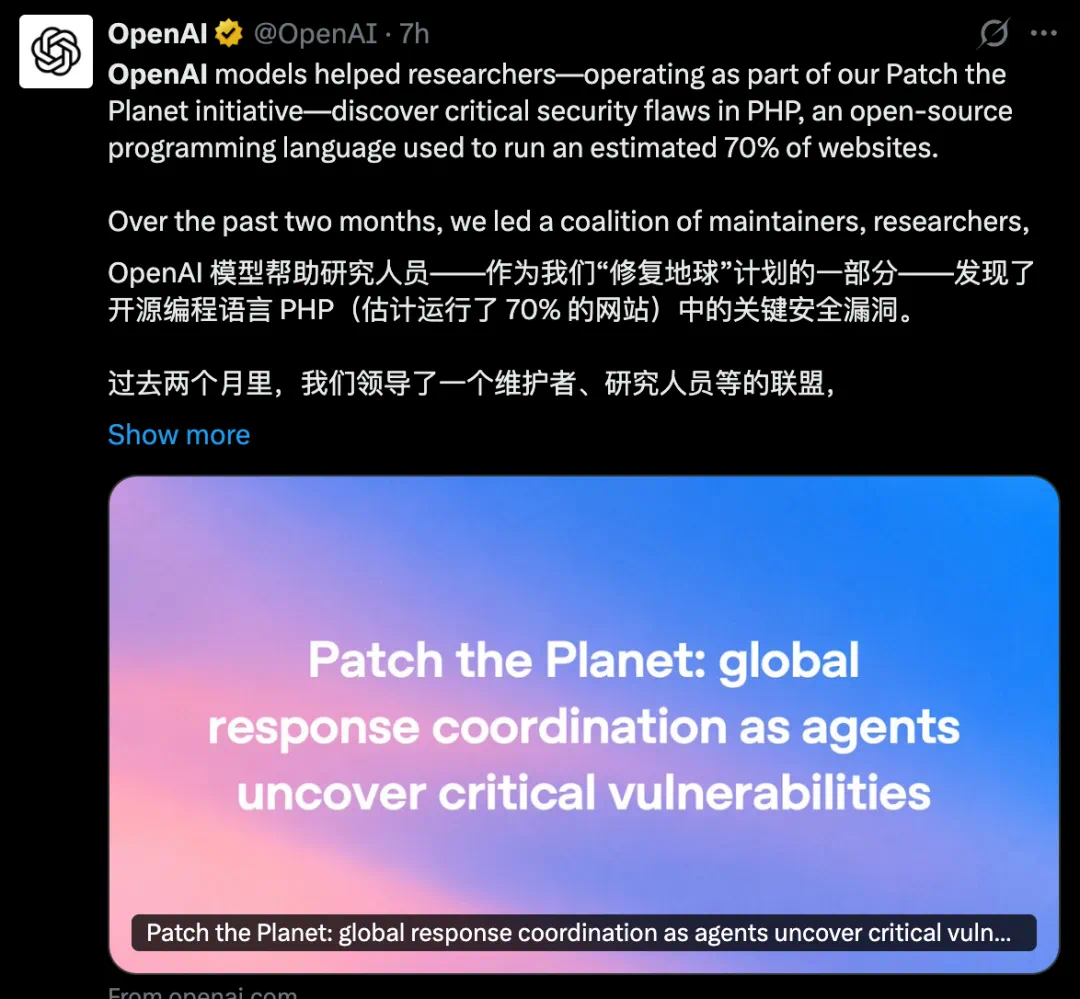
PHP released security updates (8.5.12, 8.4.27, 8.3.36, 8.2.35) fixing two critical unauthenticated remote code execution vulnerabilities, collectively dubbed PHP2Shell, affecting up to 70% of websites. The flaws were discovered in August by OpenAI's GPT-5.6 Sol and independently by Google's Wiz, and AWS reported exploitation starting October 17, four days before public disclosure.
6 reports · 2 sources
News updates every hour. Subscribe in your RSS reader to get new stories automatically.
Subscribe