IQuest Research unveils Tessera, scaling equivariant transformer MD to 30M atoms on 512 GPUs
IQuest Research introduced Tessera, a distributed computing system that scales equivariant transformer-based machine learning force fields to tens of millions of atoms. On 512 GPUs, it completed energy and force calculations for approximately 30.7 million atoms in 1.684 seconds per step with 89.7% scaling efficiency, and validated continuous molecular dynamics trajectories at the ten-million-atom scale.
Coverage timeline
机器之心ScienceAI
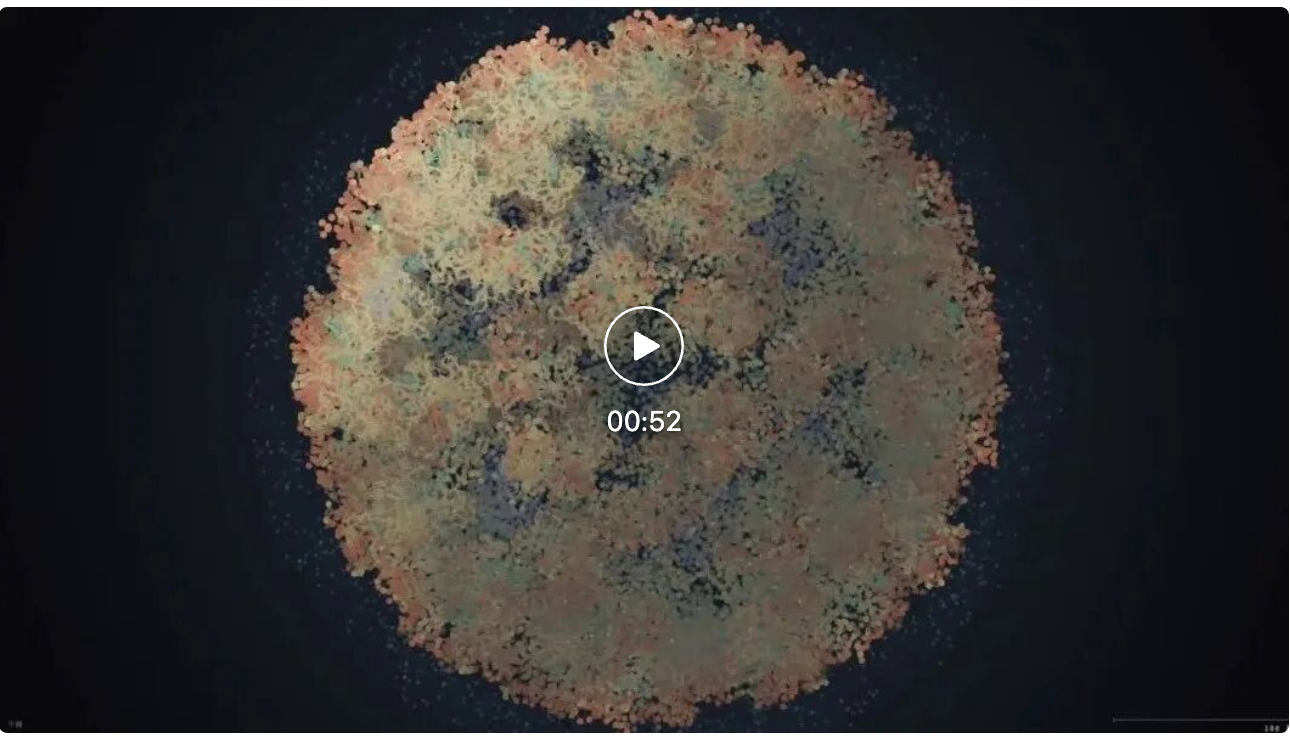
一颗诺如病毒的蛋白质衣壳,连同周围的水和离子,构成了一个包含约 1006 万个原子的复杂体系。要在计算机中模拟它的动态变化,需要在每一个时间步计算原子受力,并不断更新所有原子的位置。 视频:至知借助Tessera,完成了诺如病毒体系 100 ps 的连续分子动力学模拟 这一模拟背后,是大规模分子计算对模型表达能力与计算效率的双重要求。随着机器学习力场向复杂分子、生物大分子及材料体系拓展,如何在保持模型表达能力的同时扩大计算规模,成为分子动力学研究的重要课题。 近日,至知创新研究院(IQuest Research)在论文《Ab Initio Accuracy Beyond the Cutoff: Distributed Message-Passing Equivariant Attention at Tens-of-Millions-of-Atom Scale》中,提出分布式计算系统 Tessera ,在 512 张高性能 GPU 上完成了约 3070 万原子的完整能量与受力计算,单步耗时 1.684 秒, 扩展效率达到 89.7 % ,并进一步在千万原子级体系中完成连续分子动力学轨迹验证。 这项研究基于 UBio-MolFM 模型体系,采用 E2Former V2 架构,围绕原子分区、动态邻居搜索、跨设备通信与 GPU 计算执行展开协同优化,使具有多层消息传递能力的机器学习力场能够扩展到数千万原子的计算规模。 图:Tessera 整体技术架构 多层消息传递,为什么难以扩展到数百张 GPU? 分子动力学(Molecular Dynamics,MD)通过反复计算原子受力、更新原子位置,模拟物质体系的动态演化。机器学习力场(Machine Learning Force Fields,MLFFs)利用第一性原理计算生成的数据训练模型,以较低的计算成本预测原子能量与受力。随着等变神经网络与消息传递机制的发展,模型能够通过多层特征传播,获取更丰富的原子环境信息。 此次研究使用的 E2Former V2 包含约 2350 万参数 ,由三个截断半径为 5 Å 的短程等变层和一个截断半径为 8 Å 的长程等变层组成。经过四层消息传递,模型的最大理论感受野达到 23 Å ,使单个原子能够通过邻居之间的信息传播,利用更大范围内的结构信息。 这一能力也增
Related stories
Chinese AI startups HyperVolve and Apexin announce funding and model releases
Chinese AI startup HyperVolve announced tens of millions RMB in angel funding led by Lanchi Ventures, with participation from SenseTime Guoxiang Capital, Lenovo Star, Inno Fund, and Tsinghua alumni seed fund, to build research foundation models using recursive self-improvement. Separately, Apexin, founded by 27-year-old Tsinghua assistant professor Chen Yongchao, released Apex-35B-V1.0, a 35B model claiming SOTA results on 21 benchmarks against comparable models.
2 reports · 1 sources
Open-source projects unlock hidden Tensor Core throughput on GeForce GPUs, doubling RTX 4090 performance
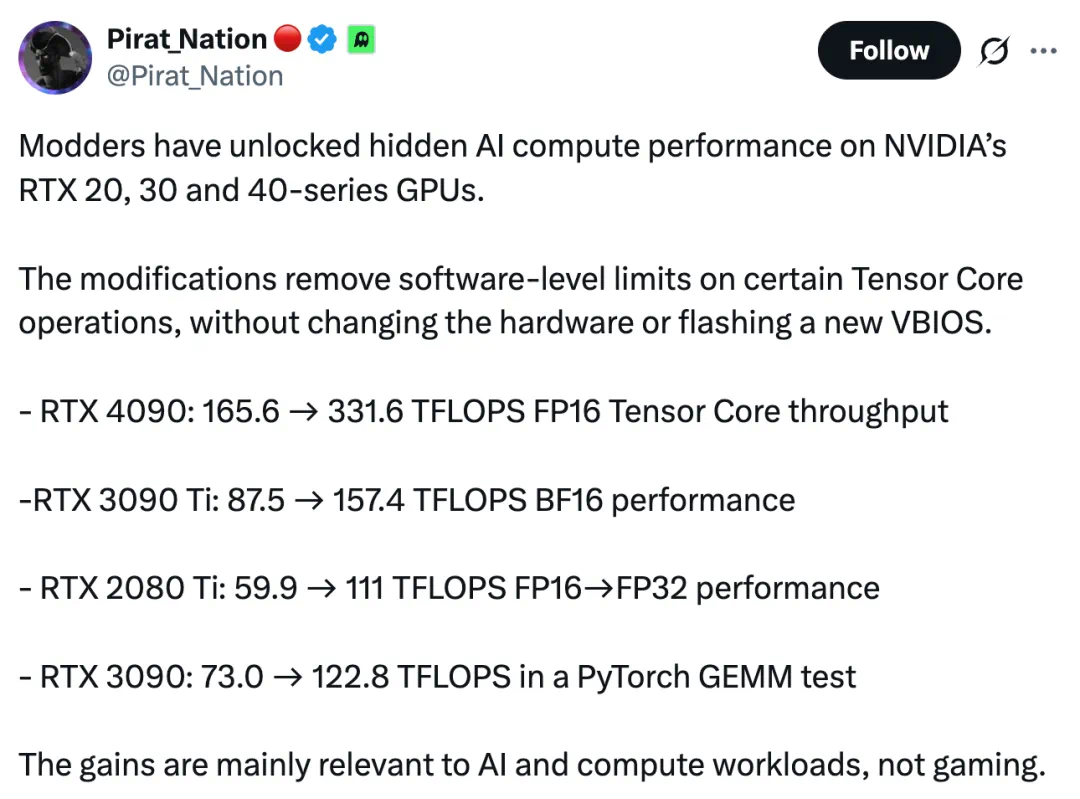
Open-source developers released projects on GitHub that unlock higher Tensor Core throughput on NVIDIA GeForce GPUs by modifying boot-time configuration, without driver swaps or BIOS flashes. Tests reportedly doubled the FP16/FP32 and BF16/FP32 throughput of an RTX 4090 from about 165 TFLOPS to over 330 TFLOPS, with gains also observed on RTX 3090 Ti, RTX 4070 Ti SUPER, and RTX 2080 Ti. The projects target RTX 20, 30, and 40 series, with some experiments done on Windows 11.
MIT: GPT-6 Astra edits Qwen weights, boosting MATH-500 from 7.9% to 48.1%
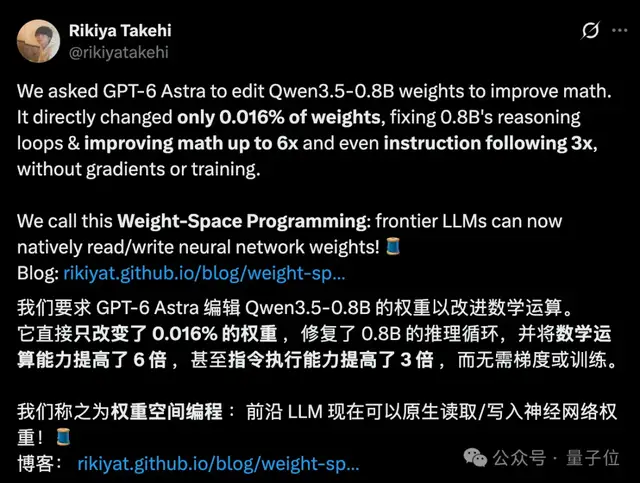
MIT CSAIL researchers demonstrated that GPT-6 Astra can directly read and modify the weights of Qwen3.5-0.8B, improving its MATH-500 score from 7.9% to 48.1% by altering only 0.016% of parameters, without training or gradient descent. The team named this capability Weight-Space Programming. However, spaCy author Matthew Honnibal publicly challenged the paper, arguing that the experimental conditions across the three claimed abilities differ significantly and that the presentation is misleading.
6 reports · 5 sources2949 points · 892 comments
OpenAI releases GPT-6.1 Terra with computer-use focus, API price halved
OpenAI announced GPT-6.1 Terra, a fast, efficient model emphasizing visual reasoning and computer use, priced at $1 per million input tokens and $5 per million output tokens. The standard API price is 50% lower than GPT-5.6 Terra and GPT-6.1 Sol, and the model is available in ChatGPT Work, Codex, and via API (gpt-6.1-terra) for Plus, Pro, Enterprise, and Edu users. In the Agents' Last Exam benchmark, Terra scored 15 points higher than GPT-5.6 Terra at medium reasoning intensity, with about one-third the cost, and matched GPT-6 Astra's performance at one-tenth the token price.
4 reports · 4 sources

News updates every hour. Subscribe in your RSS reader to get new stories automatically.
Subscribe