Open-source projects unlock hidden Tensor Core throughput on GeForce GPUs, doubling RTX 4090 performance
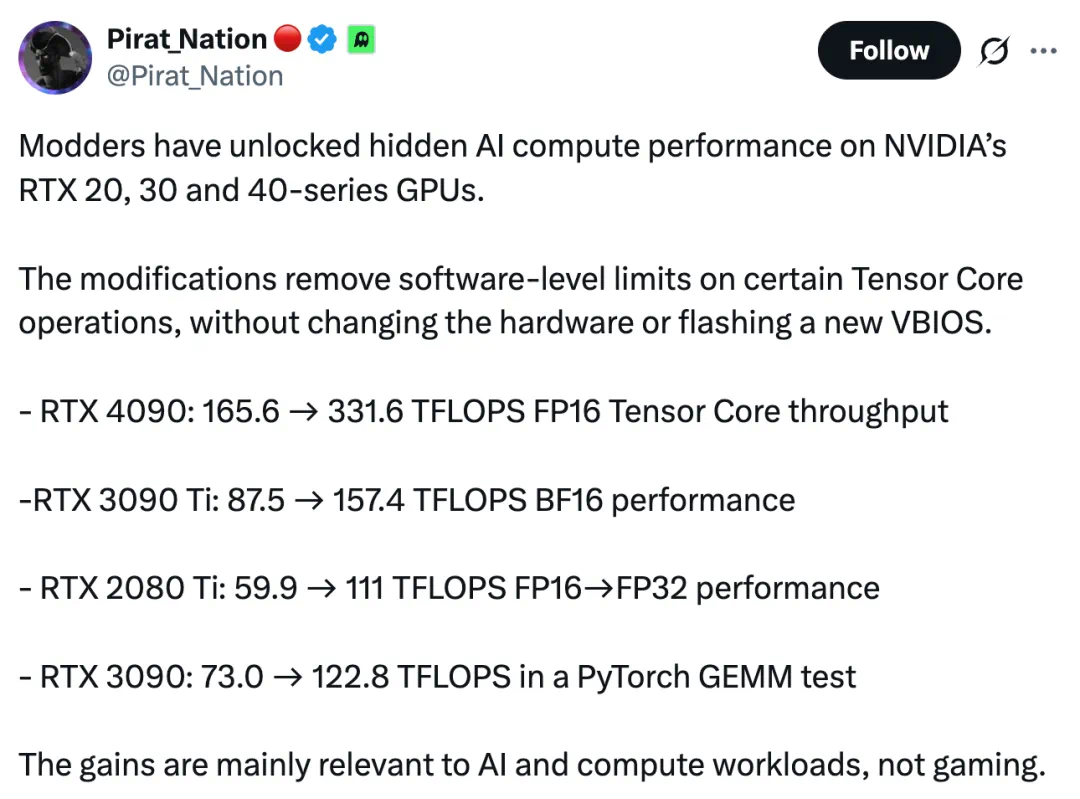
Open-source developers released projects on GitHub that unlock higher Tensor Core throughput on NVIDIA GeForce GPUs by modifying boot-time configuration, without driver swaps or BIOS flashes. Tests reportedly doubled the FP16/FP32 and BF16/FP32 throughput of an RTX 4090 from about 165 TFLOPS to over 330 TFLOPS, with gains also observed on RTX 3090 Ti, RTX 4070 Ti SUPER, and RTX 2080 Ti. The projects target RTX 20, 30, and 40 series, with some experiments done on Windows 11.
Coverage timeline
机器之心机器之心
一张 RTX 4090,什么硬件都没换, 特定 Tensor Core 运算吞吐率竟然从 165.6 TFLOPS 飙升至 331.6 TFLOPS,直接翻倍 ! 更让人意外的是,这次被挖出潜力的远不止 RTX 4090。RTX 3090 Ti、RTX 4070 Ti SUPER,甚至 2018 年发布的 RTX 2080 Ti,都在社区测试中取得了显著的性能提升。 这一切源于 GitHub 上一批开发者对英伟达 GPU 底层计算限制的探索。 他们发现,部分 GeForce 显卡的 Tensor Core 在执行特定混合精度运算时,存在指令发射速率限制。通过修改 GPU 启动阶段的相关配置,可以让原本受限的运算路径恢复更高吞吐率。 不需要更换 GPU,也不用刷写显卡 BIOS 。在已验证的 Linux 方案中,原版 NVIDIA 驱动甚至可以照常运行。 目前,针对 RTX 20、30、40 三代显卡的相关项目均已出现在 GitHub 上,部分开发者还在 Windows 11 环境中完成了实验。一场围绕英伟达显卡「隐藏算力」的挖掘,正在开源社区展开。 RTX 4090 算力翻倍 最引人注目的成绩来自 RTX 4090。开发者 JustAResearcher 在开源项目 gpu-unlock-ada 中,展示了 RTX 4090 解锁前后的测试结果。仅仅 2 天时间,该项目已经积累了 2.7k 的 Star 量。 项目地址:https://github.com/JustAResearcher/gpu-unlock-ada 具体来讲,在 FP16 输入、FP32 累加的 Tensor Core 运算中,吞吐率从 165.6 TFLOPS 飙升至 331.6 TFLOPS,几乎翻倍。BF16 输入、FP32 累加的测试也出现了相同的变化,从 165.5 TFLOPS 提升至 330.6 TFLOPS。这意味着,在特定混合精度运算下,同一张 RTX 4090 可以达到此前约两倍的指令吞吐率。 为了排除偶然因素,开发者还将测试 循环次数从 2 万次增加到 4 万次 ,得到的 FP16/FP32 和 BF16/FP32 吞吐率分别为 330.8 TFLOPS 和 330.3 TFLOPS,与之前的结果基本一致。 更值得关注的是,整个实验没有更换显卡硬件,也没有通过提高功耗上限、手
Related stories
Tsinghua, Infinigence-AI, SJTU Open-Source On-Device Inference Engine APXInf for Embodied Models
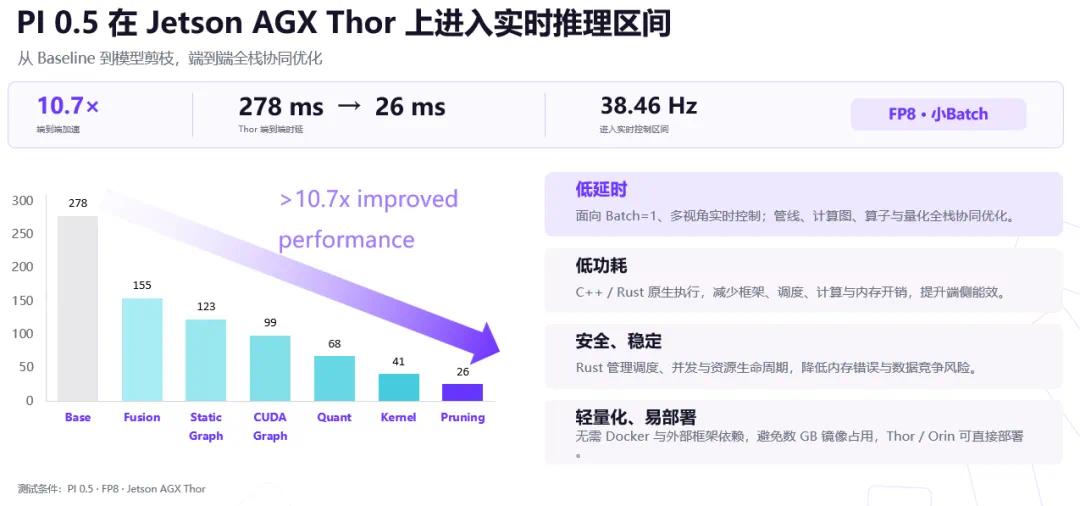
On September 15, Tsinghua University, Infinigence-AI, and Shanghai Jiao Tong University open-sourced APXInf, an on-device inference engine for embodied models. The engine reportedly achieves a 10.7x end-to-end speedup on robot hardware, reducing inference latency from 278ms to 26ms on Thor chips with FP8 configuration, enabling real-time control at 38.46Hz.
1 reports · 1 sources
Google open-sources TorchTPU, making TPU a native PyTorch device
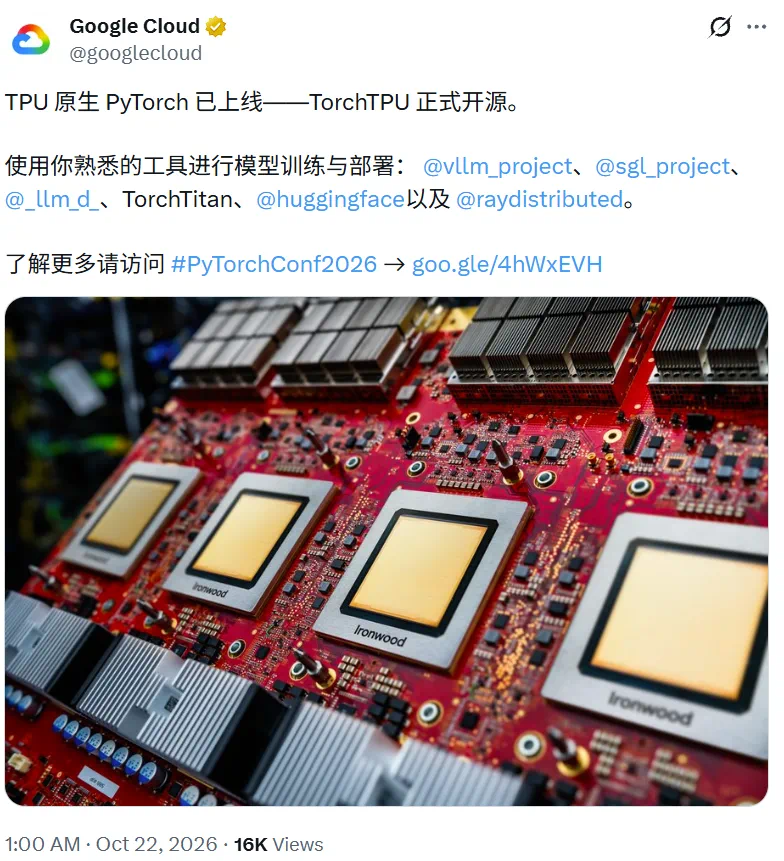
At PyTorch Conference 2026, Google announced the open-sourcing of TorchTPU, a software stack enabling native PyTorch execution on TPUs, developed with Meta and integrated by vLLM, SGLang, Hugging Face, Ray, and TorchTitan. The project, available on GitHub with a 23-page technical report on arXiv, allows deployment to TPU via a single parameter in Hugging Face Transformers v5, positioning TPU alongside GPU and CPU as a native PyTorch option.
Tsinghua and Qujing Introduce KTransformers-FineTune for CPU-GPU MoE Fine-Tuning
Tsinghua University's MADSys lab and Qujing Technology, with LlamaFactory, introduced KTransformers-FineTune (KT-FT), a CPU-GPU co-computation method for fine-tuning mixture-of-experts (MoE) models. It claims 2.5-21.2x throughput gains over traditional offloading by having the CPU compute expert weights directly instead of transferring them to the GPU. The approach includes a semantic-aware proactive layout engine and dynamic thread scheduling for routing skew, and is fully open-sourced.
DeepSeek open-sources Ascend infrastructure components, partners with Huawei
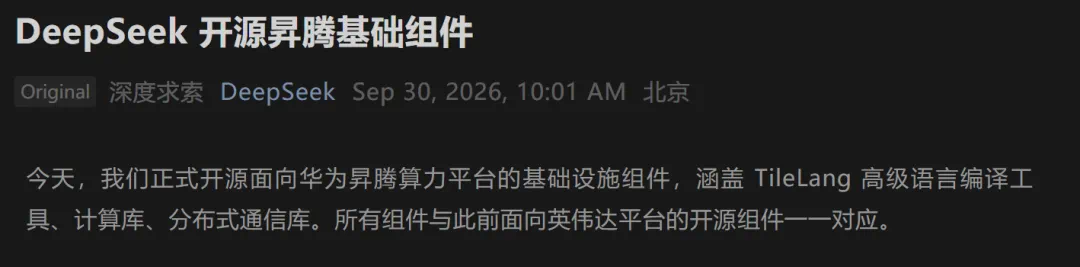
DeepSeek announced on September 30 the open-sourcing of infrastructure components for Huawei's Ascend platform, including the TileLang compiler, high-performance computing libraries (DeepGEMM, FlashMLA, TileKernels, DeepSelect), and the DeepEP distributed communication library. Huawei also open-sourced joint innovations around Ascend 950 and supernodes in the CANN community, covering deployment, training, KV cache pooling, and Agentic RL. The move aims to build an efficient AI chip software ecosystem with Huawei, providing developers with tools corresponding to those previously released for GPU platforms.
News updates every hour. Subscribe in your RSS reader to get new stories automatically.
Subscribe