vLLM Engineers Detail Scaling Kimi K3 Inference on AMD MI355X to Match NVIDIA B300
vLLM engineers published a blog post describing how they scaled inference for the Kimi K3 model on AMD Instinct MI355X GPUs, achieving per-GPU throughput matching NVIDIA HGX B300 on the AgentX benchmark. The post details the bottleneck analysis and key optimization decisions that enabled this performance parity.
Coverage timeline
vLLM BlogAMD and Embedded LLM
Inside the Kimi K3 optimization effort: understanding the bottlenecks and the decisions that made inference faster
Related stories
vLLM Adds Day-0 Support for NVIDIA Vera Rubin NVL72, Claims 7.8x Throughput over GB200
vLLM announced support for NVIDIA Vera Rubin NVL72, claiming 7.8x throughput over GB200 NVL72. The platform offers daily container builds and day-0 model support for DeepSeek, Moonshot AI, Z.ai, and MiniMax, leveraging Blackwell kernel compatibility and Rubin-tuned kernels via FlashInfer 0.7.0.
NVIDIA launches Nemotron 3.5 Super VL, 120B open model; vLLM adds Day 0 support
NVIDIA has launched Nemotron 3.5 Super VL, a 120B-parameter open model for enterprise agents, claiming it outperforms frontier models on specialized benchmarks. vLLM announced Day 0 support for the model, enabling multimodal agent workflows with image, document, and video understanding, OpenAI-compatible serving, and multi-token prediction.
2 reports · 2 sources
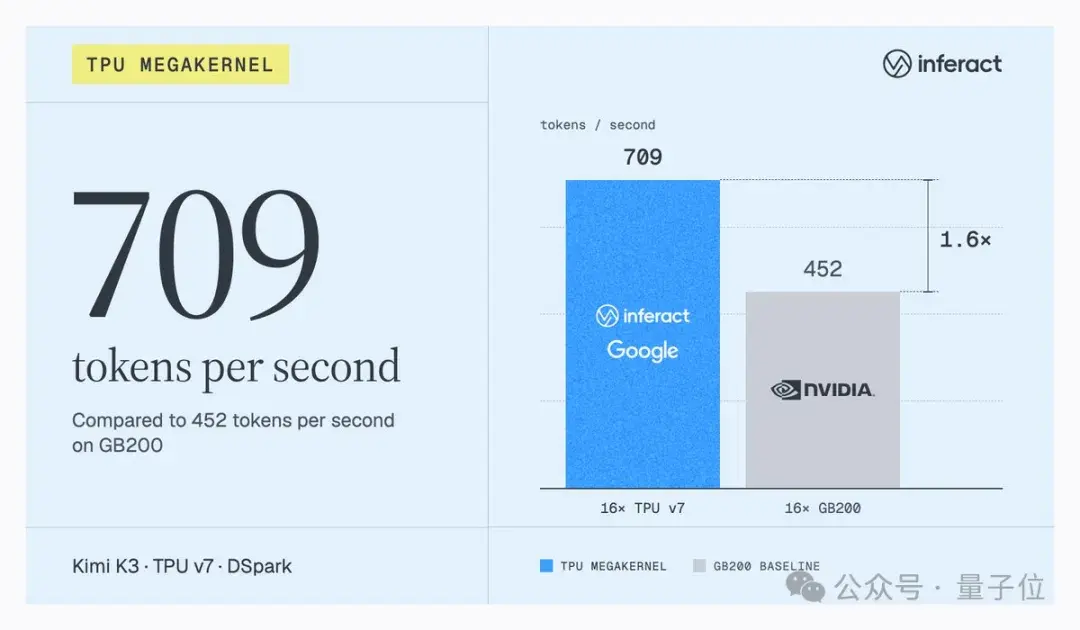
Inferact runs Kimi K3 on 16 Google TPU v7 at 709 tokens/s, 57% faster than GB200
Inferact, a startup founded by the original vLLM team, reported that 16 Google TPU v7 chips ran Kimi K3 at 709 tokens per second, 57% faster than 16 Nvidia GB200 GPUs under identical conditions. The speedup comes from a custom megakernel inference kernel and DeepSeek's DSpark speculative decoding framework; the code has been open-sourced.
1 reports · 1 sources
vLLM reports PD serving results for Qwen3.8-2.4T on GB300 NVL72
vLLM's blog reports PD serving performance for the Qwen3.8-2.4T model on a GB300 NVL72 cluster with an 8K/1K workload. In high-throughput scenarios, vLLM achieved 5000 total token throughput per GPU, and 180 generated tokens per user in low-latency scenarios, both on the Pareto frontier. The post provides srt-slurm recipes and details the decision-making process for reproduction and optimization.
News updates every hour. Subscribe in your RSS reader to get new stories automatically.
Subscribe