Google unveils Gemini 4 Argon, limits early access to cyber defenders
Google DeepMind announced Gemini 4 Argon, its next frontier model, on September 30, 2026, with initial access restricted to a set of trusted cybersecurity defenders via the Fairwind Program. The model features a 1M-token output limit, priced at $2/1M input and $10/1M output tokens initially, rising later, and reportedly outperforms GPT-6 Astra on coding and knowledge benchmarks. Internal skepticism exists, with some employees claiming real-world coding struggles, which Google disputes.
Coverage timeline
Google DeepMind Blog
Hacker Newsbradleyg223
Techmeme
Madison Mills / Axios : Google rolls out Gemini 4 Argon to a small group of cybersecurity partners and says it outperforms GPT-6 Astra on certain coding and knowledge work benchmarks — Google is unveiling its long-awaited next-generation AI model, Gemini 4 Argon, to a small group of cybersecurity partners, the company said Wednesday.

Bloomberg : Sources: some Google employees say Gemini 4 performs well on benchmarks but struggles with some real-world coding tasks; Google disputes that characterization — As Alphabet Inc.'s Google prepares for the coming launch of Gemini 4, it's grappling with internal skepticism …

The Verge AIJay Peters
Google today revealed its next AI frontier model, which it's calling Gemini 4 Argon. The new model delivers "frontier performance in complex workflows across real-world software engineering, enterprise knowledge work like legal and finance, and cybersecurity defense," according to chief AI architect and Google DeepMind SVP Koray Kavukcuoglu. But the company is limiting access at first to a "set of trusted cyber defenders," and Kavukcuoglu says that Google is "actively engaged in the U.S. government's voluntary process for pre-release model access while we gradually expand access." Kavukcuoglu says Gemini 4 Argon is already powering Google's … Read the full story at The Verge.

Hacker Newstheanonymousone
TechCrunch AILucas Ropek
Google has released its latest Gemini model, marketing it as a workhorse for coding and cybersecurity work.
Matthias Bastian / The Decoder : Gemini 4 Argon has a 1M-token output limit, up from 64K for prior models; it initially costs $2/1M input and $10/1M output tokens, rising to $4 and $20 later — Key Points … Ask about this article... Argon is Google's first frontier model in more than seven months, following Gemini 3.1 Pro.

机器之心机器之心
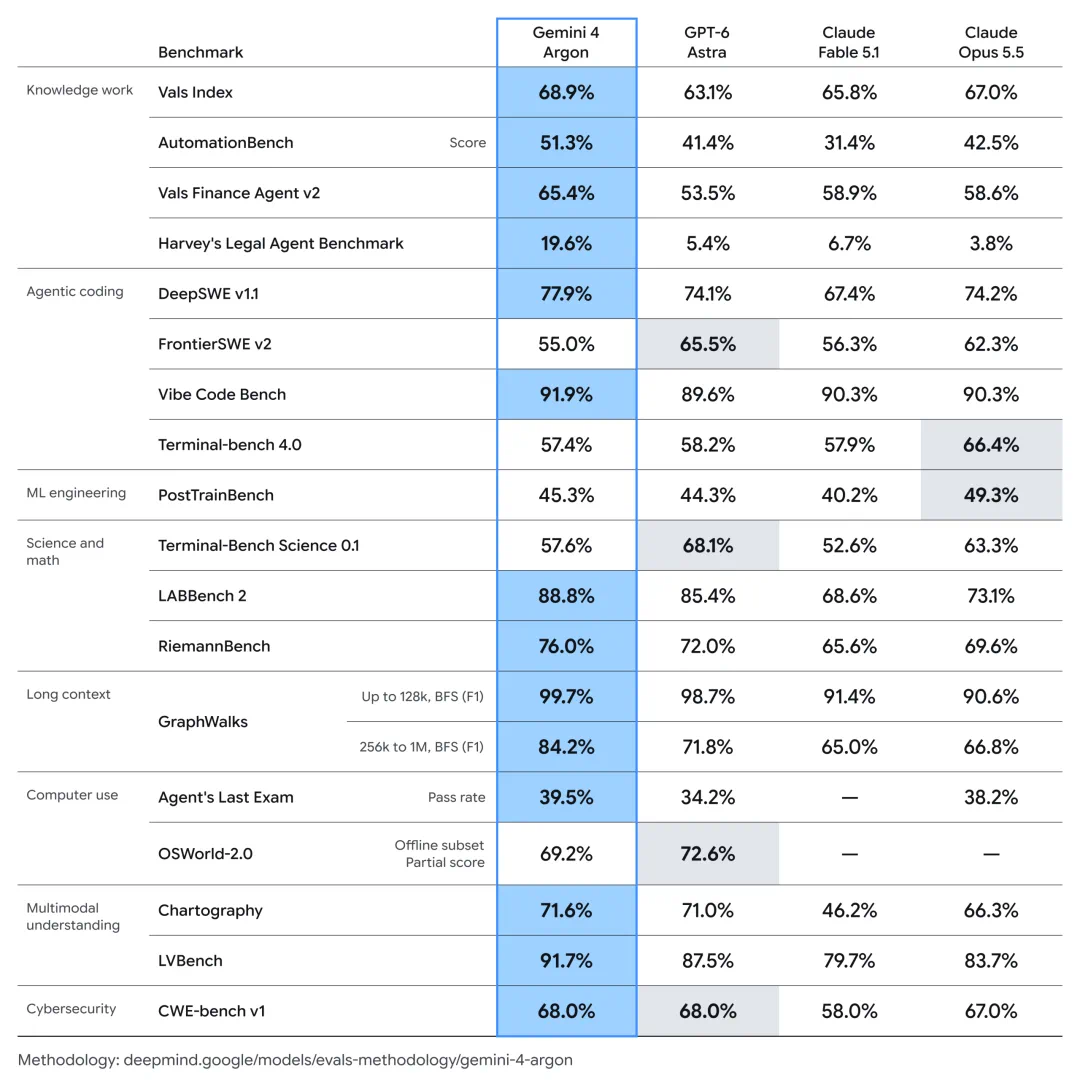
刚刚,Google 宣布推出新一代前沿模型 Gemini 4 Argon。 Google 将 Argon 定位为 面向复杂、长周期工作流的模型 ,重点覆盖软件工程、法律与金融等企业知识工作,以及网络安全防御。 与以往直接面向公众开放的方式不同,Argon 将采用分阶段发布策略。该模型将通过 Fairwind Program,首批提供给受信任的网络安全防御者。 价格方面,Argon API 的初始定价为每百万输入 Token 2 美元、每百万输出 Token 10 美元,缓存输入 Token 的价格比标准输入价格低 95%。 单次输出上限扩至 100 万 Token Gemini 4 Argon 最受关注的变化,是将 输出 Token 上限从此前的 6.4 万提升至 100 万 。 这里的 100 万 Token 指单次输出上限,和上下文窗口是两个指标。更高的输出空间意味着,模型可以在一条任务轨迹中持续推理,并生成数十万甚至接近百万 Token 的结果。这类能力主要面向大型代码迁移、深度研究和多步骤企业流程。 有网友指出,多数前沿模型的输出上限大约为 12.8 万 Token。相比之下,Argon 单次生成 100 万 Token 的能力挺罕见。 Google 称,Argon 在 DeepSWE v1.1 软件工程评测中的得分为 77.9%,达到当前最高水平。该评测主要衡量模型处理真实、长期软件工程任务的能力。 在企业知识工作方面,Argon 位列 Vals Index 第一。该指数覆盖金融、编程、法律和税务等领域,并按照各行业对美国国内生产总值的贡献进行加权。 Argon 还在 Vals Finance Agent v2、Harvey Legal Agent Benchmark 和 Zapier 的 AutomationBench 等评测中取得领先表现,AutomationBench 得分为 51.3%。 Argon 也强调视觉理解能力。Google 表示,模型可以分析专业图表、理解长视频,并根据多份文档采取行动。在长视频理解评测 LVBench 中,Argon 得分 91.7%。 已进入 Google 内部工程流程 Google 表示,已有数千名员工在日常工作中使用 Argon,应用场景包括代码调试、算法设计和大型代码库迁移。 在量子计算领域,Argon 帮助研究
量子位量子位
谷歌Gemini 4突然发布!RSI加持,GPT和Opus都让让 鹭羽 2026-10-01 23:02:14 来源: 量子位 价格只有Astra一半 鹭羽 发自 凹非寺 量子位 | 公众号QbitAI 哎呦喂,谷歌终于也是蹬起来了。。。 假期第一天,谷歌携 Gemini 4 Argon 空降多榜单第一。 拳打Opus 5.5,脚踢GPT-6 Astra。 更夸张的还在后头,单项任务成本最低可至 1.99美元 ,直接是Astra费用砍半。 最高百万Token输出上限 ,面向编程、金融和法律等复杂工作流,而且划重点,网络安全防御能力超牛掰。 这波等等党要赢麻了。 不过吧,咱普通用户现在只可远观,暂时还吃不上。 Gemini 4 Argon目前只开放给部分经过筛选的网络安全团队使用,其它订阅用户得一步步来。 倒是谷歌内部对新一代旗舰模型的态度还挺有意思的。 劈柴哥、哈萨比斯还有接班人Koray Kavukcuoglu,纷纷一键三连为其站台: 谷歌is back! DeepMind研究员Zirui Wang发帖直言: RSI来了! 我已做无可做,是时候追逐我的咖啡师梦想了:) 讲真? 轮到你了,谷歌 全体起立!咱盼星星盼月亮的 Gemini 4 ,它终于来了。 仔细数一数,距离谷歌上一代旗舰模型发布都快一年了,哪吒都没这么难产。 这一年OpenAI、Anthropic是追着谷歌砍啊,放假前一周还连发Opus 5.5、Sonnet 5.5、GPT-6.1 Sol逼宫。 你说谷歌能不急吗,新型号 Argon 火速上岸。 先看跑分情况, 清一色的性能领跑 。 Argon在衡量长期软件工程任务的DeepSWE v1.1上拿到77.9%,高于Claude Opus 5.5的74.2%和GPT-6 Astra的74.1%。 网络安全漏洞修复测试CWE-bench v1则拿到68%,和GPT-6 Astra 并列第一 。 Argon以68.90%登顶Vals Index榜首,较Gemini 3.8 Flash实现大幅提升。 尤其是 RSI指数 一跃第四,超越了GPT-6 Astra。 Gemini 4 Argon在另外的第三方评测中也不遑多让。 文本领域,Argon在代码编写、高难度提示词、指令遵循、长查询以及创意写作赛道优势显著,以1525分位居 Text Arena第一 。 在评测
Related stories
Google DeepMind unveils Genie 4 world model with real-time audio and natural-language scene editing
Google DeepMind announced Genie 4, its fourth-generation world model for real-time interactive simulations. It generates audio alongside visuals, allows users to modify scenes via natural language prompts in real time, and produces simulations of about two minutes, up from one minute in Genie 3. Powered by Gemini 3.8 Flash, it is initially available as a research preview to trusted testers, targeting pre-visualization, game prototyping, and robot training.
5 reports · 5 sources

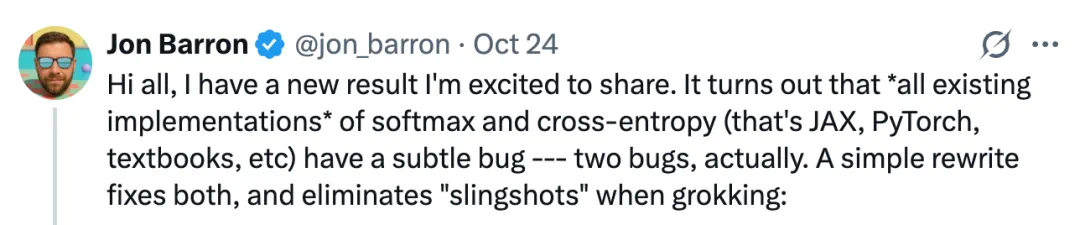
DeepMind Researchers Find Numerical Precision Bugs in Softmax and Cross-Entropy Across Major Frameworks
Google DeepMind researchers identified two numerical precision bugs in the standard Softmax and cross-entropy implementations used by PyTorch, JAX, and TensorFlow. The bugs can subtly alter gradients during training, potentially causing loss spikes or capability regression. The team proposed a fix that adjusts the computation without increasing floating-point precision or redesigning the loss function; the paper was submitted to arXiv on October 22.
Anonymous Models Kibitz and Kalmia Appear in Code Arena, Suspected to Be Kimi K3.1 and Qwen 4
Two anonymous models, Kibitz and Kalmia, have appeared in Code Arena blind tests on Arena.ai, with community speculation linking them to upcoming releases from Moonshot AI (Kimi K3.1) and Alibaba (Qwen 4). Users report impressive capabilities in generating SVG, web pages, and interactive 3D scenes, with some claiming Kibitz's token cost is 1/14 that of GPT-6 Astra for similar tasks. Evidence includes a leaked configuration request pointing to 'k3.1' and token fingerprinting that matches Moonshot models.

Google launches TorchTPU, vLLM adds TPU backend
Google announced TorchTPU, an open-source version of PyTorch that lets AI applications run on TPUs and Google Cloud via simple configuration changes without rewriting code. Concurrently, vLLM introduced vllm-torchtpu, a new backend for Google Cloud TPUs built on TorchTPU, featuring Pallas kernels, multi-host parallelism, KV cache offloading, and disaggregated serving. These moves, following Amazon's similar tool, challenge Nvidia's dominance in AI development.
3 reports · 3 sources
News updates every hour. Subscribe in your RSS reader to get new stories automatically.
Subscribe