Anonymous Models Kibitz and Kalmia Appear in Code Arena, Suspected to Be Kimi K3.1 and Qwen 4
Two anonymous models, Kibitz and Kalmia, have appeared in Code Arena blind tests on Arena.ai, with community speculation linking them to upcoming releases from Moonshot AI (Kimi K3.1) and Alibaba (Qwen 4). Users report impressive capabilities in generating SVG, web pages, and interactive 3D scenes, with some claiming Kibitz's token cost is 1/14 that of GPT-6 Astra for similar tasks. Evidence includes a leaked configuration request pointing to 'k3.1' and token fingerprinting that matches Moonshot models.
Coverage timeline
机器之心机器之心
大的要来了,而且一下来了俩。 最近两天,人们在 Arena.ai(原 LMArena)的编程对战 Code Arena 中发现了两个陌生的名字:Kibitz、Kalmia。厂商在正式发布前,经常会把新模型以匿名代号放进盲测,让真实用户在不知情的情况下投票。经过仔细分析,很多人把它们与国产新模型联系在了一块。人们认为 Kibitz 疑似是月之暗面的 Kimi K3.1,Kalmia 疑似阿里的 Qwen 4。 先来看看效果,X 上有人不停「抽卡」,用刷到的新模型制作出了不少 SVG、网页和可交互的 3D 场景。 「build what you think you look like in Minecraft」: Kibitz 构建的中世纪像素城堡: Kalmia 构建的 3D 可驾驶汽车: Kibitz 与 Kalmia 构建的直升机: AI 构建这些效果需要协调场景绘制、运动、镜头和用户输入,相当于一次性完成前端开发、空间建模与交互逻辑,这为我们观察模型的前端开发、空间表达和指令遵循能力提供了直观的窗口。 大家对于这两个模型能够实现的效果表示惊叹,认为 Kibitz 或许可以创下开源模型的新高,而 Kalmia 甚至能够比肩 GPT 6.1 Sol Ultra。 同样让人在意的是成本,Arena 能查看部分费用指标,社区有人表示,Kibitz 做同样的事,Token 成本只是 GPT‑6 Astra 的 1/14。 有关两家的新模型,Kimi K 3.1 即将发布的消息比较有谱。前天在 AI 社区已有人公布了一次对 Kimi 官方域名下配置接口的请求,返回内容包含切换目标 "to": "k3.1" 等,这说明产品端已经在准备 K3.1 的会话切换。不过,发帖者随后更新称,该配置当晚已被撤回。 另一条线索来自模型处理特殊字符串时留下的「指纹」。 AI Tracker Bot 表示,在两次测试中,Kibitz 对 11 个用于识别 Moonshot 模型的特殊 token 都出现了乱码,与该账号测试过的 Kimi 模型表现一致,而来自其他 7 家 AI 实验室的模型则能够准确复制这些内容。这让 Kibitz 与 Kimi 的联系进一步加强。 有关 Qwen 4,我们目前比较清楚的是它的技术方向。 在 8 月份发布 Qwen3.8-Flash-Next 的时候,新模型在官

Related stories
Google unveils Gemini 4 Argon, limits early access to cyber defenders
Google DeepMind announced Gemini 4 Argon, its next frontier model, on September 30, 2026, with initial access restricted to a set of trusted cybersecurity defenders via the Fairwind Program. The model features a 1M-token output limit, priced at $2/1M input and $10/1M output tokens initially, rising later, and reportedly outperforms GPT-6 Astra on coding and knowledge benchmarks. Internal skepticism exists, with some employees claiming real-world coding struggles, which Google disputes.
10 reports · 7 sources1691 points · 1177 comments

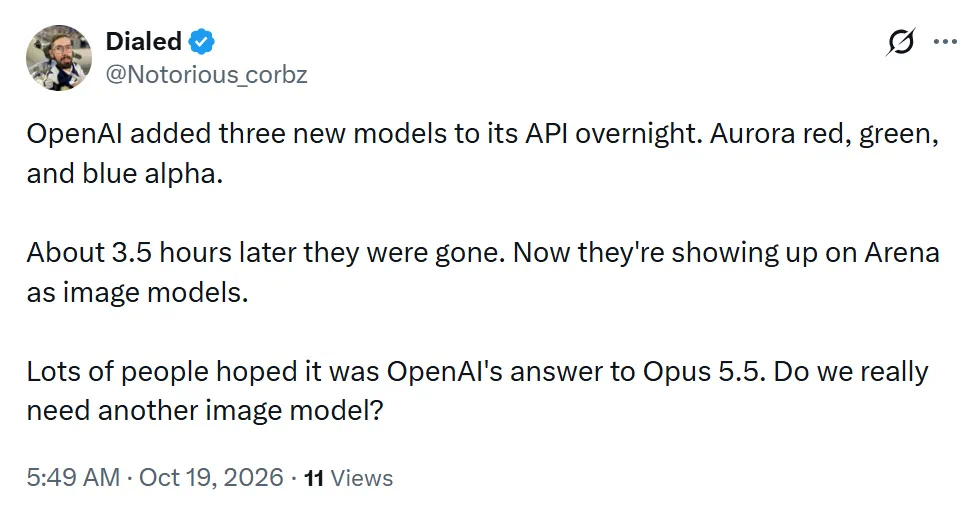
Mysterious Aurora Models Appear and Vanish in OpenAI API List
On October 18, developers spotted three unfamiliar model names—aurora-red-alpha, aurora-green-alpha, and aurora-blue-alpha—in a third-party mirror of OpenAI's API model list. The entries quickly disappeared, and attempts to call them returned HTTP 503 errors citing no available capacity. OpenAI has not officially commented, and speculation ranges from unreleased GPT-6 Astra checkpoints to image models.
1 reports · 1 sources
MiniMax unveils M3.1 Flash, claiming top agent scores and low cost
MiniMax released M3.1 Flash, the official version of the previously anonymous Space Bunny model, claiming a generational leap in agentic tasks, coding, computer use, and cybersecurity. The model scores 29.6% on Agents' Last Exam (ALE), the top for Chinese models, with pricing at 1 yuan per million input tokens and 4 yuan per million output tokens. Weights are due October 23, with day-0 support from vLLM on Blackwell, Rubin, and AMD MI350 GPUs.
4 reports · 4 sources

Anthropic: Small AI models may self-replicate on IoT devices within months
Anthropic researchers report that small AI models may be months away from self-replicating on commercial IoT devices like smart ovens and off-brand Android TV boxes. In tests, a 9B model ran inference on 8 of 9 hardware types, and GLM-5.2 autonomously spread an 8B model to all 8 nodes in 4 of 5 attempts. The researchers predict models under 30B could achieve end-to-end replication by the end of 2026.

News updates every hour. Subscribe in your RSS reader to get new stories automatically.
Subscribe