MiniMax launches M3.1 Flash, claims leap in agentic tasks, coding, cybersecurity
MiniMax announced M3.1 Flash, a new model variant it says delivers a generational leap in agentic tasks, coding, computer use, and cybersecurity. The company said weights will be released on October 23, and noted that Space Bunny, which processed over 200 trillion tokens anonymously, was an early version of the model.
Coverage timeline
MiniMax Blog

Techmeme
MiniMax : MiniMax launches M3.1 Flash, saying it delivers “a generational leap” in agentic tasks, coding, computer use, and cybersecurity, with weights due October 23 — Space Bunny 🐰, which processed more than 200 trillion tokens while operating anonymously, was an early version of MiniMax M3.1 Flash.

Related stories
MiniMax M3.1-Flash-Preview matches Claude Opus 5.5 front-end feats
On September 28, MiniMax released M3.1-Flash-Preview, the latest M-series model with million-token context and native multimodality, available in MiniMax Code and via API subscription. Users found it can replicate front-end generation feats of Claude Opus 5.5, such as a gacha game page with full character panels, without multiple attempts.
1 reports · 1 sources
Ant Group open-sources Ling-3.1-flash, a 560B-parameter MoE model with 1M context
Ant Group's Ling-3.1-flash, a 560B-parameter mixture-of-experts model with 25B active parameters and a 1M-token context window, was released open-source on October 15. The model targets long-horizon complex task execution, using a hybrid linear attention design with KDA layers and Gated MLA to manage computational costs on long sequences.
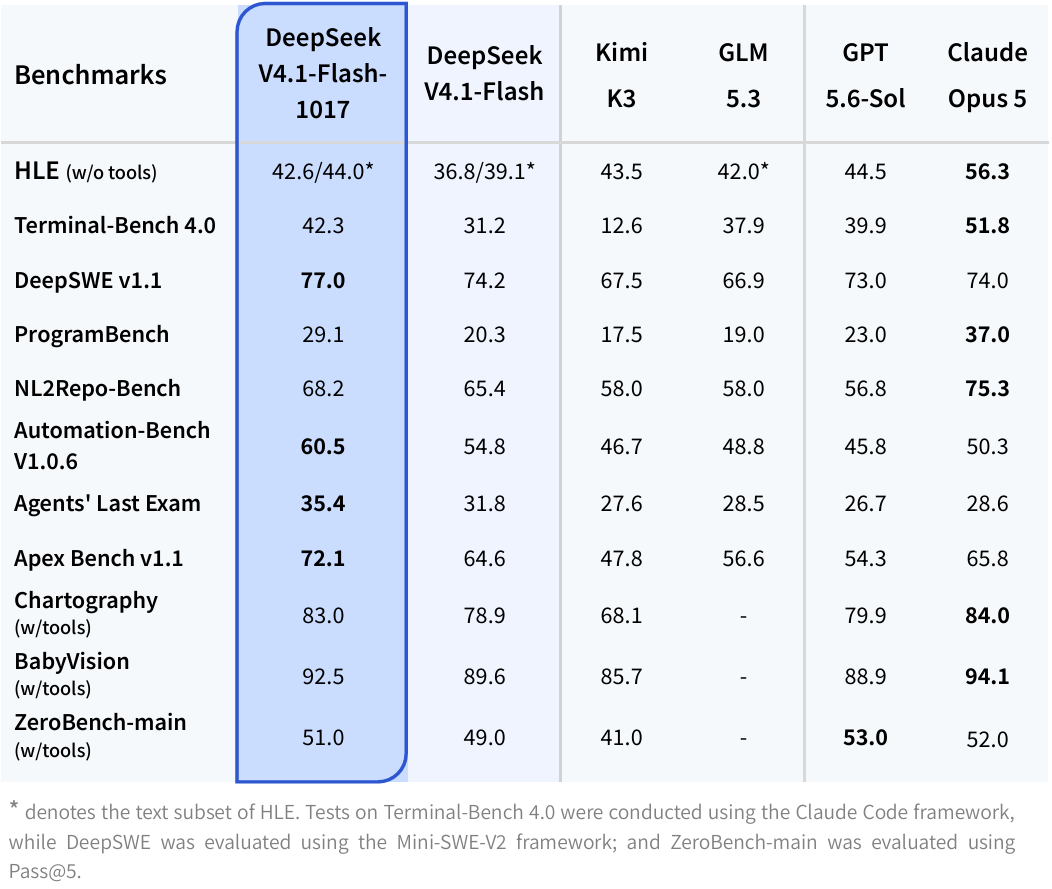
DeepSeek releases V4.1-Flash-1017 open-weight model with faster, cheaper agent tasks
DeepSeek released V4.1-Flash-1017, an open-weight model checkpoint with 763B parameters, claiming stronger benchmark performance, faster task completion, and shorter outputs than its predecessor. The model is optimized for agent frameworks like DeepSeek Harness, Tencent CodeBuddy, and WorkBuddy, and is now live on the website, app, and API. DeepSeek also opened its Search & Fetch APIs to everyone, priced at $0.75 per 1000 successful requests.
8 reports · 5 sources950 points · 713 comments
Google DeepMind releases Nano Banana 2.1 image model based on Gemini 3.6 Flash
Google DeepMind has released Nano Banana 2.1, an efficient image generation and editing model based on Gemini 3.6 Flash, now stable in the Gemini API. The update claims broad improvements in visual design, mask editing, subject consistency, and image naturalness, with pricing about 50% lower than Nano Banana 2. The model supports 1K, 2K, and 4K outputs, handles up to 14 reference images for multi-image fusion, and is distributed across Gemini App, Google AI Studio, Gemini API, Google Search AI Mode, Google Ads, Flow, and Stitch.

News updates every hour. Subscribe in your RSS reader to get new stories automatically.
Subscribe