GPT-6 Astra Helps Prove Remaining Cases of 57-Year-Old Circle Packing Problem for N up to 20
A math enthusiast named nor used GPT-6 Astra to rigorously prove the remaining cases (N=15, 16, 17, 18, 20) of the 'packing circles in a circle' problem, extending verified results to N≤20. Previously, only N≤14 and N=19 had been proven. The problem, posed in 1969, asks for the minimal radius of a large circle that can contain N unit circles without overlap.
Coverage timeline
量子位量子位
刚刚,GPT-6 Astra联手非职业数学家,证明57年「摆圆」 难题 鱼羊 2026-10-12 15:48:53 来源: 量子位 GPT-6 Astra扫荡数学证明ing 鱼羊 发自 凹非寺 量子位 | 公众号QbitAI AI现在真是开启数学证明扫荡模式了。 刚刚,又有 数学爱好者 用GPT-6 Astra把一个 57年 数学难题推进了一大步。 问题听上去倒是不复杂: 给你N个半径为1的圆盘,怎么把它们塞进一个大圆里,才能让大圆的半径尽可能小? 事实上,数学家们也确实在1969年就给出了漂亮的排列方案,只不过……57年来,谁也没能严格证明那就是最优解。 于是这一次,数学爱好者nor掏出了GPT-6 Astra……然后一口气把15、16、17、18和20这5种情况,也就是 N≤20的剩余情况都给严格证明了 …… 此前,只有N≤14和N=19的情况已经得到验证。 啊对了,N到20,并不是AI的极限,只是nor没想着往下证了…… 卡了半个世纪的证明 咱们先把这个问题用更数学的形式来归置归置。 假设有N个半径均为1的圆盘,以及一个半径为R的大圆。 要求: 所有小圆盘必须完全位于大圆内部,可以与大圆边界相切,但不能超出边界。 任意两个小圆盘不能发生内部重叠,但允许彼此相切。 小圆盘可以在大圆内任意移动、排列,不限制排列方式。 问题是:对于给定的正整数N,大圆半径R最小可以是多少? 看上去是一道平平无奇奥数题,但实际上,寻找最优排列只是问题的第一层,但就难在如何严格在数学上证明,排列已经达到极限,没有其他更好的摆法。 在1968年,美国数学家葛立恒就证明了N≤7的情况。 1969年,数学研究者Udo Pirl把证明范围推进到10个圆盘,并进一步研究了11-19个圆盘的排列方案。 但一直到2003年前后,N≤14以及N=19的情形才被严格证明。 nor是一位长期研究数学、机器学习和优化算法的技术作者,多次公开参与AI辅助数学研究。 他本人在十多年前就关注到了这个题目,而这个问题在过去十几年间确实也没啥进展…… 那还说啥,丢给GPT-6 Astra正好(bushi)。 nor也循序渐进的:先让GPT-6 Astra处理N=15的情况;模型解决之后,再让它把同样的方法推广到16、17,以及18和20……GPT-6 Astra都成功给出了证明结果。 只是嘛…… 证明过程一如既往晦
Related stories
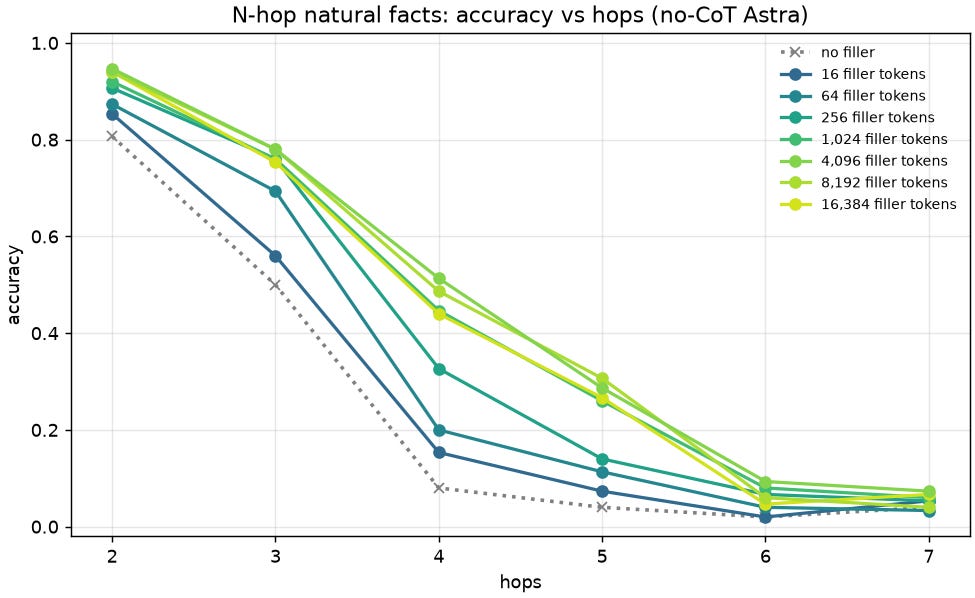
Redwood Research: Filler tokens boost GPT-6-Astra reasoning, complicating monitoring
Redwood Research reports that GPT-6-Astra performs significantly better on serial reasoning tasks when prompts are padded with meaningless filler tokens, improving from ~10% to ~50% on 4-hop natural facts reasoning and from ~60% to ~90% on old AIME problems. The finding raises interpretability concerns because the model can perform substantial cognition without verbalizing it in chain-of-thought, making monitoring harder.
1 reports · 1 sources
Danish team extracts hidden chain-of-thought from frontier models via tool calling
Researchers at Aalborg University's AI Safety Lab, with the Seafill open-source community, published a paper showing that hidden chain-of-thought reasoning can be extracted from frontier models via standard API tool calling. They validated the method on open models, where extracted reasoning matched or slightly exceeded native reasoning in accuracy, and applied it to closed models across math, code, and science benchmarks. All extraction experiments were completed before September 9, 2026, and OpenAI and Anthropic were informed.
1 reports · 1 sources

OpenAI releases 722 AI-generated math manuscripts, claims on quasi-Riemann and Kakeya
OpenAI published 722 mathematical manuscripts produced by an unreleased internal frontier model, grouped into 372 result families across 17 fields, including claims on the quasi-Riemann hypothesis, BSD conjecture, and four-dimensional Kakeya conjecture. The company said most results came from a single prompt to a single AI agent, with average compute per result roughly equivalent to three hours of ChatGPT Pro thinking. Mathematicians described the release as overwhelming, noting it could take years to fully understand, and OpenAI withdrew three papers two days later.
16 reports · 6 sources1334 points · 1520 comments

Yau Shing-Tung's paper on exotic spheres acknowledges GPT 6 Astra and Claude Pro
Mathematician Yau Shing-Tung, who once said AI could not affect top mathematicians, has co-authored a paper that thanks GPT 6 Astra and Claude Pro for helping explore proof ideas and calculations. The paper addresses a conjecture about seven-dimensional exotic spheres, listed by Yau in 1982, and provides an answer to whether these spheres can have positive sectional curvature everywhere.

News updates every hour. Subscribe in your RSS reader to get new stories automatically.
Subscribe