Yau Shing-Tung's paper on exotic spheres acknowledges GPT 6 Astra and Claude Pro
Mathematician Yau Shing-Tung, who once said AI could not affect top mathematicians, has co-authored a paper that thanks GPT 6 Astra and Claude Pro for helping explore proof ideas and calculations. The paper addresses a conjecture about seven-dimensional exotic spheres, listed by Yau in 1982, and provides an answer to whether these spheres can have positive sectional curvature everywhere.
Coverage timeline
量子位量子位
丘成桐新论文致谢了GPT和Claude 梦晨 2026-10-02 15:27:03 来源: 量子位 44年前被亲自列入问题清单 克雷西 发自 凹非寺 量子位 | 公众号QbitAI 「AI不可能对最尖端的数学家有任何影响」……吗? 说出这句话的 丘成桐,现在已经用上AI辅助研究了 。 而且解决的问题,还是44年前他亲自列入自己的问题清单的。 丘成桐参与的最新论文,在致谢里感谢了GPT 6 Astra和Claude Pro,说它们帮忙探索了部分证明思路和计算。 这篇论文处理的是微分几何里的一个经典猜想。 问题关注的是七维空间,当中的球面有28种不同的「版本」,其中27种和我们熟悉的球面微妙地不同,数学上叫「怪球」。 数学家一直想知道, 这些怪球能不能像普通球面一样,每个地方都均匀地向内弯 。 怪球1956年就被发现了,但这个弯曲的问题悬了70年。丘成桐1982年把它列进自己的问题清单,排第二位。 现在,这篇AI辅助的论文终于给出了答案。 七维空间的27种「怪球」 1956年,美国数学家米尔诺(John Milnor)构造出了一种奇怪的东西。 它和标准的七维球面在拓扑上完全一样,你可以把它想象成一团橡皮泥,随便揉捏、拉伸,都能变成普通的球面。 但是如果你禁止揉捏,只允许光滑地变形,也就是每一个点的移动方式都平缓过渡、不许有突变,它就变不回去了。 这种球面和标准球面「形状一样,手感不同」,数学上叫做「怪球」(exotic sphere)。 米尔诺凭借这个发现拿了菲尔兹奖。 七年之后,科维尔(Kervaire)和米尔诺证明,七维空间里这种「光滑版本」一共有28种。 标准球面算其中一种,其余27种都是怪球,这28种构成一个代数结构,数学上记作Θ₇ ≅ Z/28Z。 标准球面有一个很好的性质,它的「截面曲率」(sectional curvature)处处为正。 通俗地说,就是这个球面的每一小块、从每一个角度去看,都是向内弯曲的,没有任何一个地方是平的或者向外翻的。 数学家自然想知道,另外那27个怪球,能不能也做到这一点。 最先取得突破的是格罗莫尔(Gromoll)和迈耶(Meyer)。1974年,他们在一个怪球上构造出了「非负曲率」的度量。 也就是说,这个怪球的每一小块要么向内弯,要么刚好是平的,但不会向外翻。 2020年,格特(Goette)、凯林(Kerin)和尚卡尔(S

Related stories
GPT-6 Astra Helps Prove Remaining Cases of 57-Year-Old Circle Packing Problem for N up to 20
A math enthusiast named nor used GPT-6 Astra to rigorously prove the remaining cases (N=15, 16, 17, 18, 20) of the 'packing circles in a circle' problem, extending verified results to N≤20. Previously, only N≤14 and N=19 had been proven. The problem, posed in 1969, asks for the minimal radius of a large circle that can contain N unit circles without overlap.
1 reports · 1 sources
Danish team extracts hidden chain-of-thought from frontier models via tool calling
Researchers at Aalborg University's AI Safety Lab, with the Seafill open-source community, published a paper showing that hidden chain-of-thought reasoning can be extracted from frontier models via standard API tool calling. They validated the method on open models, where extracted reasoning matched or slightly exceeded native reasoning in accuracy, and applied it to closed models across math, code, and science benchmarks. All extraction experiments were completed before September 9, 2026, and OpenAI and Anthropic were informed.
1 reports · 1 sources

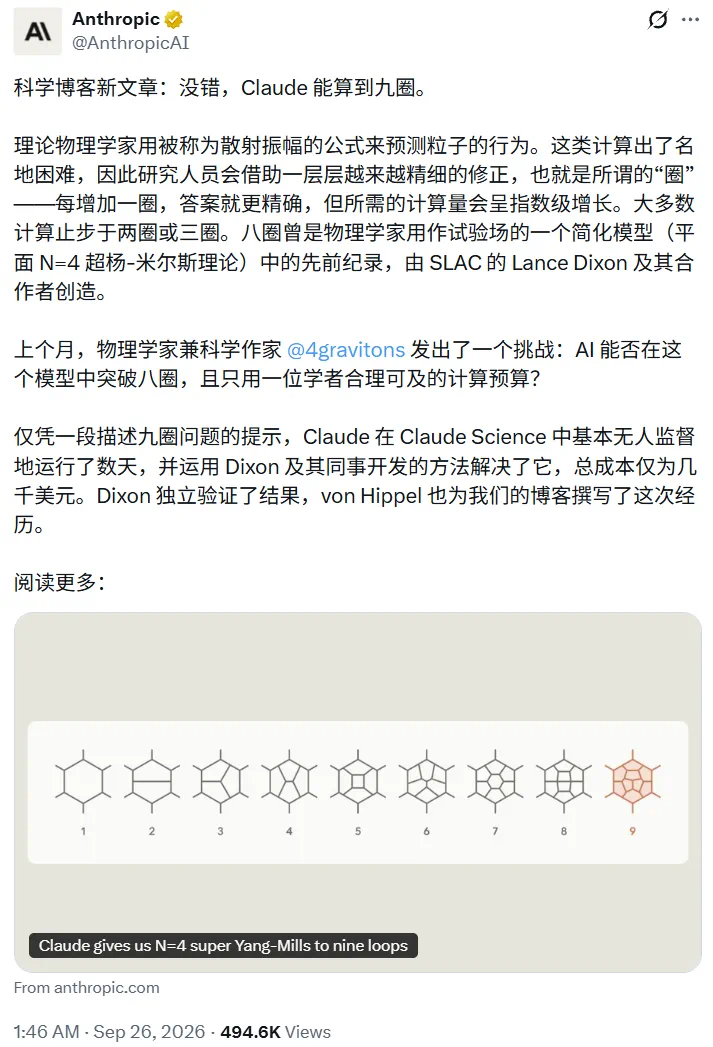
Anthropic's Claude computes nine-loop scattering amplitude, breaking three-year record
Anthropic announced that its AI model Claude, running nearly unsupervised on the Claude Science platform for several days, computed a nine-loop six-particle scattering amplitude in planar N=4 super-Yang-Mills theory, surpassing the previous eight-loop record set by Lance Dixon and collaborators in 2023. The result was independently verified by Dixon, who praised Claude's execution of the complex calculation. The computation cost roughly $1,000-2,000 for a regular user, with only about $100 for the numerical part, and was initiated by a public challenge from physicist Matt von Hippel.
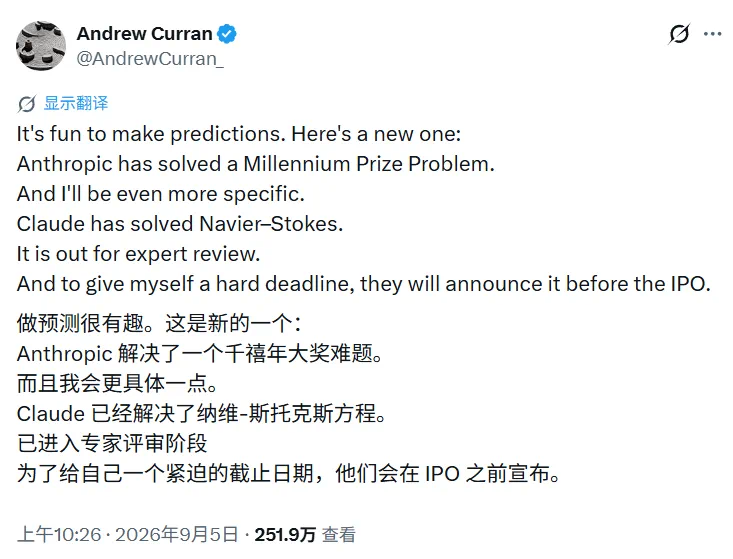
Rumor: Anthropic AI Solved Navier-Stokes? Tao Denies
A viral rumor claims Anthropic's AI solved the Navier-Stokes existence and smoothness problem, one of the Millennium Prize Problems. The rumor originated from a speculative post by blogger Andrew Curran, following mathematician Terence Tao's thought experiment about AI solving open math problems. Tao has denied having insider information, and no paper or proof has been publicly released.
2 reports · 2 sources
News updates every hour. Subscribe in your RSS reader to get new stories automatically.
Subscribe