Anthropic's Claude Fable 5.2 solves two open problems in black hole physics
Anthropic Research announced that Claude Fable 5.2 has solved two open problems in theoretical physics concerning black holes and quantum gravity. The first problem involved completing a calculation proposed over 20 years ago, showing that a sharp transition associated with black hole formation persists even when spacetime lacks a definite shape. The second problem involved finding the exact limit of a simplified version of a technique used to test candidate quantum gravity theories.
Coverage timeline
Anthropic Research
Claude Fable 5.2 has solved two open problems in theoretical physics. Both concern black holes and the search for a theory of quantum gravity.
机器之心ScienceAI
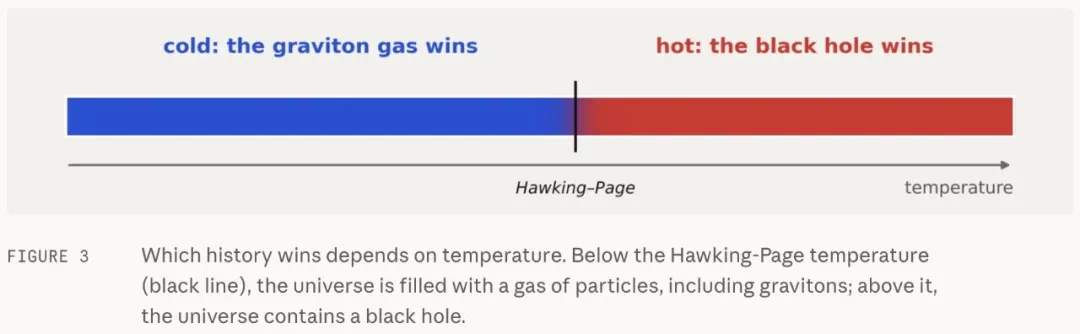
编辑丨cherry 现代物理学建立在两大框架之上:广义相对论和量子力学。广义相对论描述非常大的事物,比如恒星;量子力学描述非常小的事物,比如原子。两者在预测宇宙行为方面都出奇地出色,但它们在数学上互不相容。找到一个统一它们的理论,是物理学最大的目标之一。 「量子引力」是一个尝试融合二者的方向,旨在对引力场进行量子化描述。黑洞是一个天然的试验场,因为它们是相对论和量子力学都发挥作用的少数领域之一,它们将巨大的质量压缩在非常小的空间内。 最近,Claude 解决了理论物理学中两个开放性问题。两者都涉及黑洞以及对量子引力理论的探索。在第一个问题中,它完成了一项物理学家在 20 多年前提出但从未被解决的计算。Claude 的结果表明,与黑洞形成相关的突然转变即使在时空不再具有确定形状的情况下依然存在。在第二个问题中,Claude 找到了一种用于检验候选量子引力理论的技术的最简版本的精确极限。 研究准备 研究量子引力最有用的工具之一被称为全息对偶。真实宇宙有三个空间维度和一个时间维度,相对论将它们合并为四维时空。但研究量子引力的物理学家通常使用更简单的模型宇宙,以便更详细地理解它们。 全息对偶的基本思想是,其中一些理论宇宙可以用两种方式描述:作为一个具有引力和时空的完整宇宙;用完全不含引力的量子术语「书写」在宇宙的外边界上。 正如真实的全息图将三维图像编码在二维平面上一样,量子模型用少一个维度的方式编码宇宙的全部信息。例如,一个具有四个空间维度的宇宙可以完全由一个具有三个空间维度的量子理论来描述。这使物理学家能够将关于引力的难题转化为关于量子物理的问题,而后者有时更容易回答。 八月,Anthropic 的研究员 Hongbin Chen 作为副业项目测试 Claude 的能力。他要求 Claude 列出一份理论物理学中有趣的开放问题清单,特别关注黑洞和自举法(bootstrap method)。Claude 数小时后带回了 22 个候选问题,Hongbin Chen 设立了独立的智能体来处理每一个问题;它们可以阅读彼此的进度帖,并在处理相关问题时协作。这些智能体在后台运行,没有特殊设置,持续了大约六周。 问题一:霍金 - 佩奇相变 Claude 解决的第一个问题涉及当你加热这些理论宇宙之一时会发生什么。在低温下,宇宙充满粒子气体。高于某一温度时,则会形成一个黑洞。 1983
Related stories
Anthropic launches Claude Fable 5.2 and Mythos 5.2 with coding, reasoning, vision gains
Anthropic released Claude Fable 5.2 and Claude Mythos 5.2, flagship models aimed at complex technical work, with claimed improvements in coding, reasoning, vision, and communication. The models are priced at $8 per million input tokens and $40 per million output tokens, a 20% cut from 5.1, with a fast mode at $16/$80. During prerelease testing, the models formalized a proof of Fermat's Last Theorem in 30 hours, solved two open black hole physics problems, and scored 64.9% on the RoboDojo Sim benchmark, up from 27.6% for Fable 5.1.
14 reports · 7 sources916 points · 1051 comments

Mysterious startup PSI claims AI-assisted proofs for 5 open quantum problems
Physical Superintelligence (PSI), a company publicly launched on September 1, 2026, announced AI-assisted solutions to five open problems in quantum information theory, drawn from the Open Quantum Problems (OQP) directory established by Reinhard Werner in 1999. The problems span entanglement distillation, quantum field theory, high-dimensional quantum communication, quantum channel capacity, and quantum causality, with papers, Lean formal proofs, and verification code posted on GitHub for review. Three of the problems (OQP 2, OQP 12, OQP 27) date from the early 2000s, and PSI claims this is its first achievement toward building 'the world's most advanced physics research laboratory'.

Leaked Azure entries hint at Anthropic's Claude Fable 5.5 and next-gen Opus
Screenshots from Azure's model catalog and user tests suggest Anthropic is preparing two new Claude models: Fable 5.5 and a next-generation Opus, possibly launching as soon as next week. The Fable 5.5 entry briefly appeared in Azure's catalog, and benchmark tests show a model codenamed Obsidian 3 scoring slightly above the current Opus 5.5. The leaks come amid Anthropic's upcoming IPO.

OpenAI claims disproof of Exponential Time Hypothesis, plus math and physics results
OpenAI announced three new discoveries in mathematics, computer science, and physics, including a claimed disproof of the Exponential Time Hypothesis (ETH), a conjecture widely believed for nearly 30 years. The results cover local smoothing for the Euclidean wave equation, the Kakeya conjecture in four dimensions, and a rigorous mathematical existence proof for four-dimensional quantum field theories including quantum chromodynamics. External experts guided the results, and materials were released on GitHub for verification.
5 reports · 5 sources1153 points · 701 comments

News updates every hour. Subscribe in your RSS reader to get new stories automatically.
Subscribe