Chinese AI outlet surveys divergent world model definitions from Li, LeCun, Zhu
A Chinese AI outlet surveyed competing definitions of world models from Fei-Fei Li, Yann LeCun, and Jun Zhu, noting the term lacks consensus in 2026. Li's World Labs categorizes models as renderers, simulators, and planners; LeCun advocates learning predictable world structures in abstract latent spaces; Zhu's framework defines core capabilities from first principles and proposes a five-level roadmap.
Coverage timeline
机器之心机器之心
编辑|杨文 2026 年,「世界模型」是 AI 圈最没有共识的词之一。 一段能够连续生成的视频,被叫作世界模型;一个随键鼠操作实时变化的数字环境,也被叫作世界模型;在潜空间预测未来状态的系统,以及直接输出机器人动作的策略,同样使用这个名字。 这些模型都在处理世界的信息,能力边界却相去甚远。生成视频里的画面可以足够逼真,却违背真实的物理规律;机器人能够完成一次抓取,也可能只熟悉实验室里的物体、机位和动作轨迹。一个系统究竟学到了视觉相关性、物理结构,还是行动与结果之间的关系,仅靠 Demo 很难回答。 概念混乱增加了技术判断的难度 。画质、几何精度、预测能力和任务成功率被混在一起比较,不同团队看似争夺同一赛道,实际回答的可能是不同问题。 因此,世界模型研究开始回到一个基本问题,模型需要具备哪些能力,才能从生成内容走向理解并改变世界? 李飞飞和 World Labs 按功能将世界模型分为渲染器、模拟器和规划器,分别输出像素、世界状态与动作。 链接:https://www.worldlabs.ai/blog/taxonomy-of-world-models LeCun 则主张在抽象潜空间中学习可预测的世界结构,让模型保留对理解、推理和规划有用的信息。 链接:https://ai.meta.com/research/vjepa/ 清华大学朱军给出了第三个角度。早在去年 12 月 Motus 发布时,他就公开阐述「通用世界模型」整体构想,今年 3 月,他又将其定位为连接数字世界与物理世界的基础。几个月后,朱军及团队在论文《General World Models from First-Principles》中进一步完善这套框架, 从第一性原理定义核心能力,并给出一张五级进化路线图 。 论文链接:https://www.shengshu.com/assets/gwm-principles-and-roadmap.pdf 技术报告:https://www.shengshu.com/zh/general-world-model/ 论文将通用世界模型的核心能力归纳为 理解、想象和行动 。模型需要从历史观测中形成对当前世界的判断,推演不同选择可能产生的未来,采取行动,再用新观测修正自身。 沿着这一框架,视频生成、实时交互、潜空间预测和机器人控制可被视为同一条能力路线上的不同阶段。 世界模

Related stories
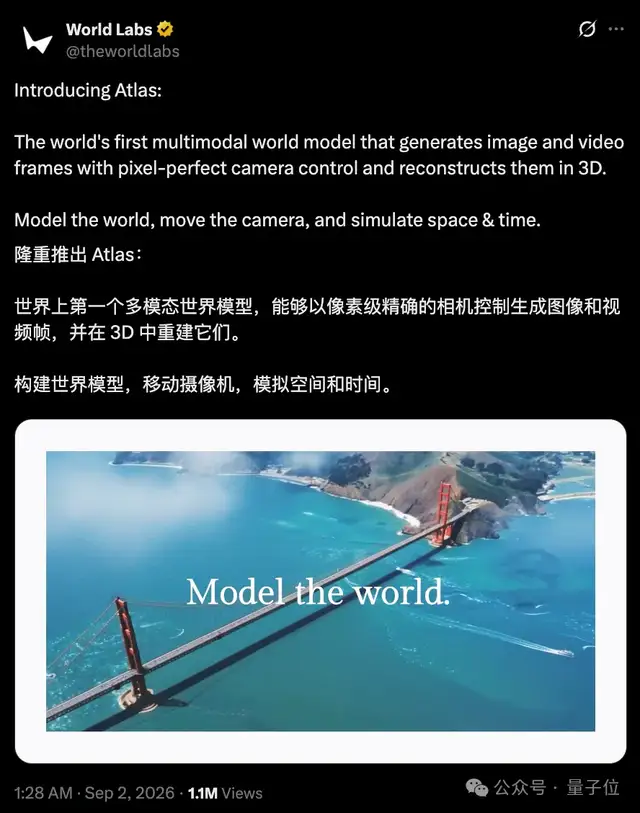
World Labs unveils Atlas, a multimodal world model with pixel-level camera control and 3D reconstruction
World Labs, founded by Fei-Fei Li, released Atlas, described as the world's first multimodal world model. It generates images and videos with pixel-level camera control, reconstructs 3D scenes from one to dozens of images, and supports spatiotemporal simulation for robotics and VFX. Atlas is trained from scratch on text, image, video, and 3D data, and is currently available to select partners, not open-sourced.
3 reports · 3 sources
PlayWorld benchmark evaluates world models via agent players on long-horizon goals
Researchers from HKU, CUHK, Zhejiang University, and Kuaishou Keling introduced PlayWorld, a benchmark that evaluates world models by having an agent player interact with them over long-horizon objectives, observing geometric consistency, interaction correctness, and evolution plausibility. Unlike fixed action sequences, PlayWorld uses scene-related long-term goals, allowing the agent to adjust based on real-time observations. The evaluation set and code are open-sourced.
Kai-Fu Lee: China's open models close AI gap despite US chip curbs
In a Bloomberg Q&A, Kai-Fu Lee said Chinese AI companies are rapidly narrowing the gap with US rivals, aided by open-source models, despite years of US export restrictions on advanced chips. He also addressed AI's impact on jobs and the role of Chinese AI in developing countries.
1 reports · 1 sources
Chinese labs hold 9 of top 10 text-to-video models, Bloomberg reports
Bloomberg reports that Chinese AI labs account for nine of the top 10 text-to-video models ranked by Artificial Analysis, indicating growing global adoption and a potential advantage in developing world models. The report notes that new large language models such as Moonshot's Kimi K3 have dominated debates about China's AI ambitions.
News updates every hour. Subscribe in your RSS reader to get new stories automatically.
Subscribe