Zhizhi Innovation open-sources IQuest-Q1, 320B-param sparse MoE coding model
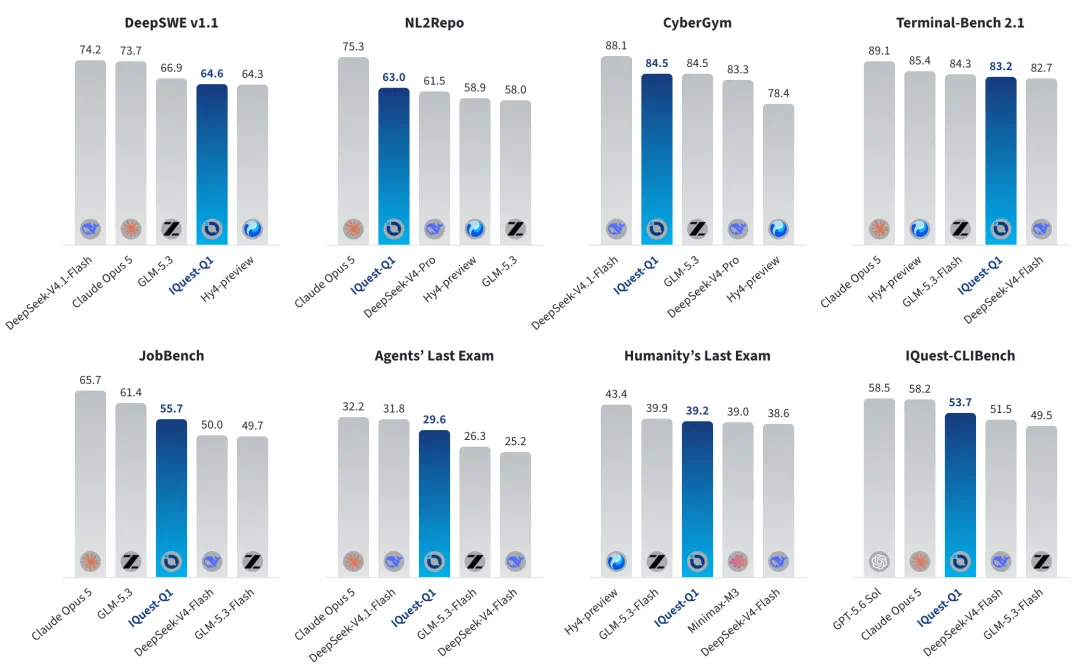
Chinese research institute Zhizhi Innovation released IQuest-Q1, a sparse MoE model with ~320B total parameters and ~15B active parameters, focused on coding, software engineering, and complex agentic tasks. The model shows balanced performance across benchmarks including NL2Repo, CyberGym, Terminal-Bench 2.1, DeepSWE v1.1, and JobBench, with weights and blog published on GitHub and Hugging Face.
Coverage timeline
机器之心机器之心
当 GPT-6 打出「抢着干活」的口号、Claude 把编程与终端操作牢牢按在自家腹地,开源阵营这半年也在同一条战线上加速集结 —— 从 Qwen 3.8、Kimi K3 到腾讯混元 Hy4,几乎每一次亮相都在把「代码 + 智能体」这条主线往前推一格。 一个共同的信号是:模型的价值锚点,正在从「答得漂亮」转向「干得成事」。 而在这大语言模型的红海中,一个新玩家正在悄然走入大家的视野。 我们观察到,就在昨天晚上,至知创新研究院开源了一个模型IQuest-Q1。模型采用稀疏 MoE 架构,总参数约 320B、激活参数仅约 15B,把训练重点放在代码、软件工程与复杂任务执行上,同时向推理、工具使用、长上下文理解与多步任务处理延伸。 在同代开源模型里,这是一个偏 "轻量" 的尺寸 —— 但从官方公布的评测和演示看,它给出的结果并不 “轻”。 模型权重与 Blog 已同步发布。 GitHub:https://github.com/IQuestLab/IQuest-Q1 Hugging Face:https://huggingface.co/IQuestLab/IQuest-Q1 Blog:https://iquestlab.github.io/ 榜单表现:小激活参数,均衡打法演示之外,跑分是另一把尺子 在涵盖代码、软件工程、终端操作、工具使用和复杂智能体任务的多项标准评测中,IQuest-Q1 整体呈现出较为均衡的表现 —— 没有靠单项极高分撑起成绩,各类任务上的能力分布相对完整。 具体到单项: 其中,IQuest-Q1 在仓库级代码生成NL2Repo以及网络安全基准CyberGym上得到了稳健的成绩; 并且在终端Terminal-Bench 2.1、代码长程任务DeepSWE v1.1、办公场景JobBench等复杂任务评测中展现出均衡的能力。 考虑到 15B 的激活规模,这份成绩单在推理成本上也留出了不小的空间。 从写游戏到修 bug,模型开始 "接活" IQuest-Q1 主打的是「可交付」—— 模型在任务过程中持续理解上下文、调用工具、处理反馈,最终交出一个可验证的结果,而不是一段停在编辑器里的代码。 我们拿到了官方放出的几组任务演示,覆盖前端交互、3D 场景、训练调试与真实工作环境,基本能勾勒出这款模型的能力边界。 在前端场景,用户一句自然语言指令下去,模型直接吐出
Related stories
Open-Source 5B Image Model MOSS-Image Hits 1.3M Downloads in 4 Days
MOSS-Image, an open-source 5B-parameter image generation model from Mosi AI and OpenMOSS, gained over 1.3 million downloads within four days of release, topping Hugging Face's text-to-image trend chart. Developers praised its natural look, attributing it to training data that excludes AI-generated images, and quickly created accelerated versions, quantized formats, and LoRA adaptations.
1 reports · 1 sources

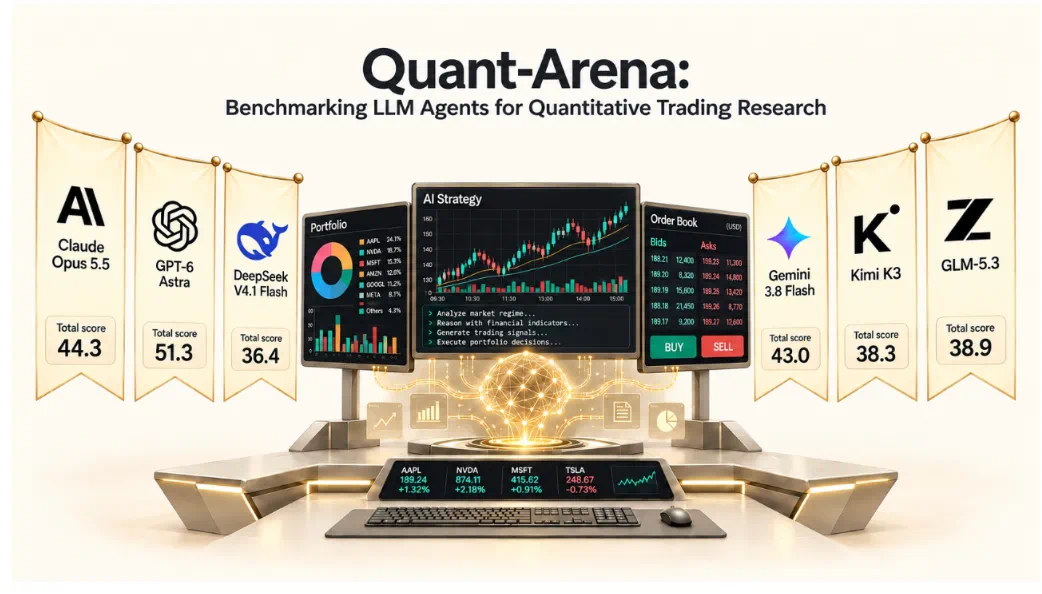
EinsiaAI's Quant Arena benchmark: most LLMs lose money on A-share trading
EinsiaAI's Navers Lab released Quant Arena, a benchmark testing nine models from six frontier model providers on A-share quantitative trading using real historical data from 2022-2023 and sealed 2024 market data. Only GPT series and Claude Opus 5.5 achieved profitability; the top scorer GPT-6 Astra posted 10.7% annualized return, below the 17.1% market benchmark. The study highlights that better market prediction does not necessarily translate into higher returns.
1 reports · 1 sources
Fudan, Tencent Hunyuan, Tsinghua Release ExplorationBench to Test AI Rule Discovery
Fudan University, Tencent Hunyuan, and Tsinghua University released ExplorationBench, a benchmark measuring how AI systems discover rules in unfamiliar environments. It includes two altered 'alien worlds'—the programming language AlienCode and the logic proof system AlienLogic—where models must learn rules through trial and error. Results showed that without environment feedback, scores remained low (max 11.0%), while autonomous exploration led to high scores (up to 89.0%).
Ant Group open-sources Ling-3.1-flash, a 560B-parameter MoE model with 1M context
Ant Group's Ling-3.1-flash, a 560B-parameter mixture-of-experts model with 25B active parameters and a 1M-token context window, was released open-source on October 15. The model targets long-horizon complex task execution, using a hybrid linear attention design with KDA layers and Gated MLA to manage computational costs on long sequences.
News updates every hour. Subscribe in your RSS reader to get new stories automatically.
Subscribe