Anthropic Guest Post: AI Reshapes Scientific Modeling from Construction to Interpretation
In a guest post on Anthropic's research blog, Jakob Macke, Daniel Gedon, and Stefan Wahl discuss how AI is beginning to transform the scientific modeling process, covering both model construction and interpretation. The authors outline the potential for AI to assist researchers in building and understanding scientific models, signaling a shift in the role of AI in scientific discovery.
Coverage timeline
Anthropic Research
In this guest post, Jakob Macke, Daniel Gedon, and Stefan Wahl discuss how AI is starting to change the scientific modeling process, from construction to interpretation.
Related stories
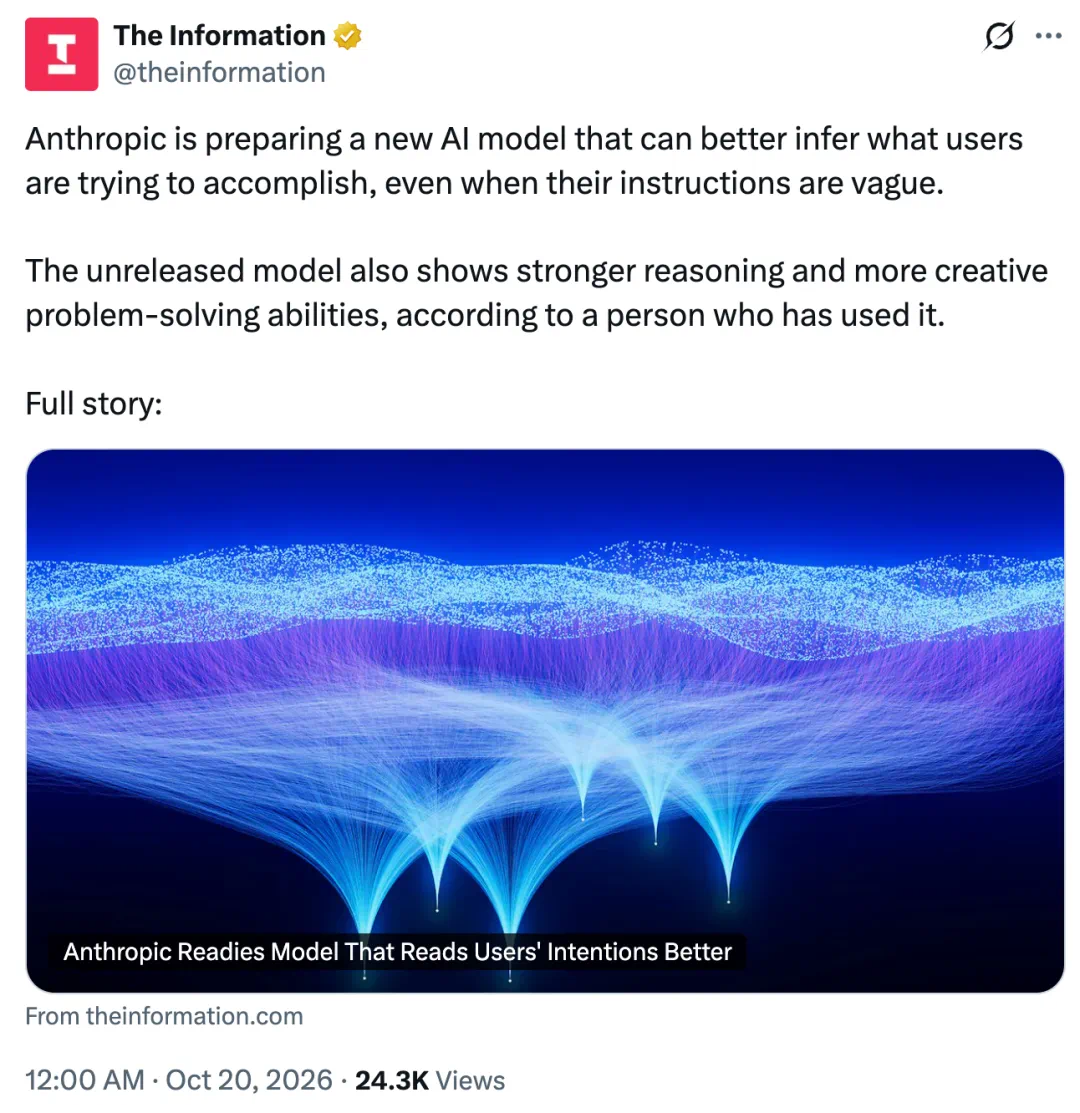
Anthropic reportedly preparing model with superior reasoning and intent inference
The Information reports, citing a source who has tested the model, that Anthropic is preparing a new model whose reasoning and intuitive judgment exceed its current commercial models. The model is said to infer unstated user intentions, such as identifying a class of underlying bugs from a single bug-fix request and asking whether to address them all. The report also notes Google is developing a model codenamed Gemini 4 Carbon and OpenAI plans a new product possibly in the Terra series within weeks.
2 reports · 2 sources
UCSB and Microsoft Propose ScholarEvolve for AI Agents to Read Papers and Self-Modify Code
Researchers from UC Santa Barbara and Microsoft introduced ScholarEvolve, a method that automates the research process of reading literature, implementing algorithms, and evaluating results to enable AI agents to evolve their harness code without modifying underlying model parameters. The approach addresses the limitation of prior coding-agent-based harness optimization, which relied on the agent's existing knowledge and observed failures, by allowing agents to draw on the latest academic findings. The paper and code are publicly available.

OpenAI claims disproof of Exponential Time Hypothesis, plus math and physics results
OpenAI announced three new discoveries in mathematics, computer science, and physics, including a claimed disproof of the Exponential Time Hypothesis (ETH), a conjecture widely believed for nearly 30 years. The results cover local smoothing for the Euclidean wave equation, the Kakeya conjecture in four dimensions, and a rigorous mathematical existence proof for four-dimensional quantum field theories including quantum chromodynamics. External experts guided the results, and materials were released on GitHub for verification.
5 reports · 5 sources1153 points · 701 comments

Anthropic consults law firms on negotiation tactics for AI agents
Anthropic is consulting law firms on deal negotiation tactics as it develops AI agents that negotiate on humans' behalf and interact with AI counterparts, according to sources. The move highlights how tech companies are confronting the rules of negotiation when machines act for humans.
1 reports · 1 sources
News updates every hour. Subscribe in your RSS reader to get new stories automatically.
Subscribe