Meta and academic researchers propose World-T³, a video world model with test-time training for long-term memory
Researchers from Meta Reality Labs, the University of Illinois Chicago, and Brown University propose World-T³, a camera-controllable video world model that uses test-time training to store historical observations in fast weights, keyed by camera pose, enabling consistent scene recall when revisiting locations. On a long-term revisit benchmark of 120 trajectories, it improves revisit PSNR from 13.52 dB to 18.31 dB and reduces absolute rotation error from 3.344° to 1.075°, while a 4-step distilled model runs at 20.6 FPS on a single NVIDIA B200 GPU at 1280×704 resolution.
Coverage timeline
机器之心机器之心
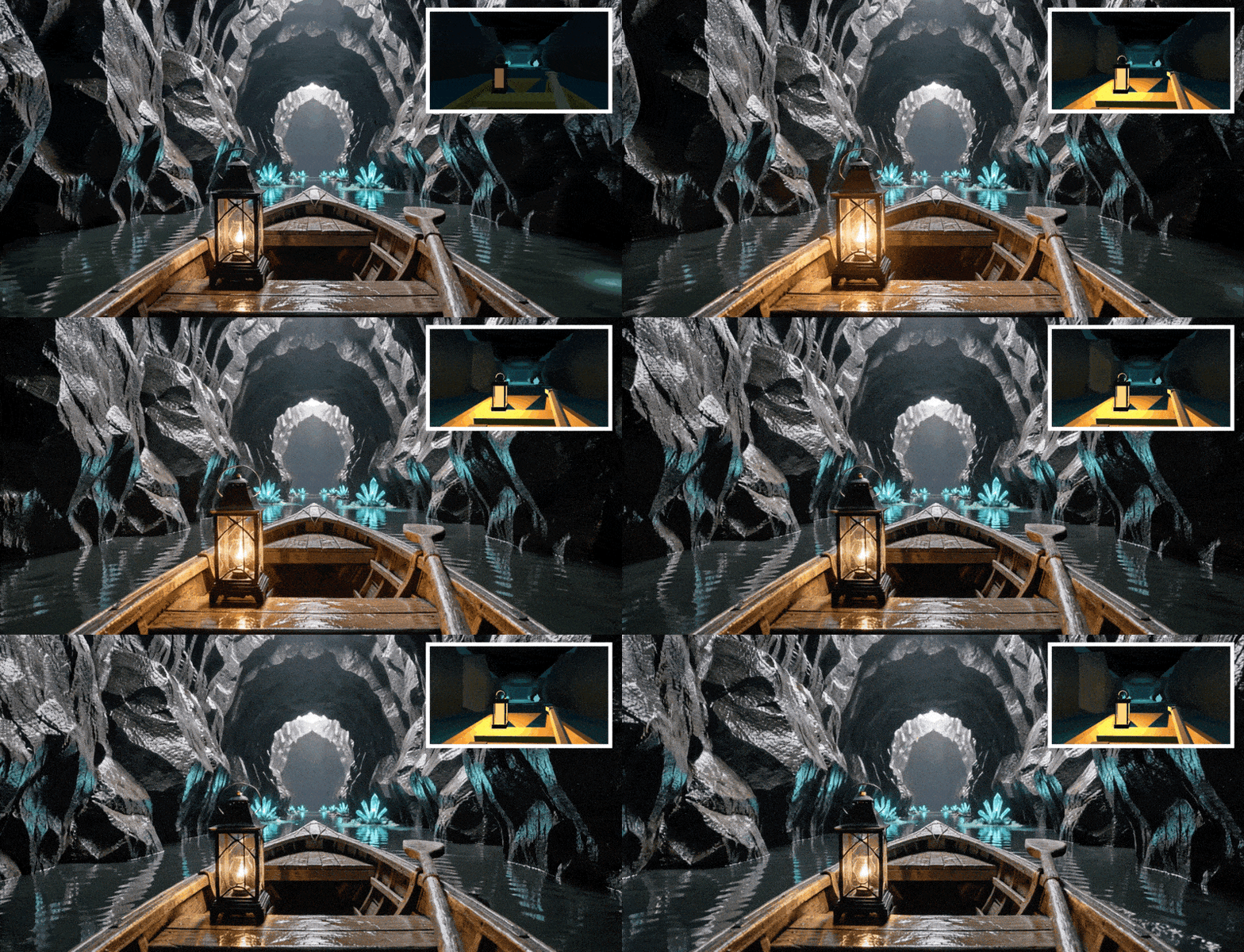
近两年,视频世界模型(video world model)成为生成式 AI 最受关注的方向之一。只需给定一张参考图和一段场景描述,模型就能根据用户输入的相机位姿或控制指令,逐帧生成出一个可以自由漫游的虚拟世界。但当交互从几秒钟拉长到几十秒,一个尴尬的问题就暴露出来:模型会失忆。自回归视频扩散模型在局部总能保持连贯,可一旦之前看到的画面滑出了注意力上下文窗口,模型就只能依靠生成先验重新脑补。 最近,来自 Meta Reality Labs、伊利诺伊大学芝加哥分校和布朗大学的研究团队提出了 World-T³(Test-Time Training)。World-T³ 是一个相机可控的视频世界模型,它在生成过程中通过测试时训练,把滑出上下文窗口的历史观测按相机位姿写进一组专用的快速权重(fast weights);当相机回到曾经到过的位置,模型再以位姿为钥匙,把当时的场景特征读出来。 在一个包含 120 段「去程 + 原路返回」轨迹的长时重访基准上,World-T³ 把重访 PSNR 从最强基线的 13.52 dB 提升到 18.31 dB,把绝对旋转误差从 3.344° 降到 1.075°。与此同时,经过双教师蒸馏的 4 步模型在单张 NVIDIA B200 GPU 上以 1280×704 分辨率跑出 20.6 FPS,生成过程中记忆也在实时更新。与 Matrix-Game 3.0、HY-World 1.5、DreamX-AR、LingBot-Fast、SANA-WM 等视频世界模型相比,4 步的 World-T³ 在全部 6 项重访一致性指标上均排名第一。 当相机回到之前到过的位置时,World-T³ 能忠实还原场景;而现有自回归基线(以 SANA-WM 为例)会遗忘上下文窗口之外的内容,重新合成出不同的场景。 本文共同第一作者为吴俊毅(Junyi Wu)和李泽坤(Zekun Li),该工作完成于两位共同第一作者在 Meta Reality Lab 实习期间,项目负责人为 Meta Reality Lab 资深研究员黄悉偈(Xijie Huang)。吴俊毅(Junyi Wu)现为伊利诺伊大学芝加哥分校计算机科学四年级博士生,研究方向是计算机视觉与具身智能;李泽坤(Zekun Li)现为布朗大学

Related stories
VAST open-sources EdenLive real-time world model, 24+ FPS at 720P on consumer GPU
VAST released and open-sourced EdenLive, a real-time world model that generates interactive visuals at over 24 FPS at 720P on a single Nvidia RTX 5090 consumer GPU. It supports arbitrary reference inputs, customizable art styles, and long-duration continuous generation, with end-to-end latency in the hundreds of milliseconds. The release includes model weights, inference code, a technical report, and an end-to-end demo.
1 reports · 1 sources
Fudan, Tencent Hunyuan, Tsinghua Release ExplorationBench to Test AI Rule Discovery
Fudan University, Tencent Hunyuan, and Tsinghua University released ExplorationBench, a benchmark measuring how AI systems discover rules in unfamiliar environments. It includes two altered 'alien worlds'—the programming language AlienCode and the logic proof system AlienLogic—where models must learn rules through trial and error. Results showed that without environment feedback, scores remained low (max 11.0%), while autonomous exploration led to high scores (up to 89.0%).
2 reports · 1 sources

MemTensor Releases MemT 1.0, Claiming First Memory-Native Open-Source Foundation Models
On October 20, 2026, Memory Tensor released MemT 1.0, a family of memory-native foundation models that encode historical information into continuously updated internal memory states, enabling parameterized memory to participate in subsequent generation. The release includes MemT-1.0-Flash (288B parameters, 17B active, 336M dynamic memory) and MemT-1.0-Nano (36B parameters, 3B active, 10M dynamic memory), with open-source checkpoints and a technical report, marking the first engineering validation of memory-native models at near-300B parameter scale. The approach integrates a parallel memory computation path alongside existing attention in selected Transformer modules, making memory a learnable capability of the model itself.
Microsoft unveils Maia 300 AI chip, claims 40% more tokens per megawatt
Microsoft announced its third-generation in-house AI chip, the Maia 300, built on TSMC's N2P process node and designed as the primary AI inference system for its products and services. The company expects the chip to deliver 40% more tokens per megawatt compared to leading GPU-based systems, with production rollout starting in 2027. Maia 300 racks will hold 96 chips using about 167 kW, and Microsoft plans multi-gigawatt deployments starting next year.
3 reports · 2 sources

News updates every hour. Subscribe in your RSS reader to get new stories automatically.
Subscribe