Recursive Self-Improvement Moves from Theory to Practice in 2026
In 2026, major AI labs disclosed concrete steps toward recursive self-improvement (RSI), a concept from I.J. Good's 1965 paper. OpenAI announced an automated research intern in September, Anthropic reported Claude leading 26% of its R&D, and Zhipu deployed an AI system that improves itself in production. These developments mark RSI's transition from philosophical speculation to measurable corporate KPIs.
Coverage timeline
机器之心机器之心
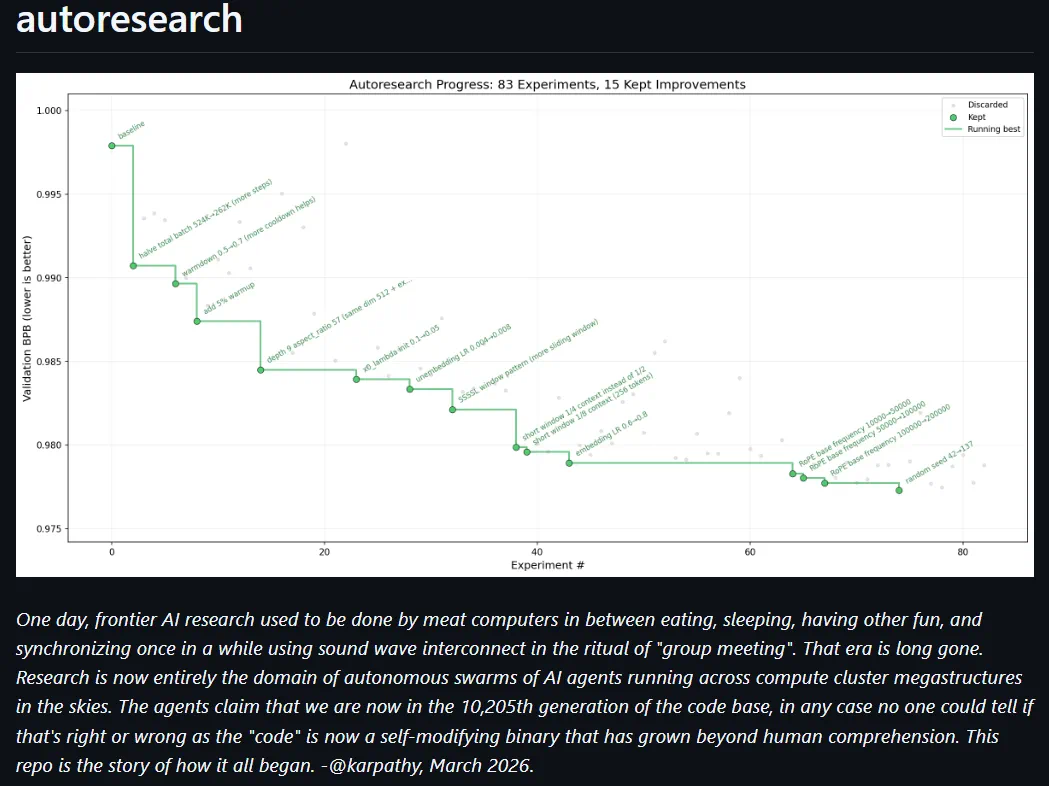
编辑|Panda 今年 3 月,Andrej Karpathy 在 GitHub 上开源了一个叫 autoresearch 的小项目。 README 的开头是一段「来自未来」的追忆:前沿 AI 研究曾经由「肉做的计算机」完成,它们要吃饭、要睡觉,偶尔通过「声波互联」在一种叫「组会」的仪式上同步一下进度。 如今,研究已经完全交给了在天空中巨型算力集群上奔跑的智能体群,据智能体们自己说,代码库已经迭代到了第 10205 代。没有人能判断这是真是假,因为「代码」早已变成一个超出人类理解的自修改二进制文件。Karpathy 写道,这个仓库讲的是「这一切是如何开始的」。 https://github.com/karpathy/autoresearch 这当然是个玩笑。但在 2026 年,这个玩笑正被一点点写进各家实验室的内部报表。6 月,Anthropic 发布长文《 When AI Builds Itself 》;9 月 6 日,OpenAI 宣布「自动化研究实习生」如期到岗;9 月 17 日,Anthropic 披露 Claude 已经「主导」公司 26% 的研发工作。同一天,智谱公开了国内大模型首个跑进生产环境的「AI 改进自身系统」实践。 这些消息共同指向一个在 AI 圈沉睡了六十年的词: 递归自我改进(Recursive Self-Improvement,RSI) 。 OpenAI 博客中对 RSI 的定义,https://openai.com/zh-Hans-CN/index/building-standards-next-phase-ai/ 一个六十年前的念头 今年成了 KPI 1965 年,英国数学家 I. J. Good 在论文《关于第一台超智能机器的推测》中写下了一个判断: 第一台超智能机器,将是人类需要做出的「最后一项发明」 ,前提是这台机器足够温顺,愿意告诉我们如何控制它。 逻辑并不复杂。 如果一台机器设计机器的能力强过人类,它就能设计出更好的机器,后者再设计出更好的机器,如此循环,智能便会「爆炸」。 此后几十年,这个设想主要活在哲学论文和科幻小说里。2000 年代,Jürgen Schmidhuber 提出过只有在能证明「改写对自己有益」时才动手改写自身的「哥德尔机」,但它更像一个优雅的理论构造,而不是一个能跑起来的系统。 2026 年,情
Related stories
UCSB and Microsoft Propose ScholarEvolve for AI Agents to Read Papers and Self-Modify Code
Researchers from UC Santa Barbara and Microsoft introduced ScholarEvolve, a method that automates the research process of reading literature, implementing algorithms, and evaluating results to enable AI agents to evolve their harness code without modifying underlying model parameters. The approach addresses the limitation of prior coding-agent-based harness optimization, which relied on the agent's existing knowledge and observed failures, by allowing agents to draw on the latest academic findings. The paper and code are publicly available.
2 reports · 1 sources

Recursive releases Flint, 40B coding model built largely by its Eureka Machine AI system
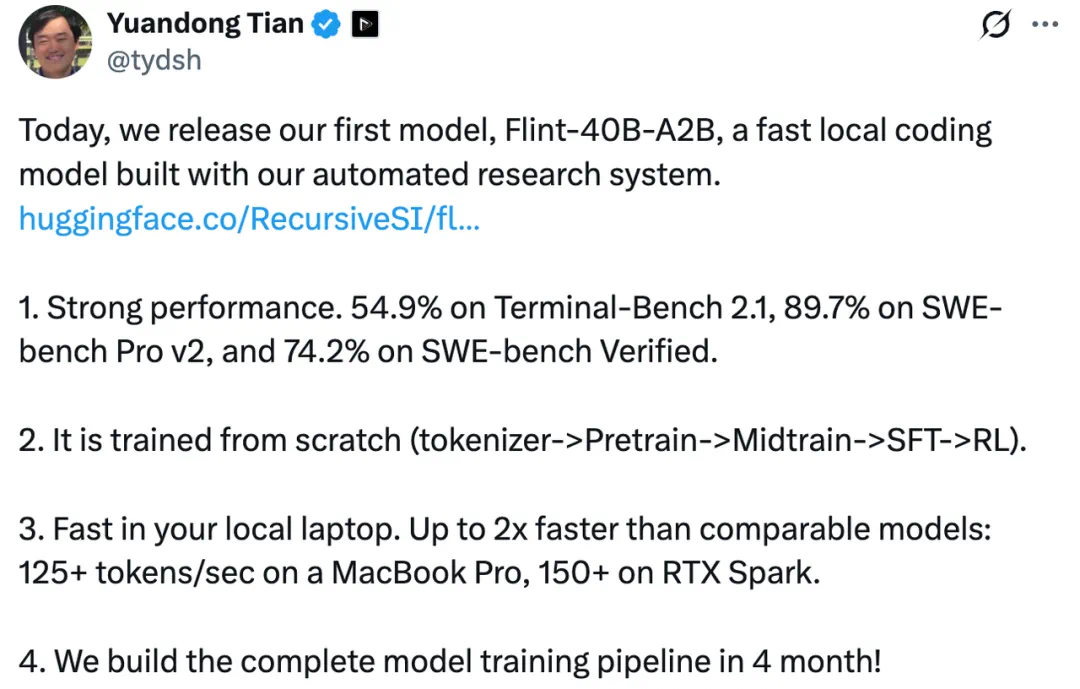
Startup Recursive has released Flint, an open-weight, 40B-parameter mixture-of-experts coding model with 2.5B active parameters per token, built in under four months with heavy automation from its Eureka Machine AI research system. The model outperforms sub-50B MoE models on coding benchmarks like SWE-Bench Pro v2 and runs at over 125 tokens per second on a MacBook Pro M4 Pro, with weights available on Hugging Face under Apache 2.0.
Hassabis: AGI expected in 2-3 years, revising earlier 2026 forecast
In a Wall Street Journal interview, Demis Hassabis said he expects artificial general intelligence (AGI) within two to three years, revising down his earlier 2026 prediction of three to five years. He also discussed AI's potential for advancing science, noting the technology's role in accelerating research.
1 reports · 1 sources
RSIGame framework lets AI agents self-improve in game development, beating one-shot GPT-5.5 output
Researchers from UC San Diego, ByteDance, and CMU propose RSIGame, an agentic framework that turns game development into a recursive self-improvement process, where agents playtest, diagnose, fix, and validate games iteratively. Experiments show RSIGame improves game quality scores from 50.26 to 64 starting from GPT-5.5-generated games, and accumulated experience can further train the underlying model.

News updates every hour. Subscribe in your RSS reader to get new stories automatically.
Subscribe