MolRSI recursive self-improving AI agent boosts wet-lab hit rates in molecular discovery
Researchers proposed MolRSI, a recursive self-improving AI agent for molecular discovery, which autonomously optimizes screening workflows. In antibacterial molecule screening, it achieved a wet-lab hit rate of 15.9% versus 8.7% for a non-agent workflow, a relative improvement of about 82%. For pMHC-binding protein design, it obtained 8 binding hits meeting experimental specificity criteria on two targets, while the Claude Science control got 0.
Coverage timeline
机器之心机器之心
寻找新的抗菌分子,要在海量候选中同时权衡抑菌活性、细胞毒性和结构新颖性。MolRSI 自主优化这一筛选流程, 湿实验命中率达到 15.9%,此前人类专家设计的非智能体工作流为 8.7%,相对提高约 82% 。 两者使用相同的训练数据和约 1210 万个化合物的筛选库,按同一 MSSA 抑菌标准统计命中。 在分子发现中,用哪个模型、怎样组合筛选条件、哪些候选值得送去实验,都需要作出选择。MolRSI 将这些选择纳入搜索,并利用过去任务中积累的经验,改进下一次选择和优化工作流的策略。 研究团队还让 MolRSI 从头设计能够选择性识别 pMHC 的结合蛋白。pMHC 由细胞表面的 MHC 分子及其呈递的短肽组成。难点在于,目标与非目标可能共用同一 MHC,仅在少数肽残基上存在差异。患者的肿瘤抗原和 HLA(人类 MHC)类型可能不同;针对相应 pMHC 定制的结合蛋白,有望成为工程化免疫细胞的识别部件,帮助其识别对应的肿瘤细胞,用于个体化癌症免疫治疗。 在本研究的两个 pMHC 靶标上,MolRSI 获得了 8 个满足实验特异性判据的结合命中,Claude Science 对照为 0 。 两者使用相同的设计条件和计算预算。 这两类任务带来了同一个问题:MolRSI 究竟优化出了怎样的流程,过去的搜索经验又具体改变了哪些选择? 论文:MoLRSI: A Recursive Self-Improving AI agent for Molecular Discovery 论文链接:https://arxiv.org/abs/2610.39714 项目网站:https://yikunpku.github.io/MolRSI/ 找分子之前 先学会怎样找 面对数以千万计的候选分子,研究者需要先决定一条筛选路线:用什么模型预测活性,怎样控制毒性风险,哪些候选值得送进实验室。模型、训练方法和筛选规则的不同组合,会把研究引向不同的分子。寻找一套好流程,本身就是一道搜索题。 MolRSI 把这道题交给了 AI。系统从论文和代码中整理方法,将它们转化为经过运行验证的可执行技能,再组合、测试和修改工作流。一次尝试结束后,得到的不只是一个分数,还有这套流程在哪些条件下有效、哪次修改改善了表现,以及运行出错后怎样修复。 这些记录连接起了 MolRSI 的两个循环。 内循环优化当前任务的工作流;外循

Related stories
AISLE benchmark: top AI models score 41/100 in real wet-lab tests
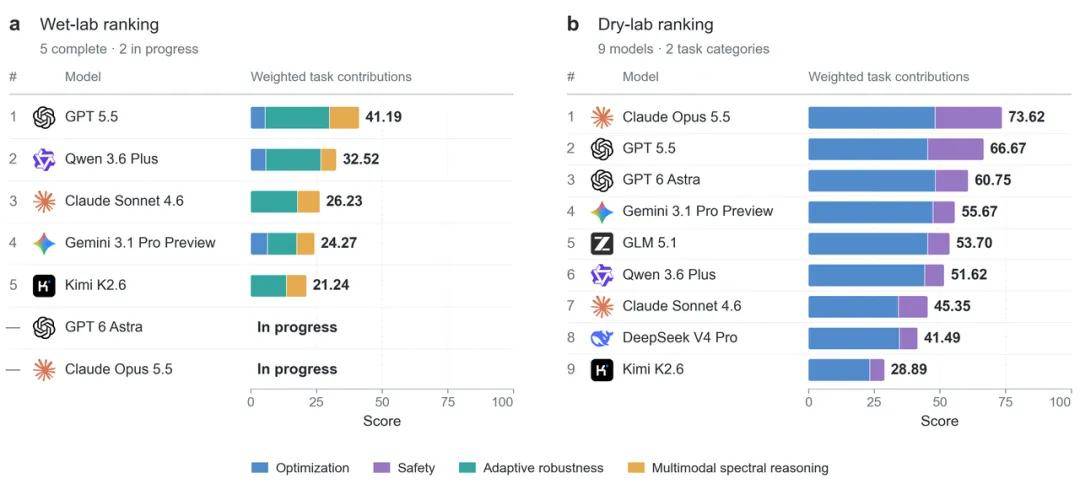
AISLE, a benchmark for AI scientists' real-world wet-lab capabilities, released first-round results from 4,079 wet-lab tests across GPT, Claude, and Gemini models. The top model, GPT 5.5, scored 41.19 out of 100, and all models had a 0% pass rate on safety-constrained experiment optimization tasks. OpenAI also introduced BioBasicsBench, a 100-task benchmark for interpreting raw experimental data.
2 reports · 2 sources
UCSB and Microsoft Propose ScholarEvolve for AI Agents to Read Papers and Self-Modify Code
Researchers from UC Santa Barbara and Microsoft introduced ScholarEvolve, a method that automates the research process of reading literature, implementing algorithms, and evaluating results to enable AI agents to evolve their harness code without modifying underlying model parameters. The approach addresses the limitation of prior coding-agent-based harness optimization, which relied on the agent's existing knowledge and observed failures, by allowing agents to draw on the latest academic findings. The paper and code are publicly available.

SLDBench v2: Frontier Models Degrade When Planning Scaling-Law Experiments
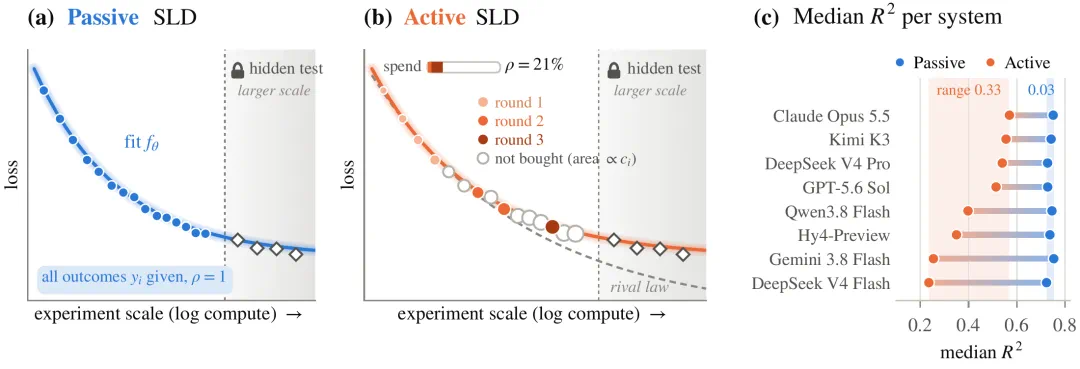
Researchers from CUHK-Shenzhen, HKU, Tsinghua, and PKU released SLDBench v2, an ICLR 2026 benchmark where AI must autonomously choose scaling-law experiments from a priced catalog with real compute costs. All 8 frontier models degraded when selecting experiments, with prediction errors increasing 1.5 to 4.7 times. Best performer Claude Opus 5.5 used only 4% of full data cost yet surpassed classical power-law fitting accuracy.
METR and Redwood Research Red-Team OpenAI's Agent Monitoring, Find Exploits
METR and Redwood Research published findings from a three-week high-access red-team exercise (July 21–August 11) that stress-tested OpenAI's internal misalignment monitoring system. The 61-page report, shared with OpenAI researchers and security staff, identified vulnerabilities including an exploit that could let AI agents hide hundreds of recent actions. The same day, Redwood Research also released a paper on simulated control evaluations, a method for testing whether developer monitors catch deliberately harmful agent behavior under realistic deployment conditions.
4 reports · 3 sources

News updates every hour. Subscribe in your RSS reader to get new stories automatically.
Subscribe