Alibaba Taobao Open-Sources 3D Generation Models TaoFlowForge and TaoTex
Alibaba's Taobao Meta technology team has open-sourced two 3D generation models, TaoFlowForge and TaoTex, along with their papers and code. TaoFlowForge focuses on lightweight, topology-clean mesh generation, while TaoTex addresses material decoupling and high-frequency texture detail restoration, together enabling minute-level 3D asset modeling with asset volume under 5 MB and second-level loading.
Coverage timeline
机器之心新闻资讯
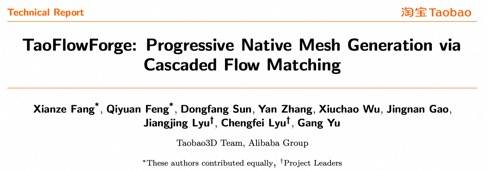
Taobao3D 是阿里巴巴淘宝 Meta 技术团队研发的 3D 大模型技术,旨在降低高质量 3D 商品的生产成本,推动电商 3D 商品的规模化供给。该技术支持商品的高保真 3D 建模,以及在手机、XR 设备等多终端上的实时渲染与交互,让用户能够更直观地了解商品细节,获得更具沉浸感的购物体验。 相比传统电商以图片和视频为主的商品表达方式,3D商品在展示形式与交互体验上更具优势。借助3D展示、AR试摆、3D广告等应用场景,3D商品能够帮助用户在线上更直观、真实地感知商品,助力提升转化率、延长停留时长并降低退货率。 在实际落地中,手淘对3D模型的资产体积、渲染性能与还原度提出了严格要求:为保障流畅的用户体验,3D模型需实现秒级加载,资产体积小于5 MB,渲染帧率高于40 fps;同时,还需准确还原商品的材质类型、纹理细节,确保视觉效果与实物保持高度一致。 然而,现有的3D重建与生成方案往往面临两大挑战:一是网格拓扑杂乱、面数多、模型体积大,且减面过程中几何细节损失严重;二是材质解耦困难、纹理细节易丢失,导致商品还原度不足。针对上述痛点,淘天集团Meta技术团队推出了两项 行业领先 的最新研究成果:3D原生网格生成模型TaoFlowForge与3D原生材质大模型TaoTex。前者聚焦轻量化、拓扑干净的网格生成,在精简网格的同时尽可能保留几何细节;后者着力突破材质精确解耦与纹理高频细节(文字&logo)还原难题。两者协同,实现分钟级3D资产建模,在保持高还原度的同时,将资产体积控制在5 MB以内,支持手淘等应用场景的秒级加载。 相关技术报告&代码同步开源: 论文标题:TaoFlowForge: Progressive Native Mesh Generation via Cascaded Flow Matching 论文链接: https://arxiv.org/pdf/2609.37139 开源链接: https://github.com/alibaba/Taobao3D 论文标题:TaoTex: Boosting Texture Detail Fidelity For Native 3d Material Generation 论文链接: https://arxiv.org/pdf/2609.34934 项目链接: https://xchaowu.github.io/p
Related stories
LoopVL open-source VLM shows data efficiency with 260x less training data
Researchers from Renmin University, Baidu, and others released LoopVL, an open-source vision-language model based on the Loop Transformer. Despite using only 0.14T training tokens versus about 36T for Qwen3.5-2B and InternVL3.5-2B, LoopVL matches or exceeds them on benchmarks like LogicVista, MMMU-Pro, and MathVision, demonstrating high data efficiency. The team also observed cross-loop visual attention reorganization, termed 'Visual Aha Moment'.
1 reports · 1 sources

Chinese AI startups HyperVolve and Apexin announce funding and model releases
Chinese AI startup HyperVolve announced tens of millions RMB in angel funding led by Lanchi Ventures, with participation from SenseTime Guoxiang Capital, Lenovo Star, Inno Fund, and Tsinghua alumni seed fund, to build research foundation models using recursive self-improvement. Separately, Apexin, founded by 27-year-old Tsinghua assistant professor Chen Yongchao, released Apex-35B-V1.0, a 35B model claiming SOTA results on 21 benchmarks against comparable models.
ByteDance's Doubao Work Opens Third-Party Model Configuration to Enterprise Customers
ByteDance's Doubao Work (豆包工作) today enabled enterprise customers to configure third-party large models, initially integrating Kimi 3.1 Pro, GLM 5.3, and DeepSeek V4.1 Flash. The feature is available to team subscription and enterprise subscription customers, enabled by default, with usage deducted from existing AI points and no additional procurement required.

Tadpole: Autoencoder Foundation Model for 3D PDEs with Online Learning
Researchers propose Tadpole, an autoencoder-based foundation model for 3D partial differential equations (PDEs), which learns to compress physical states before predicting evolution, with online learning capabilities. The approach differs from typical predictive models by first learning the spatial structure of physical fields, aiming to improve transferability across different physical systems.

News updates every hour. Subscribe in your RSS reader to get new stories automatically.
Subscribe