Tsinghua's ATW lets AI build runnable physics simulations from video, boosting reasoning accuracy
Tsinghua University researchers introduced Asking the World (ATW), a framework that enables AI to build runnable physical simulations from videos and answer physics questions via property queries, motion simulation, and conditional interventions. Using Gemini-3-Flash as the base model, ATW achieved 80.82% and 70.56% overall accuracy on the CLEVRER and ContPhy benchmarks, improving by 46.50 and 28.10 percentage points respectively over direct video-based answering. The method requires no additional training or fine-tuning and offers a more economical model choice than Astra.
Coverage timeline
机器之心机器之心
AI 能逼真地 “搭出” 一个世界,就能准确预测它如何运转吗? GPT-6 Astra 展现出的场景建模能力令人印象深刻。但几何与外观的逼真还原,并不意味着对物理规律的准确把握。 避免物体穿模、借助语义先验估计物理属性,与准确推演物体运动之间 ,仍有距离。后者还需要进一步识别质量、摩擦系数和阻尼等难以仅凭外观确定的属性与参数。 从还原外观到推演运动,AI 还要跨过一道 “物理关”。 清华大学团队提出的 Asking the World(ATW) 框架,让 AI 根据视频自主构建可运行的物理仿真世界,再通过属性查询、运动仿真和条件干预获取证据,回答物理属性、运动预测及反事实推理等问题。以 Gemini-3-Flash 为基座模型,ATW 在 CLEVRER 和 ContPhy 两项物理推理基准上的整体准确率分别达到 80.82% 和 70.56% ,相较于直接根据视频回答,分别提升 46.50 和 28.10 个百分点。 作为团队 PhysMind 的续作 ,ATW 继承了 “从视频恢复物理世界,再通过实验开展推理” 的思路,进一步让智能体决定如何建模、开展哪些实验,并将方法拓展至更多材料和物理场景。 这套方法无需额外训练或微调,也提供了更经济的模型选择:相比 Astra,Gemini-3-Flash 这类视觉语言模型的 调用成本低得多 。ATW 由视觉语言模型理解问题、选择操作,再由物理工具计算运动。 01|从视频恢复可执行的物理世界 ATW 的方法基础来自团队此前的工作 PhysMind。它从视频恢复几何、运动与物理参数,建立能够继续仿真,也允许修改条件的 “可执行世界”。 例如,移走视频中的球体,哪些碰撞仍会发生?原视频没有给出答案。PhysMind 会在重建场景中移除球体,重新运行仿真,依据轨迹和碰撞事件作答。 图 1:PhysMind 通过修改重建场景并运行仿真,为 “移走球体后哪些碰撞仍会发生” 提供判断依据。 要构建这样的世界,PhysMind 先识别物体、恢复形状与运动轨迹,再结合地面和支撑关系校正结果。物体滑行时的减速、碰撞前后的速度变化,则为估计摩擦和质量关系提供线索。 系统利用连续时间解析方法估计摩擦、质量比例和碰撞恢复系数等物理参数,使仿真尽可能符合观测。 这一过程称为 “系统辨识” 。同一段视频只需建模一次,后续多个问题便可复用。 图 2:P

Related stories
Fudan, Tencent Hunyuan, Tsinghua Release ExplorationBench to Test AI Rule Discovery
Fudan University, Tencent Hunyuan, and Tsinghua University released ExplorationBench, a benchmark measuring how AI systems discover rules in unfamiliar environments. It includes two altered 'alien worlds'—the programming language AlienCode and the logic proof system AlienLogic—where models must learn rules through trial and error. Results showed that without environment feedback, scores remained low (max 11.0%), while autonomous exploration led to high scores (up to 89.0%).
2 reports · 1 sources

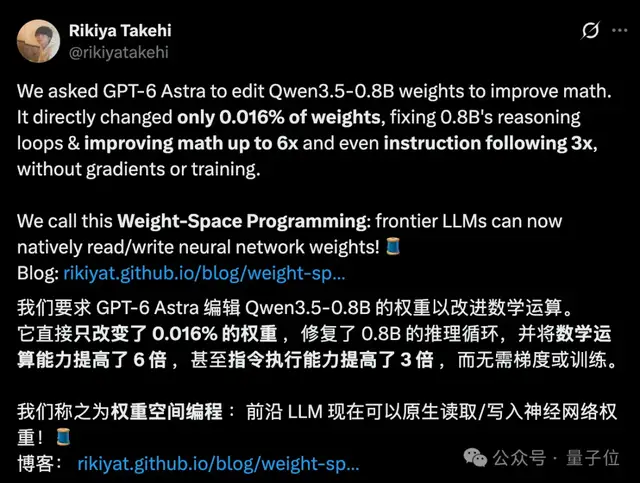
MIT: GPT-6 Astra edits Qwen weights, boosting MATH-500 from 7.9% to 48.1%
MIT CSAIL researchers demonstrated that GPT-6 Astra can directly read and modify the weights of Qwen3.5-0.8B, improving its MATH-500 score from 7.9% to 48.1% by altering only 0.016% of parameters, without training or gradient descent. The team named this capability Weight-Space Programming. However, spaCy author Matthew Honnibal publicly challenged the paper, arguing that the experimental conditions across the three claimed abilities differ significantly and that the presentation is misleading.
6 reports · 5 sources2949 points · 892 comments
UCSB and Microsoft Propose ScholarEvolve for AI Agents to Read Papers and Self-Modify Code
Researchers from UC Santa Barbara and Microsoft introduced ScholarEvolve, a method that automates the research process of reading literature, implementing algorithms, and evaluating results to enable AI agents to evolve their harness code without modifying underlying model parameters. The approach addresses the limitation of prior coding-agent-based harness optimization, which relied on the agent's existing knowledge and observed failures, by allowing agents to draw on the latest academic findings. The paper and code are publicly available.

Meta and academic researchers propose World-T³, a video world model with test-time training for long-term memory
Researchers from Meta Reality Labs, the University of Illinois Chicago, and Brown University propose World-T³, a camera-controllable video world model that uses test-time training to store historical observations in fast weights, keyed by camera pose, enabling consistent scene recall when revisiting locations. On a long-term revisit benchmark of 120 trajectories, it improves revisit PSNR from 13.52 dB to 18.31 dB and reduces absolute rotation error from 3.344° to 1.075°, while a 4-step distilled model runs at 20.6 FPS on a single NVIDIA B200 GPU at 1280×704 resolution.

News updates every hour. Subscribe in your RSS reader to get new stories automatically.
Subscribe