Nature explores 'Einstein test': AI confined to 1900 knowledge hints at light quanta
Nature reports on the 'Einstein test', proposed by Google DeepMind co-founder Demis Hassabis, which challenges AI to rediscover physics theories using only historical knowledge. Independent researcher Michael Hla trained GPT-1900 on 22 billion tokens with a knowledge cutoff of 1900, and the model produced a passage highly similar to Einstein's 1905 light quantum paper, though it failed most physics tasks.
Coverage timeline
量子位量子位
Nature:AI重生到1900,这一世抢先爱因斯坦提出光量子 henry 2026-09-19 19:36:11 来源: 量子位 AI能否提出相对论? 文婷 发自 凹非寺 量子位 | 公众号QbitAI 如果把AI送回1911年,只让它掌握爱因斯坦所能了解的知识,AI能否在4年后的1915提出相对论? 这个听起来有些离谱的测验,来自诺奖得主、Google DeepMind联合创始人 哈萨比斯 。 哈萨比斯真正想考的,是AI能不能仅以1911年的知识水平,直面当时的知识和物理难题,自己提出一套新的解释框架,并完成一套超出训练材料的推理,而不是只会照着答案复读。 如果能做到,他认为这将成为检验AGI的一项有力测试。 而这个设想最巧妙的地方就在于,科学史已经告诉我们发生了什么,只要我们能把知识节点控制好,就有机会对照着历史,观察模型有没有获得超越训练数据的推理能力。 Nature在文章中,还给这类测试起了个相当响亮的名字: 爱因斯坦测试。 更有意思的是,还真有人动手做了。 今年3月,独立研究者Michael Hla把知识截止时间进一步提前到1900年,并从零训练了一个历史语言模型 GPT-1900 ,试图让它重新发现光量子、狭义相对论和广义相对论。 实验中,GPT-1900竟然吐出了一段跟爱因斯坦1905年论文 高度相似 的论述: 光可能不是连续的,而是由许多彼此分离、频率不同的部分组成。 但这场实验最终并没有诞生一个“AI爱因斯坦”。 因为GPT-1900在大多数物理任务上都失败了,其亮眼回答也高度依赖人类整理好的问题和提示,就连那个号称封闭在1900年的知识世界,也没有完全挡住现代AI的影响。 Nature在最新研究中梳理了这些尝试,并指向了一个比“AI有没有答对”更难的问题: AI究竟能不能创造真正的新idea?以及它距离成为一名科学家,还差什么? 把AI关进1900年,它冒出了“光量子”的影子 220亿token,喂出一个“1900年的大脑” Michael Hla将自己的项目命名为 Machina Mirabilis 。 这个名字借用了爱因斯坦的 “奇迹年” 。 1905年,26岁的爱因斯坦接连发表4篇改变物理学的论文,涉及光量子、布朗运动、狭义相对论和质能关系。 这个爆发式产出的一年,后来被称为“Annus Mirabilis”,即“奇迹年”。 Hla想知道

Related stories
OpenAI claims internal model solved Navier-Stokes Millennium Prize problem in 88 hours
OpenAI announced that an unreleased next-generation model, described as significantly more capable than GPT-6 Astra, solved the Navier-Stokes existence and smoothness problem, one of the Clay Mathematics Institute's Millennium Prize Problems, using about 10,000 concurrent AI agents over 88 hours. The company released a 166-page proof and Lean 4 formal verification code, and said it would forgo the $1 million prize. The announcement has sparked controversy over alleged scooping and data use, with mathematician Tristan Buckmaster disputing OpenAI's account of negotiations.
7 reports · 5 sources178 points · 179 comments

OpenAI denies seeing math prompts, admits possible use of de-identified data
OpenAI has denied that its researchers or models saw prompts from mathematicians Buckmaster and Alpöge, but stated it cannot rule out that de-identified data from their product use helped improve its models. The denial follows accusations from mathematicians, including Andreas Thom, who publicly questioned the transparency of OpenAI's training data origins and whether researchers can trust the lab with unpublished results.
5 reports · 3 sources865 points · 813 comments

Google DeepMind offers Backstory AI image authentication tool to journalists and fact-checkers
Google DeepMind has released Backstory, an experimental AI image authentication tool, for testing by journalists, researchers, and fact-checkers. The tool aims to help verify the authenticity of images, addressing the challenge of false and misleading visuals on social media.
1 reports · 1 sources
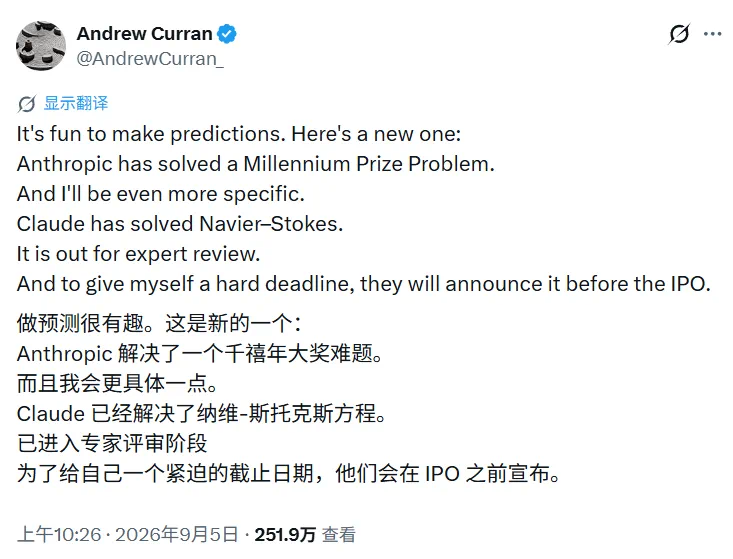
Rumor: Anthropic AI Solved Navier-Stokes? Tao Denies
A viral rumor claims Anthropic's AI solved the Navier-Stokes existence and smoothness problem, one of the Millennium Prize Problems. The rumor originated from a speculative post by blogger Andrew Curran, following mathematician Terence Tao's thought experiment about AI solving open math problems. Tao has denied having insider information, and no paper or proof has been publicly released.
News updates every hour. Subscribe in your RSS reader to get new stories automatically.
Subscribe