Xiaomi MiMo Team Details Tool-Call Repetition Fix in MiMo-V2.6
Xiaomi's MiMo team published a technical blog post on September 27, 2026, diagnosing and mitigating tool-call repetition in their MiMo-V2.6 model. The post shares lessons from scaling reinforcement learning, highlighting a 'reward blind spot' when optimizing for correctness.
Coverage timeline
小米 MiMo Blog
A lesson from scaling RL: the reward blind spot in optimizing for correctness.
Related stories
Xiaomi open-sources MiMo-V2.6 Pro and Flash; Pro tops open-weight leaderboard
Xiaomi's MiMo team released and open-sourced the MiMo-V2.6 series, including Pro and Flash omnimodal models, after a six-day livestreamed reinforcement learning training run that cost $3.5 million. MiMo-V2.6-Pro scored 46 on Artificial Analysis' Intelligence Index, tying Grok 4.7 and beating GLM-5.3, making it the top-scoring open-weight model on that benchmark; Xiaomi claims Pro performs on par with Opus 5 and GPT-5.6 Sol across most agent benchmarks.
4 reports · 3 sources
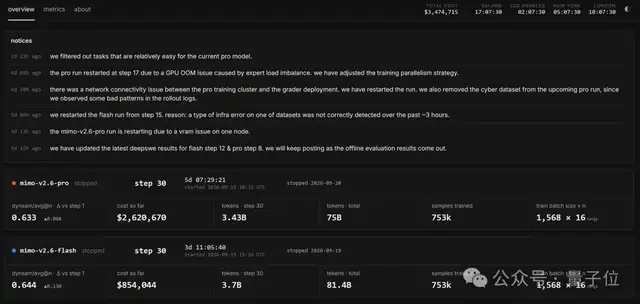
Xiaomi live-streams MiMo-V2.6 RL training, revealing costs and failures
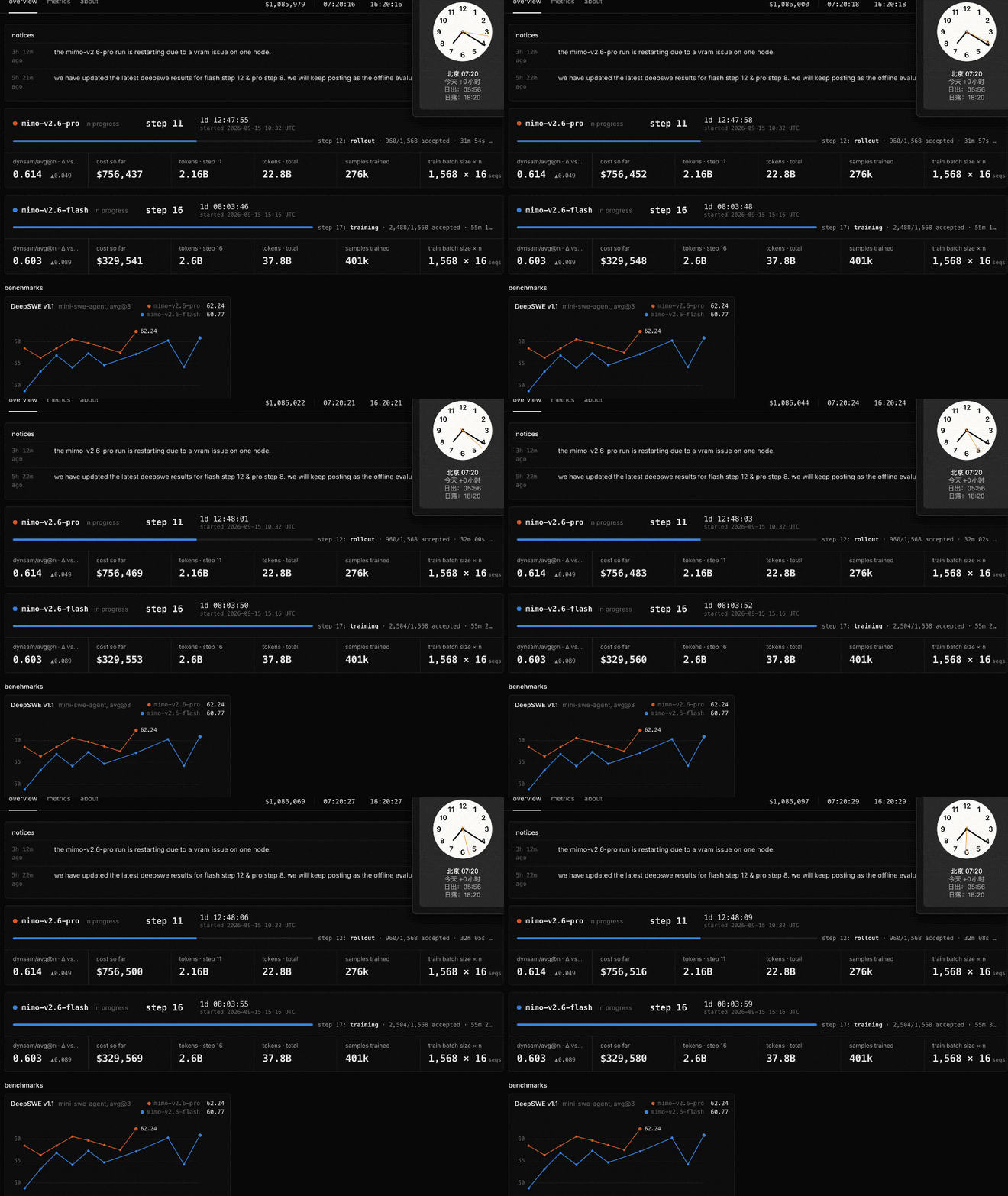
Xiaomi's RL lead Luo Fuli announced the company is live-streaming the reinforcement-learning training of its MiMo-V2.6 Flash and Pro models, publicly showing training costs, reward curves, and hardware failures. After about 36 hours, the two models have incurred over $1.08 million in costs, averaging $30,000 per hour. Early results show capability gains, with Pro's dynsam/avg@n rising from about 0.565 to 0.614 and Flash from about 0.514 to 0.603, and DeepSWE v1.1 offline scores of 62.24 and 60.77 respectively.
Tencent Hunyuan analyzes batch size impact on scaling RL training at 10K-100K GPU clusters
Tencent Hunyuan's team published a technical analysis on scaling reinforcement learning (RL) training for clusters of 10,000 to 100,000 GPUs, focusing on batch size tuning and scaling. They found that moderately increasing batch size with adjusted learning rates improves throughput, but at 16B batch size the additional sample cost outweighs the gains, slowing time-to-target.
2 reports · 2 sources

vLLM Blog Details Optimizations Behind 2.8x Throughput for Kimi K3 Serving
A vLLM blog post describes optimizations that achieve 2.8x throughput for serving Kimi K3, covering scheduling, KDA prefix caching, ReplaySSM state recovery, PD disaggregation and state offload, parallelism, MoE, and GPU kernels. The post details the technical approaches behind the performance gains.
1 reports · 1 sources
News updates every hour. Subscribe in your RSS reader to get new stories automatically.
Subscribe