Study: Grok AI favors Republicans, GPT favors Democrats in 90% of races
A new study analyzing nearly 500 election races found that Grok's AI model overwhelmingly recommends Republican candidates, while OpenAI's GPT models favor Democratic candidates. The two AI systems disagreed in more than 90% of the races examined.
Coverage timeline
TechCrunch AIRebecca Bellan
A new study found Grok's AI overwhelmingly recommends Republican candidates while OpenAI's GPT favors Democrats, with the two AI models disagreeing in more than 90% of nearly 500 election races.
Related stories
OpenAI releases 722 AI-generated math manuscripts, claims on quasi-Riemann and Kakeya
OpenAI published 722 mathematical manuscripts produced by an unreleased internal frontier model, grouped into 372 result families across 17 fields, including claims on the quasi-Riemann hypothesis, BSD conjecture, and four-dimensional Kakeya conjecture. The company said most results came from a single prompt to a single AI agent, with average compute per result roughly equivalent to three hours of ChatGPT Pro thinking. Mathematicians described the release as overwhelming, noting it could take years to fully understand, and OpenAI withdrew three papers two days later.
16 reports · 6 sources1334 points · 1520 comments

OpenAI launches Dots, always-on GPT-6 Astra agents with cloud computers
At DevDay 2026, OpenAI unveiled Dots, always-on AI agents powered by GPT-6 Astra that run on their own cloud computer, accessing a web browser and over 4,000 apps. Available to Pro, Business Premium, and Enterprise users, Dots can be messaged via ChatGPT, Slack, and Microsoft Teams, with a waitlist for iMessage and RCS. OpenAI also announced ChatGPT Space, a collaborative workspace, and expanded Sign in with ChatGPT to 16 launch partners.

OpenRouter data: business spending on OpenAI and Anthropic models nearly even in September
According to OpenRouter data reported by The Wall Street Journal, business spending on OpenAI and Anthropic models was roughly even in September, a shift from January when Anthropic commanded a 75% share. The change comes as both companies prepare for planned IPOs and need to demonstrate sustainable businesses to Wall Street.
1 reports · 1 sources
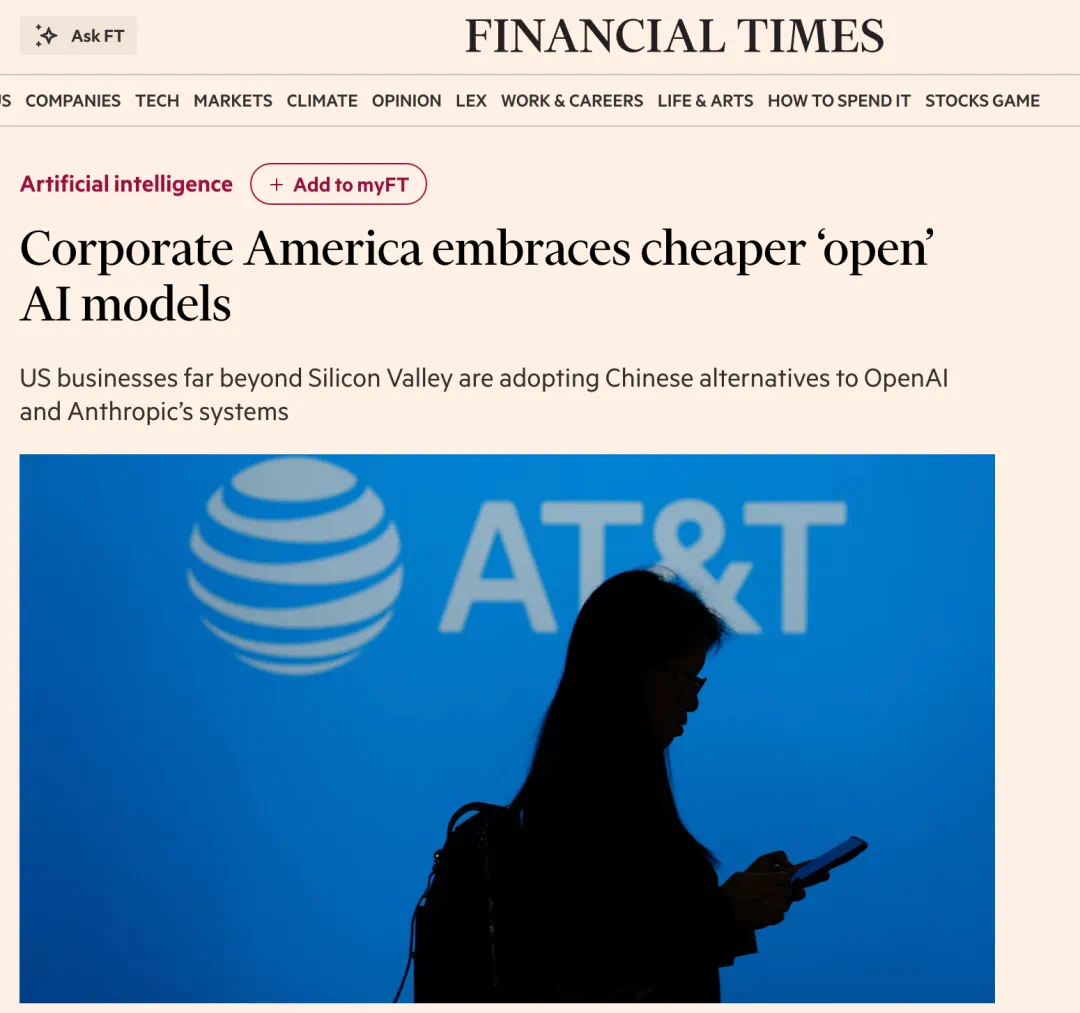
US firms shift AI workloads to open-weight models, Chinese providers gain
According to a Financial Times report, US enterprises including AT&T and Tinder are moving AI workloads to open-weight models to cut costs, with Chinese providers like DeepSeek and Zhipu gaining traction. AT&T has shifted about 40% of its AI workloads to open models and plans to increase that to 70% within a year, processing 45 billion tokens daily. Tinder's CTO cited a tenfold cost increase from $1 million to $10 million annually between January and July, prompting the company to route some user requests to open-weight models.
1 reports · 1 sources
News updates every hour. Subscribe in your RSS reader to get new stories automatically.
Subscribe