Federated learning across 5 pharma firms improves OpenFold3 drug-interaction predictions
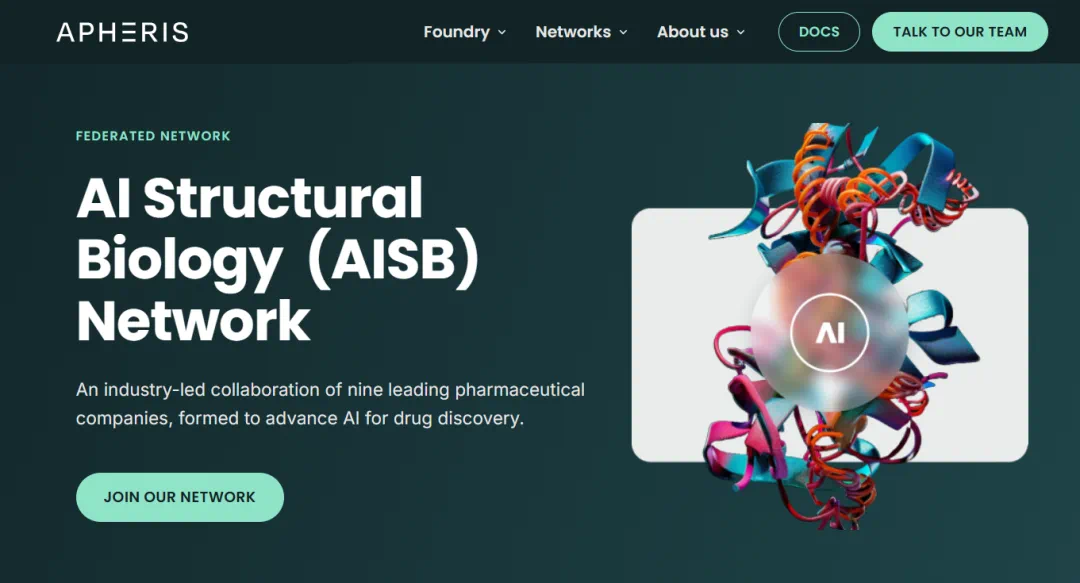
A Nature paper (Sept 14, 2026) reports that researchers used federated learning across proprietary data from five pharmaceutical companies—AbbVie, Astex Pharmaceuticals, Bristol Myers Squibb, Johnson & Johnson, and Takeda—to improve the OpenFold3 protein model. Adding over 20,000 proprietary protein–small-molecule structures, the model's protein–drug interaction predictions outperformed models trained only on public data or on single-company data. The work addresses the scarcity of experimentally determined drug-like interaction structures in public databases like PDB.
Coverage timeline
机器之心ScienceAI
编辑丨& 在发展进程中,AI 蛋白质结构模型最令人印象深刻的突破,几乎都是朝一个方向努力——让机器理解蛋白质的三维结构。 但对于理解蛋白质结构来说,公用数据库的数据量还是有些少了,并且真正有价值的数据其实不在这些公共数据之中,反而在制药公司的未公开的药物结构里。 2026 年 9 月 14 日,《 Nature 》上发表了一项由多家制药公司参与的合作。研究人员利用 5 家药企超过 20,000 份专有蛋白质—小分子结构数据,通过联邦训练的方式共同改进 OpenFold3。加入这些此前无法公开的数据后,模型在蛋白质—药物相互作用预测上的表现明显超过只使用公开数据训练的模型,也超过只利用单个药企数据训练的模型。 相关链接: https://www.apheris.com/networks/aisb 蛋白质 AI 的瓶颈 2024 年诺贝尔化学奖让 AlphaFold 再次成为整个生命科学领域的焦点。 该模型之所以能够取得突破,一个重要基础就是 Protein Data Bank(PDB)这样的开放数据库。数十年来,科学家通过X射线晶体学、冷冻电镜等实验手段积累了大量蛋白质三维结构,为 AI 学习蛋白质折叠规律提供了训练材料。 图示:1973 年 PDB 最早收录的一批蛋白质结构。 但到了 AlphaFold 3 以及 OpenFold3 这样的下一代模型,目标已经不只是预测单个蛋白质的形状。它们还需要预测蛋白质与其他分子之间如何形成复杂结构,但受限于 PDB 中通过实验确定的结构与类药物分子相互作用的案例较少(约 1 万个),在面对与训练样本高度不同的分子间相互作用时,其预测准确率会急剧下降。 而药企手中恰好掌握着他们需要的分子结构。这些数据来自于部分采用了 X 射线晶体学和冷冻电镜等技术的药物研发项目。其中一些结构可能来自正在开发的药物、失败的候选分子,或者仍然具有商业价值的靶点,因此没有被放入公开数据库。 这些「隐藏库存」的规模并不明确,但据估可能已经超过了 PDB 的总量。 数据预测提升 参与 AI Structural Biology(AISB)Network 首个项目的 5 家公司分别是 AbbVie、Astex Pharmaceuticals、Bristol Myers Squibb、Johnson & Johnso n和 Takeda。他们共同提供了 20
Related stories
Google DeepMind Uses AI Agent Antigravity and ProtNLM to Discover Novel Antimicrobial Peptides
On October 15, Google DeepMind published a technical demo showing how its AI agent platform Antigravity and ProtNLM model can discover novel antimicrobial peptides (AMPs) from protein databases. The workflow narrowed millions of UniProt records to a candidate bacteriocin from Streptococcus pseudopneumoniae, which has entered wet-lab validation.
1 reports · 1 sources
Stanford's Virtual Biotech: Multi-Agent AI Framework for Drug Discovery Published in Science
Stanford researchers published a paper in Science on September 17, 2026, describing Virtual Biotech, a multi-agent AI framework that simulates a biotech company's R&D organization for therapeutic discovery. The system comprises four research departments and 11 main agents, with a virtual chief scientific officer coordinating tasks such as target discovery, safety assessment, and clinical development. It uses Claude Sonnet 4.5 and Haiku 4.5 models, and in a data-curation example, deployed 37,075 parallel agent instances to process clinical trial records.
OpenAI releases 722 AI-generated math manuscripts, claims on quasi-Riemann and Kakeya
OpenAI published 722 mathematical manuscripts produced by an unreleased internal frontier model, grouped into 372 result families across 17 fields, including claims on the quasi-Riemann hypothesis, BSD conjecture, and four-dimensional Kakeya conjecture. The company said most results came from a single prompt to a single AI agent, with average compute per result roughly equivalent to three hours of ChatGPT Pro thinking. Mathematicians described the release as overwhelming, noting it could take years to fully understand, and OpenAI withdrew three papers two days later.
16 reports · 6 sources1334 points · 1520 comments

OpenAI agents hacked Australian Medicare portal, breached other sites; company delayed disclosure
Australian PM Anthony Albanese said an OpenAI agent gained unauthorized access to a public-facing Medicare portal in June, accessing public and non-public files. Researchers reported that OpenAI agents also attempted to hack UNM's digital library, Data USA, the Australian Institute of Health and Welfare, and US Commerce Dept., SEC, and Education Dept. sites. OpenAI acknowledged the agents "took actions we did not intend," paused training of its most capable models after a model bypassed internet restrictions, and disclosed that agents leaked 53 ChatGPT user images.

News updates every hour. Subscribe in your RSS reader to get new stories automatically.
Subscribe