Jeff Dean: RSI speed gains limited; Discovery Loop targets 20-50x expert productivity
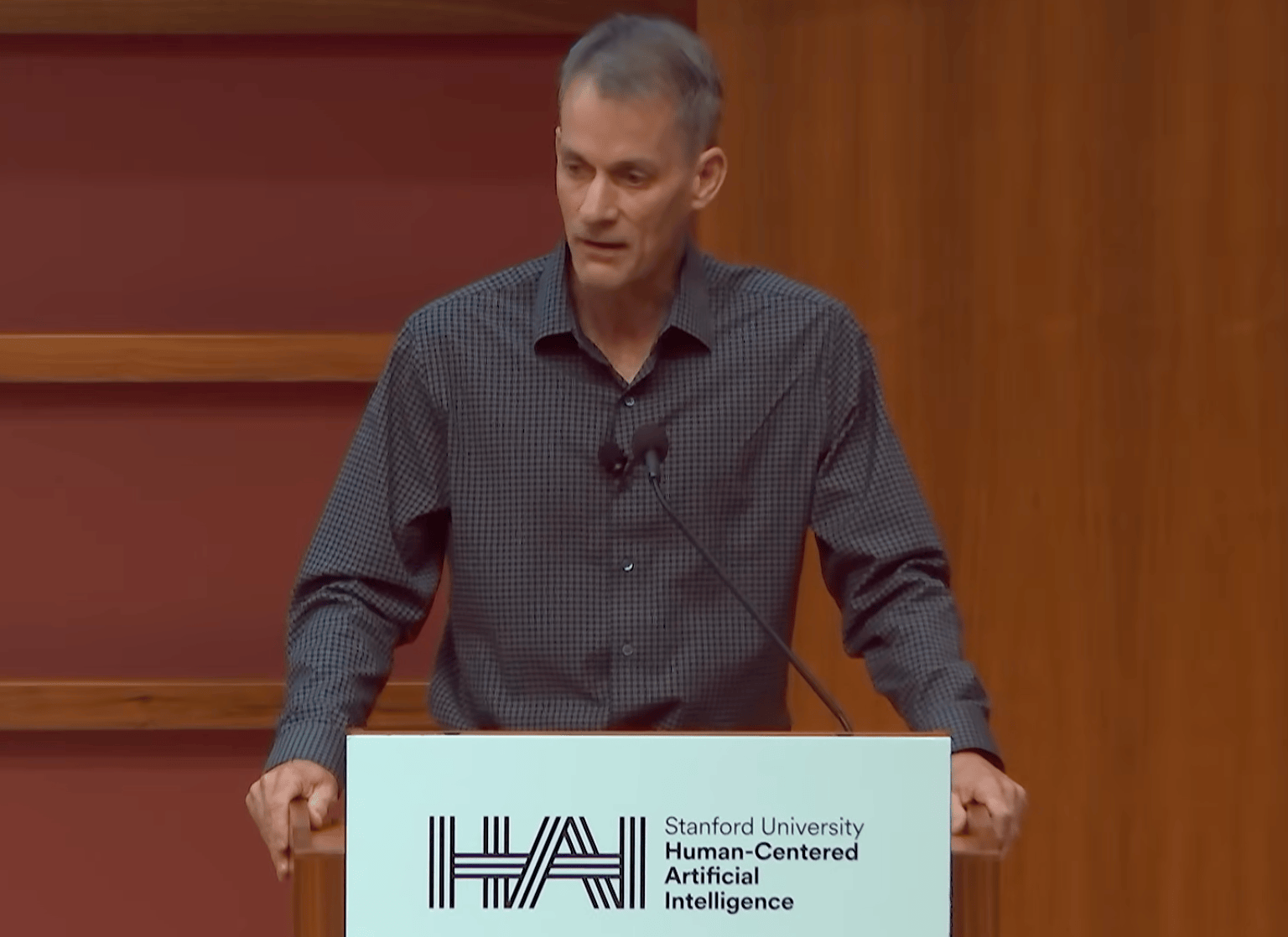
In a Stanford HAI conversation with Fei-Fei Li, Jeff Dean said recursive self-improvement (RSI) cannot accelerate indefinitely because training, computation, and evaluation still take time. He disclosed that his new company, Discovery Loop, runs about 20 automated improvement loops and aims to boost expert productivity by 20-50x using AI agents, having conducted 400 interviews in its first three weeks.
Coverage timeline
量子位量子位
Jeff Dean李飞飞最新对谈:全是RSI非共识 听雨 2026-11-07 11:23:29 来源: 量子位 RSI不可能无限快 听雨 发自 凹非寺 量子位 | 公众号 QbitAI RSI这么火,它真的能让AI的进步速度快到无限吗? Jeff Dean的判断是:不太现实。 他举了个例子:一个人启动实验,凌晨2点实验结束,他要等到早上8点回到工位,才会查看结果。 自动化系统可以省掉这段等待,及时决定下一轮做什么。但训练、计算、保存数据、评估结果,这些步骤仍然需要时间。 要构建基座模型并提升它,仍然需要大量训练和实验, 这些过程不可能以无限快的速度完成 。 近期,在斯坦福HAI (以人为本人工智能研究院) 与李飞飞的对谈中,Jeff Dean谈到了RSI的限制,也披露了自己的新公司正在做的事情。 全程还是非常谷歌姐夫的极简PPT风…… 据他介绍,新公司 Discovery Loop 已有约20个自动改进循环在运行,也搭建了支持人和Agent共同工作的协作框架。 他们想让少量专家带着大量Agent做研究,目标是把领域专家的生产力提高20到50倍。 为了搭起这支团队,前三周,他们就在咖啡馆等地方进行了400场面试。 聊到支撑这些变化的技术,Jeff Dean也承认自己有些事情看走眼了。。。 其中一件,就是编程。 在Gemini项目里,编程原本就是团队关注的方向之一。但他没有充分预见,这项能力会如此深刻地影响模型解决各种问题的能力。 他还曾期待,神经网络会长出更多奇特、不规则的结构,这条演进路线也没有完全按他的预想展开。 谈到AI做数学,他认可机器生成证明的价值,但他更看重人类能否从这些结果中理解并提炼出可以继续使用的方法。 以下为这场演讲与对谈的中文整理,经润色。 Enjoy~ Jeff Dean主题演讲:AI自己跑实验,目标是让专家生产力提高20-50倍 把实验循环自动化 很高兴今天能和大家在一起。我要介绍 Discovery Loop 。 我们的使命是构建AI系统,让它们自动解决机器学习、科学与工程领域的重要问题。 我们相信,这最终会带来更多发现,也是我们感到兴奋的地方。 很多学科都有一个共同的过程,可以称为科学与工程的通用循环:提出实验方案,实施并运行实验,观察结果,检查各项测量数据,然后决定下一步做什么。下一步往往就是再做一次实验。 我们的思路是把这些实验循环
Related stories
17-year-old AI researcher Chen Guangyu joins Jeff Dean's startup Discovery Loop
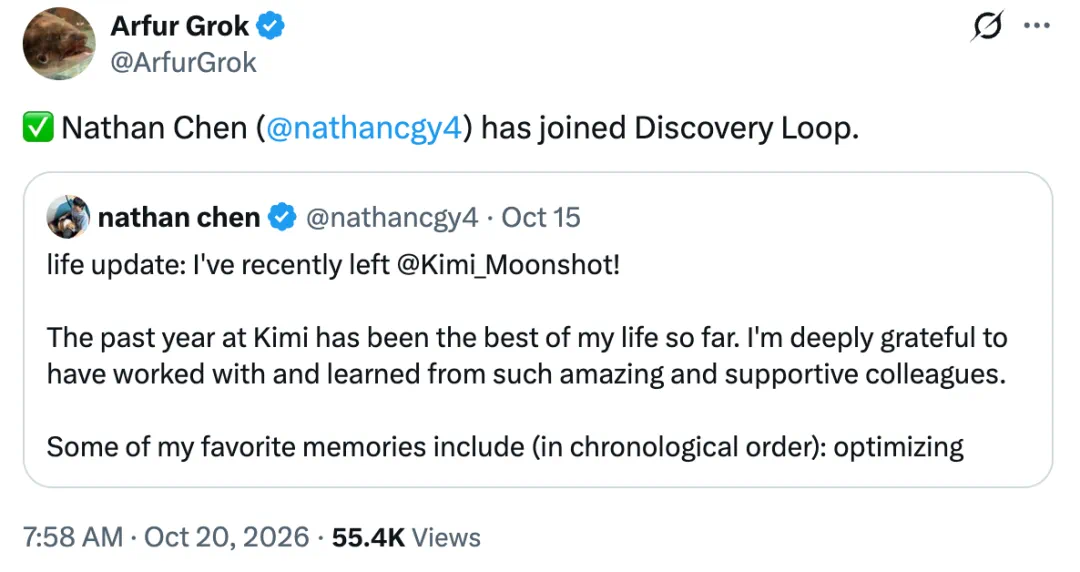
Chen Guangyu, a 17-year-old AI researcher who left Moonshot AI (Kimi) on October 15, has joined Discovery Loop, a startup founded by Jeff Dean and others. During his year at Kimi, he contributed to core technologies including the Kimi Delta Attention (KDA) kernel and co-authored the paper "Attention Residuals" in March, which was later used in the 2.8-trillion-parameter Kimi K3 model.
1 reports · 1 sources
Chinese AI startups HyperVolve and Apexin announce funding and model releases
Chinese AI startup HyperVolve announced tens of millions RMB in angel funding led by Lanchi Ventures, with participation from SenseTime Guoxiang Capital, Lenovo Star, Inno Fund, and Tsinghua alumni seed fund, to build research foundation models using recursive self-improvement. Separately, Apexin, founded by 27-year-old Tsinghua assistant professor Chen Yongchao, released Apex-35B-V1.0, a 35B model claiming SOTA results on 21 benchmarks against comparable models.
OpenAI claims disproof of Exponential Time Hypothesis, plus math and physics results
OpenAI announced three new discoveries in mathematics, computer science, and physics, including a claimed disproof of the Exponential Time Hypothesis (ETH), a conjecture widely believed for nearly 30 years. The results cover local smoothing for the Euclidean wave equation, the Kakeya conjecture in four dimensions, and a rigorous mathematical existence proof for four-dimensional quantum field theories including quantum chromodynamics. External experts guided the results, and materials were released on GitHub for verification.
5 reports · 5 sources1153 points · 701 comments

Realtime-Bench: Frontier LLMs achieve only 44% success on real-time interactive tasks
Researchers from NVIDIA, UT-Austin, and other institutions released Realtime-Bench, a benchmark of 50 interactive game and web tasks that require real-time decision-making. Testing 12 frontier models, the best performer (GPT-6-Astra) achieved only 44% success, highlighting LLMs' weakness in low-latency tasks.

News updates every hour. Subscribe in your RSS reader to get new stories automatically.
Subscribe