DeepSeek details DSec sandbox infrastructure for agentic training in Zhihu post and arXiv paper
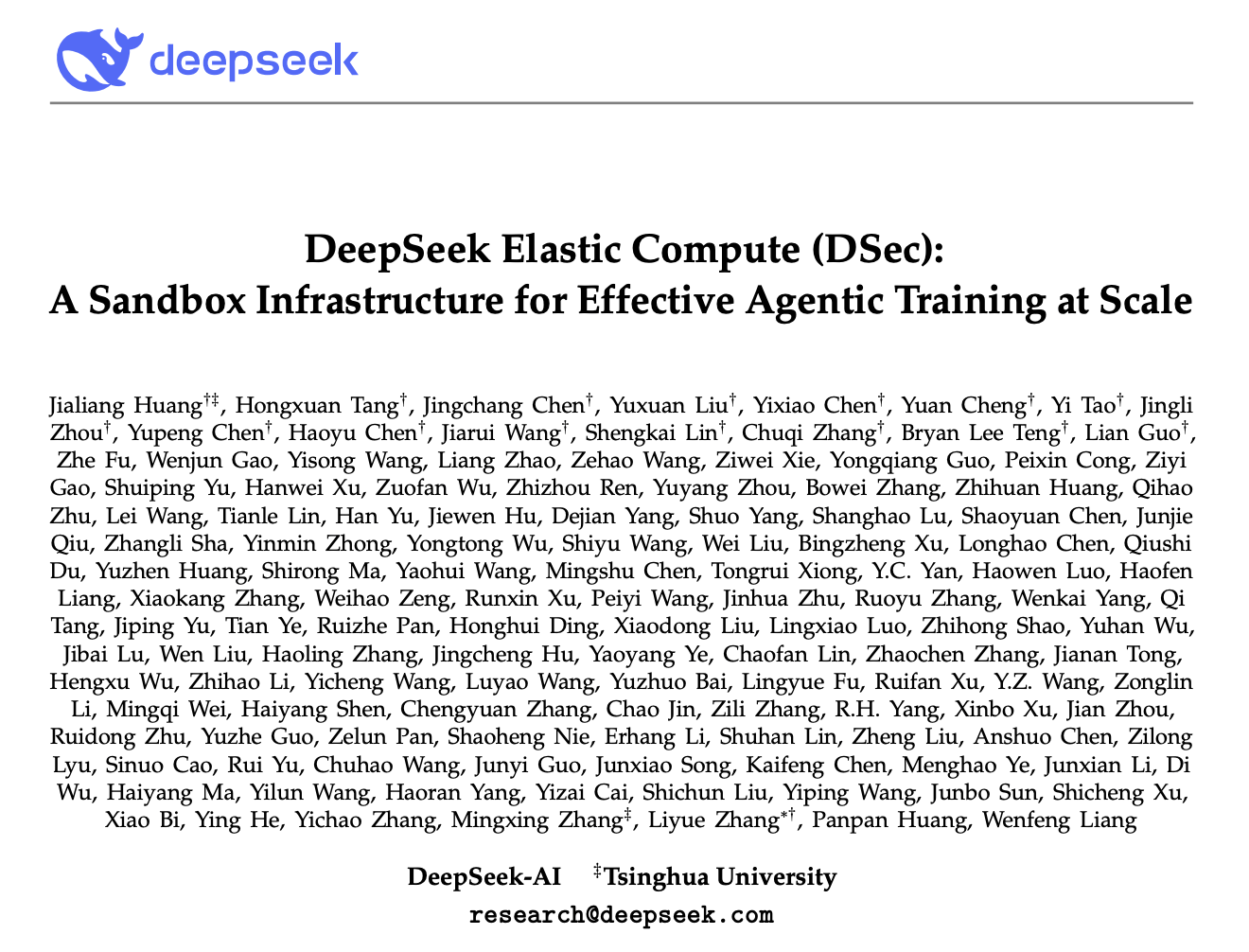
DeepSeek published a technical post on Zhihu detailing DeepSeek Elastic Compute (DSec), the sandbox infrastructure supporting all training, evaluation, and data preprocessing for DeepSeek-V4. The accompanying arXiv paper, co-authored with Tsinghua University and involving over 130 authors including Liang Wenfeng, describes DSec's design for agentic training workloads, including four execution backends (FnCall, Container, MicroVM, Full VM) accessed via a unified Python SDK (libdsec).
Coverage timeline
量子位量子位
DeepSeek知乎独家发文,首次公开V4.1 Agent训练“大本营”DSec 量子位的朋友们 2026-09-30 13:18:05 来源: 量子位 DeepSeek在知乎独家发布技术长文,首次系统阐释了DeepSeek弹性计算(DeepSeek Elastic Compute,DSec) 近日,DeepSeek在知乎独家发布技术长文,首次系统阐释了支撑DeepSeek-V4全部训练、评测与数据预处理流程的沙盒基础设施——DeepSeek弹性计算(DeepSeek Elastic Compute,DSec)。文章基于的技术报告《DeepSeek弹性计算(DSec):面向大规模智能体训练的高效沙箱基础设施(DeepSeek Elastic Compute (DSec): A Sandbox Infrastructure for Effective Agentic Training at Scale)》已公开至arXiv,由DeepSeek联合清华大学发布,作者团队超过130人,梁文锋也位列其中。 以下为DeepSeek知乎原文:https://zhuanlan.zhihu.com/p/2088265189233779592 DeepSeek 弹性计算 (DSec):面向大规模 Agent 训练的沙盒基础设施 DeepSeek 弹性计算 (DeepSeek Elastic Compute, DSec) 是支撑 DeepSeek-V4 全部训练、评测与数据预处理流程的沙盒基础设施。要训练一个可靠的 Agent 大模型,需要其能在真实环境里反复地试错:阅读代码、修改文件、安装依赖、执行测试、运行服务。这些操作会不断改变环境,沙盒必须在多轮交互中持续保留状态。 这类负载有几个鲜明的特点:沙盒创建请求是脉冲式、突发的;启动后 CPU 大部分时间闲置,内存却需要持续驻留;Agent 执行环境种类多,基础镜像复用率低;任务执行时间长,训练还可能因资源抢占而中断。这些特点直接决定了 DSec 的设计。 统一接入,适配多样任务 不同的 Agent 任务对隔离强度、操作系统功能和执行开销的要求各不相同。DSec 支持 FnCall、Container、MicroVM 和 Full VM 四种执行后端,并通过统一的 Python SDK(libdsec)接入,根据任务类型按需选择。 其

Related stories
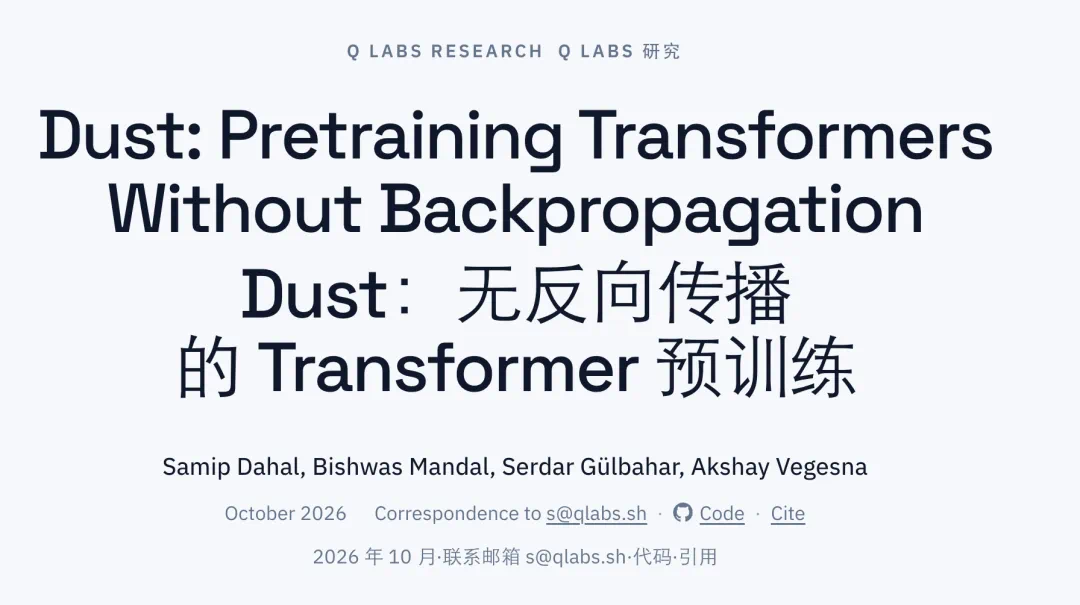
Q Labs proposes Dust, a zeroth-order optimizer that rivals backprop in Transformer pretraining up to 243M params
Q Labs, a small research lab backed by Jeff Dean, published a paper introducing Dust, a zeroth-order optimization method that adds Gaussian noise to activations per token and estimates gradients via a virtual population. They claim it is the first such method to compete with backpropagation in Transformer pretraining, with experiments up to 243M parameters and 20M tokens. Third-party replication from SOTAAZ Lab confirmed basic results but found backprop leads when given better optimizers or more epochs, and Dust is far more computationally expensive, so its significance lies in demonstrating feasibility rather than replacing backprop.
1 reports · 1 sources
DeepSeek details DSec sandbox system for agent training, 5000+ sandboxes/sec
DeepSeek published a system paper, co-authored by Liang Wenfeng, detailing DSec (DeepSeek Elastic Compute), a production sandbox infrastructure for large-scale agentic RL training and evaluation. A single production unit comprises about 160 CPU nodes, 30,000 cores, and 250 TB DRAM, generating over 5,000 sandboxes per second, up to 3 million daily, with over 380,000 concurrent at peak. The paper covers four backend types (FnCall, Container, MicroVM, Full) and states that sandbox workloads from DeepSeek V3.2 to V4.1 run on DSec.
DeepSeek open-sources Ascend infrastructure components, partners with Huawei
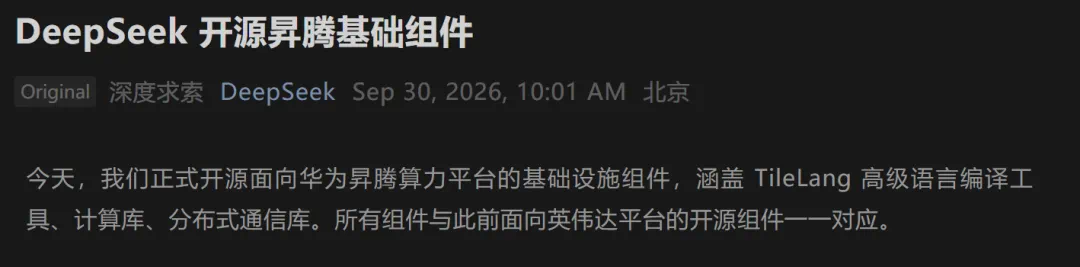
DeepSeek announced on September 30 the open-sourcing of infrastructure components for Huawei's Ascend platform, including the TileLang compiler, high-performance computing libraries (DeepGEMM, FlashMLA, TileKernels, DeepSelect), and the DeepEP distributed communication library. Huawei also open-sourced joint innovations around Ascend 950 and supernodes in the CANN community, covering deployment, training, KV cache pooling, and Agentic RL. The move aims to build an efficient AI chip software ecosystem with Huawei, providing developers with tools corresponding to those previously released for GPU platforms.
DeepSeek quietly releases official desktop version of Harness GUI agent tool
DeepSeek has released an official desktop version of its Harness GUI agent tool without a formal announcement, as confirmed by a hands-on test. The app lets users log in with a DeepSeek account or API key, select a local workspace, and assign tasks across modes like standard, PTC, minimal, and creative. It includes six built-in plugins, two of which are experimental, and emphasizes an 'Everything is a Plugin' architecture for extensibility.

News updates every hour. Subscribe in your RSS reader to get new stories automatically.
Subscribe