Google Quantum AI Reports 98.3% Win Rate in Magic Square Game on Willow Processor
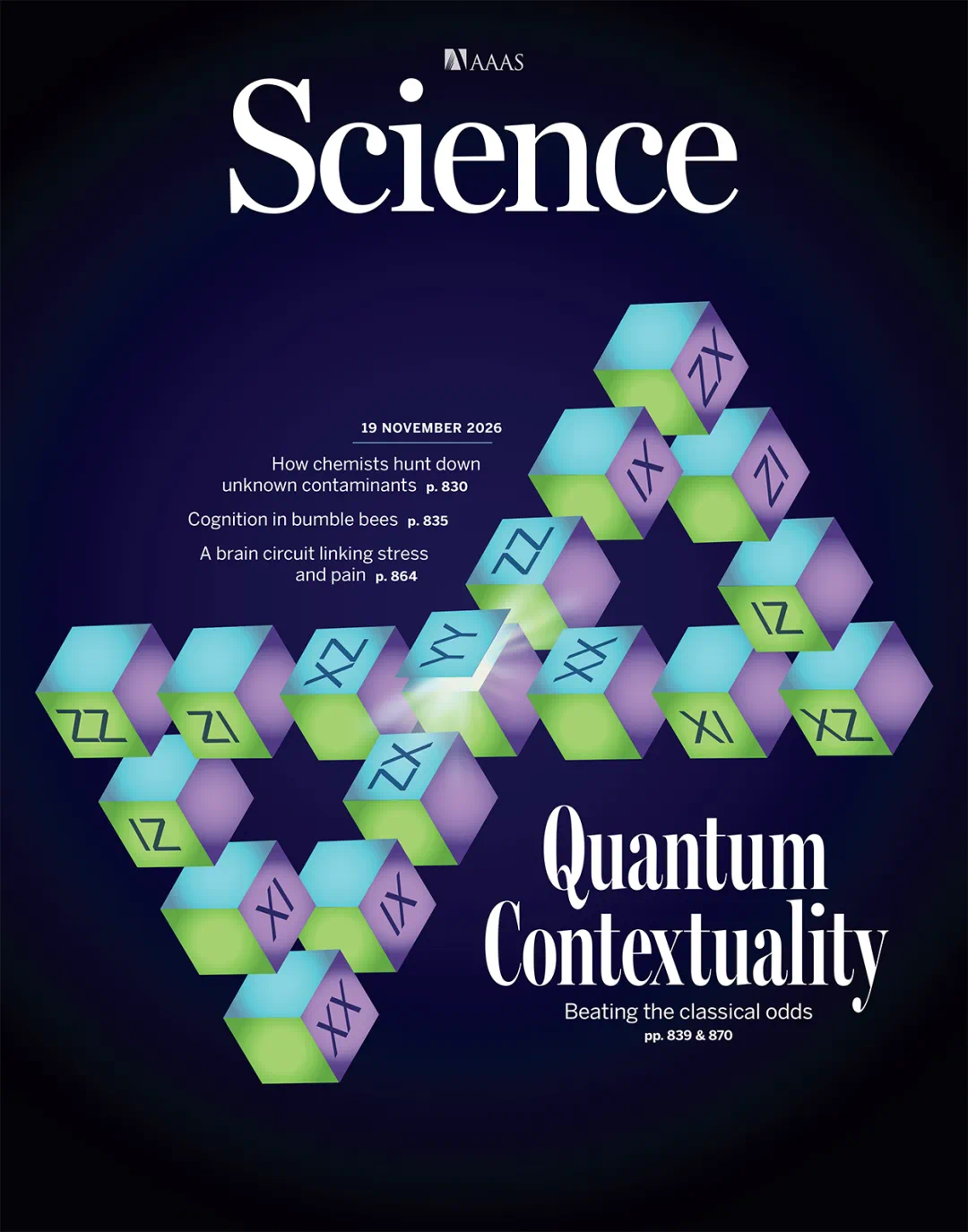
Google Quantum AI published a Science cover paper on November 19, 2026, reporting a 98.3% win rate in the Mermin–Peres magic square game using its Willow superconducting quantum processor, exceeding the classical theoretical limit of 88.89%. The study demonstrates quantum-classical separation in bounded-resource tasks by turning quantum contextuality into a measurable performance metric on real hardware.
Coverage timeline
机器之心机器之心
编辑丨& 如果给两个人一张 3×3 的表格,让他们分别填写数字,并规定每一行的乘积必须为 +1,每一列的乘积必须为 −1,那么他们无论如何都无法提前填出一张满足全部条件的表格。 这并不是一道故意刁难人的数学题,而是量子信息科学中的一个经典游戏。它揭示了量子力学的一种反直觉特性:测量结果并不总能被看作事先已经确定的数值,有时还取决于测量时所处的具体环境。 11 月 19 日,Google Quantum AI 发表「 Quantum-classical separation in bounded-resource tasks arising from measurement contextuality 」,登上《 Science 》封面。他们利用其 Willow 超导量子处理器,在这一游戏中取得 98.3% 的胜率,超过经典策略 88.89% 的理论上限。研究尝试将量子上下文性从少数粒子系统中的物理现象,转变为可在真实硬件上测量的性能指标。 论文链接: https://www.science.org/doi/10.1126/science.aec3042 一场经典策略无法完美获胜的游戏 前文中所提到的游戏名为 Mermin–Peres 幻方游戏(magic square game)。规则看上去很简单:在 3×3 表格中填入 +1 或 −1,要求每一行三个数字相乘等于 +1,每一列三个数字相乘等于 −1。 但细想之下,这两个条件无法同时满足。故而团队将这个矛盾设计成两人协作游戏。玩家 A 随机获得一行,B 获得一列,两人不能在获知题目后相互交流,但可以提前商定策略。他们分别填入三个数字,只要两人在行列交叉位置给出的数字一致,就算获胜。 对于经典计算机而言,提前约定的策略相当于预先准备一张数字表。由于不存在完全满足行列条件的表格,两人最多只能保证在 9 种可能的行列组合中赢下 8 种,即理论胜率为 88.89%。 量子策略则不同。A 和 B 可以提前共享两对纠缠的贝尔对(Bell pairs),并根据各自拿到的行或列选择相应的测量方式。由于测量结果受到具体测量情境影响,他们不必依赖一张事先填写好的完整表格。理想情况下,两人可以在每一轮都给出一致的交叉位置结果。 图 1:量子策略下的幻方游戏。 将实际胜率推至 98
Related stories
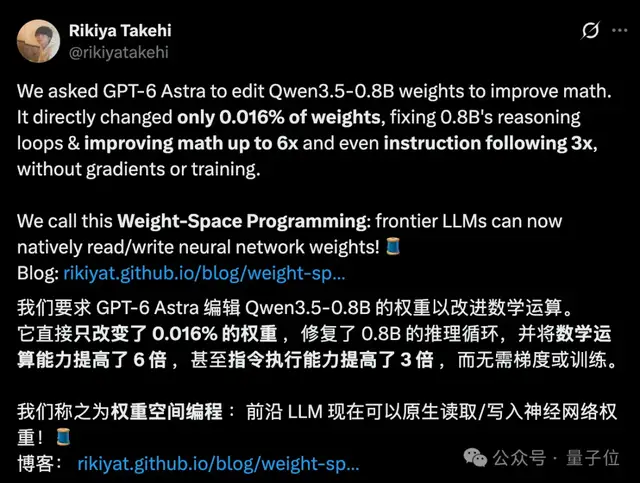
MIT: GPT-6 Astra edits Qwen weights, boosting MATH-500 from 7.9% to 48.1%
MIT CSAIL researchers demonstrated that GPT-6 Astra can directly read and modify the weights of Qwen3.5-0.8B, improving its MATH-500 score from 7.9% to 48.1% by altering only 0.016% of parameters, without training or gradient descent. The team named this capability Weight-Space Programming. However, spaCy author Matthew Honnibal publicly challenged the paper, arguing that the experimental conditions across the three claimed abilities differ significantly and that the presentation is misleading.
6 reports · 5 sources2949 points · 892 comments
OpenAI claims disproof of Exponential Time Hypothesis, plus math and physics results
OpenAI announced three new discoveries in mathematics, computer science, and physics, including a claimed disproof of the Exponential Time Hypothesis (ETH), a conjecture widely believed for nearly 30 years. The results cover local smoothing for the Euclidean wave equation, the Kakeya conjecture in four dimensions, and a rigorous mathematical existence proof for four-dimensional quantum field theories including quantum chromodynamics. External experts guided the results, and materials were released on GitHub for verification.
5 reports · 5 sources1153 points · 701 comments

Realtime-Bench: Frontier LLMs achieve only 44% success on real-time interactive tasks
Researchers from NVIDIA, UT-Austin, and other institutions released Realtime-Bench, a benchmark of 50 interactive game and web tasks that require real-time decision-making. Testing 12 frontier models, the best performer (GPT-6-Astra) achieved only 44% success, highlighting LLMs' weakness in low-latency tasks.
2 reports · 2 sources

Google DeepMind unveils Gemini 4 Carbon, tops AI benchmark
Google DeepMind announced Gemini 4 Carbon, its next frontier model, claiming state-of-the-art performance in cybersecurity and long-horizon tasks. The model scored 59 on the Artificial Analysis Intelligence Index v5.0, ranking first ahead of Claude Opus 5.5 (58) and GPT-6 Astra (57). It is initially available only to select cybersecurity defense companies through the Fairwind program, with pricing at $2 per million input tokens and $10 per million output tokens, rising to $4 and $20 later.
8 reports · 6 sources1013 points · 801 comments

News updates every hour. Subscribe in your RSS reader to get new stories automatically.
Subscribe