Tsinghua and miHoYo open-source GameScaling, eight general game-playing models
Tsinghua University, miHoYo, and other academic institutions have open-sourced the GameScaling series, comprising eight general game-playing models ranging from 0.8B to 27B parameters, under the Apache 2.0 license. The models achieve a 63.3% average success rate on the MCU benchmark in Minecraft, and smaller variants (0.8B-9B) can run in real time on a single H200 or RTX 5090 GPU.
Coverage timeline
机器之心机器之心
部分作者介绍: 张宽:清华大学人工智能学院博士生,研究游戏智能体。 苏悦:香港大学 MMLab 博士生,研究世界模型与具身智能。 罗润:新加坡国立大学博士生,研究全模态基础模型。 郑银河:米哈游崩坏系列 AI NPC & Gameplay 技术团队负责人。 李一鸣:清华大学人工智能学院助理教授,厘清智能创始人,前英伟达研究科学家。 近日,米哈游联合清华大学、香港大学、新加坡国立大学等学术机构,开源首个通用游戏模型 GameScaling 系列:覆盖 0.8B、2B、9B、27B 四档规模,共八个模型,权重与推理代码均以 Apache 2.0 协议发布。 项目主页: https://gamescaling.github.io 模型网址: https://huggingface.co/THUSI-Lab/GameScaling 代码仓库: https://github.com/THUSI-Lab/GameScaling GameScaling 可以在《我的世界》中采矿、合成、打僵尸,在 Doom 中战斗、导航,在场景逃脱任务中寻找出路。它根据画面、任务提示和近期交互历史,生成键盘与鼠标操作,随着游戏的变化不断决定下一步。 图 1 GameScaling-2B-S3 在 Minecraft 中执行采集、合成与战斗任务的实时演示片段。来源: GameScaling 网站宣传视频 GameScaling 模型炫酷的操作背后也有扎实的评测分数:在《我的世界》MCU 基准的 30 项任务中,GameScaling-27B-S1 的平均成功率达到 63.3%。据团队实测,其中的 0.8 - 9B 的 6 个模型在单张 H200 或 RTX 5090 上,即可实现接近每秒 5 次观测、每秒 30 步动作的实时游戏交互。 研究团队开源 GameScaling 模型,是希望能与社区一起研究:AI 怎样才能把在一个世界学到的经验,带到另一个世界?这也是游戏与人工智能长期相伴之后,一道自然浮现的新考题。1997 年,深蓝击败国际象棋世界冠军;2012 年深度学习爆发以来,AlphaGo 和 AlphaStar 分别在围棋和《星际争霸 II》中战胜世界冠军,OpenAI Five 在 Dota 2 中展示了多智能体协作的能力;到了大模型时代,Voyager 又在《我的世界》里探索环境、积累技能

Related stories
Fudan, Tencent Hunyuan, Tsinghua Release ExplorationBench to Test AI Rule Discovery
Fudan University, Tencent Hunyuan, and Tsinghua University released ExplorationBench, a benchmark measuring how AI systems discover rules in unfamiliar environments. It includes two altered 'alien worlds'—the programming language AlienCode and the logic proof system AlienLogic—where models must learn rules through trial and error. Results showed that without environment feedback, scores remained low (max 11.0%), while autonomous exploration led to high scores (up to 89.0%).
2 reports · 1 sources

RSIGame framework lets AI agents self-improve in game development, beating one-shot GPT-5.5 output
Researchers from UC San Diego, ByteDance, and CMU propose RSIGame, an agentic framework that turns game development into a recursive self-improvement process, where agents playtest, diagnose, fix, and validate games iteratively. Experiments show RSIGame improves game quality scores from 50.26 to 64 starting from GPT-5.5-generated games, and accumulated experience can further train the underlying model.

Meta and academic researchers propose World-T³, a video world model with test-time training for long-term memory
Researchers from Meta Reality Labs, the University of Illinois Chicago, and Brown University propose World-T³, a camera-controllable video world model that uses test-time training to store historical observations in fast weights, keyed by camera pose, enabling consistent scene recall when revisiting locations. On a long-term revisit benchmark of 120 trajectories, it improves revisit PSNR from 13.52 dB to 18.31 dB and reduces absolute rotation error from 3.344° to 1.075°, while a 4-step distilled model runs at 20.6 FPS on a single NVIDIA B200 GPU at 1280×704 resolution.

Tsinghua's BaGuaLu-2 adapts MoE memory management at runtime, boosting throughput on 12,288 DCUs
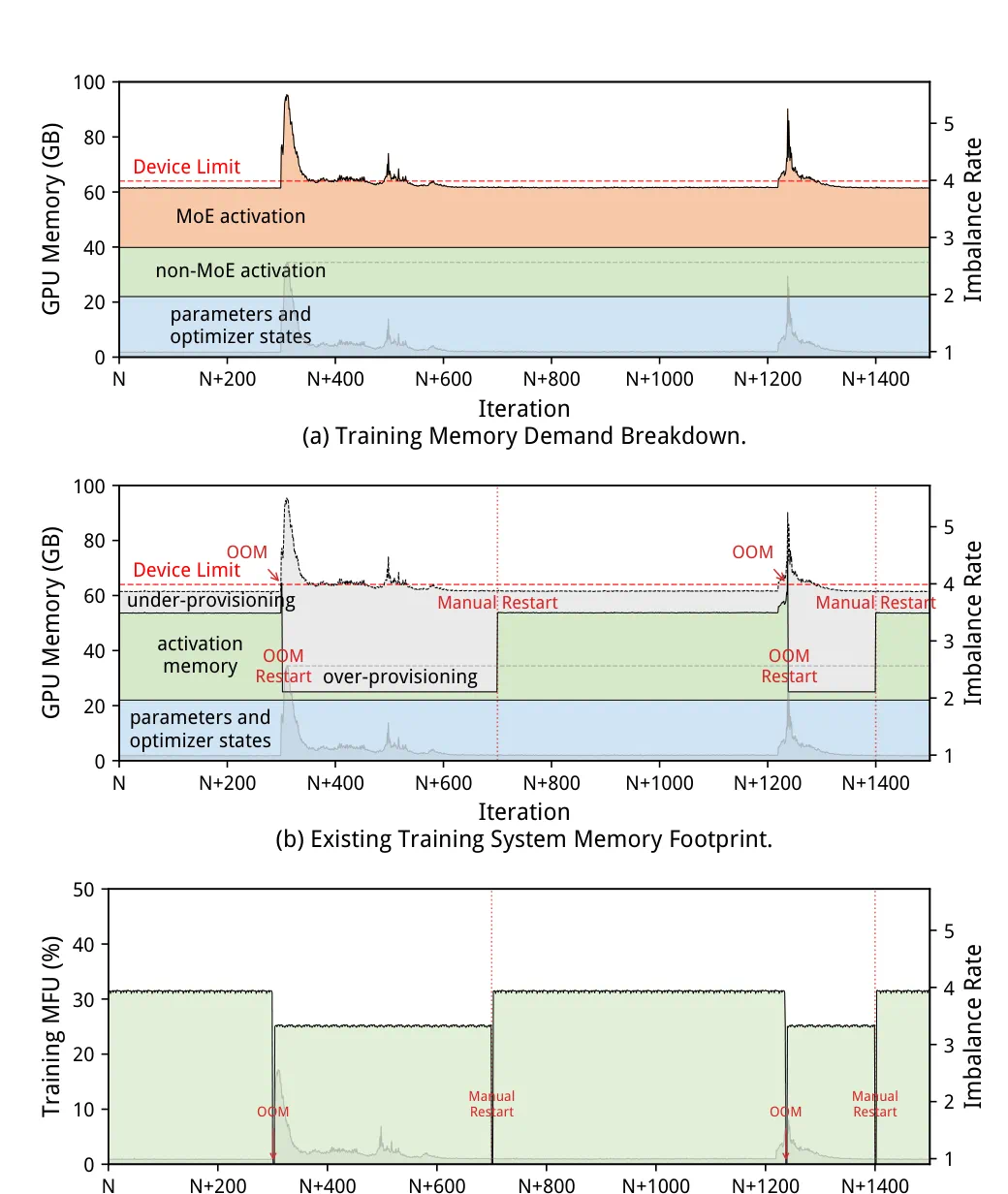
At SC26, Tsinghua researchers present BaGuaLu-2, a runtime-adaptive memory management system for MoE training that adjusts recomputation and offloading per operator based on real-time load, preventing activation spikes from causing out-of-memory crashes. Tested on 128 to 12,288 Hygon DCUs with models from 188B to 1.04 trillion parameters, it achieves an average 1.14x throughput gain over baselines, with total throughput of 2.012 EFLOPS at 12,288 cards and average MFU of 32.9%.
News updates every hour. Subscribe in your RSS reader to get new stories automatically.
Subscribe