Hugging Face and Ai2 release XYBench benchmark for detecting user misconceptions
Hugging Face and the Allen Institute for AI (Ai2) have released XYBench, an 8,115-question benchmark that evaluates whether large language models can identify misconceptions in user requests and steer toward the user's actual underlying goal. The benchmark aims to test a model's ability to go beyond literal interpretation and address the real problem behind a question.
Coverage timeline
Hugging Face Blog
Ai2 (Allen Institute for AI)
XYBench is an 8,115-question benchmark testing whether LLMs spot misconceptions in user requests and redirect toward the user’s underlying goal.

Related stories
Ai2 and Hugging Face release StateBench benchmark for tracking state changes in long documents
Ai2 and Hugging Face released StateBench, a benchmark that tests how language models track changing information across long documents at four difficulty levels. The benchmark reveals where models struggle and how targeted training helps recurrent and hybrid architectures handle longer sequences.
Ai2 benchmark shows LLM novelty judgments vary with evaluation setup
The Allen Institute for AI released a benchmark called Old Ideas, Novel Problems to test how reliably LLMs judge research-idea novelty. The findings show that small changes to the evaluation setup can produce very different verdicts on the same ideas.

Realtime-Bench: Frontier LLMs achieve only 44% success on real-time interactive tasks
Researchers from NVIDIA, UT-Austin, and other institutions released Realtime-Bench, a benchmark of 50 interactive game and web tasks that require real-time decision-making. Testing 12 frontier models, the best performer (GPT-6-Astra) achieved only 44% success, highlighting LLMs' weakness in low-latency tasks.
2 reports · 2 sources

AISLE benchmark: top AI models score 41/100 in real wet-lab tests
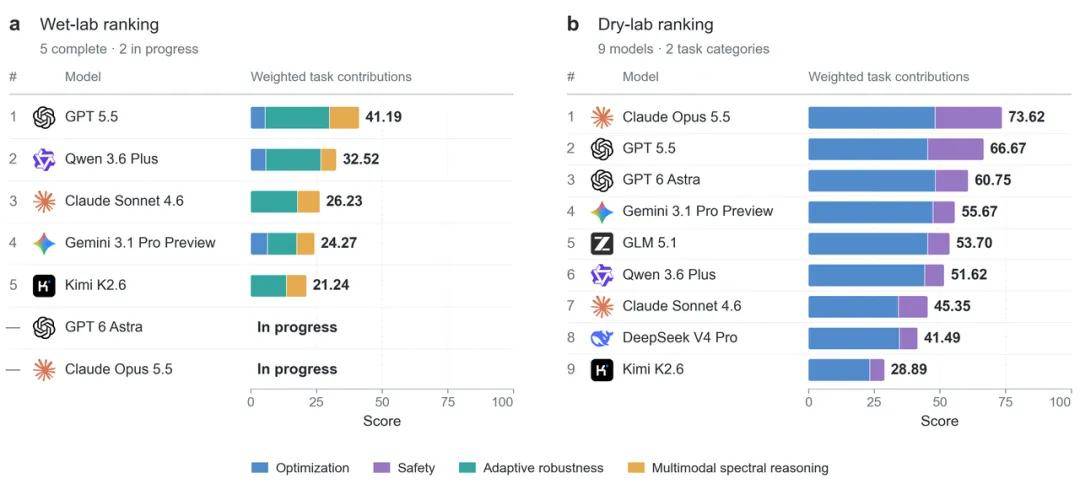
AISLE, a benchmark for AI scientists' real-world wet-lab capabilities, released first-round results from 4,079 wet-lab tests across GPT, Claude, and Gemini models. The top model, GPT 5.5, scored 41.19 out of 100, and all models had a 0% pass rate on safety-constrained experiment optimization tasks. OpenAI also introduced BioBasicsBench, a 100-task benchmark for interpreting raw experimental data.
News updates every hour. Subscribe in your RSS reader to get new stories automatically.
Subscribe