QuantaMind reactive MD platform published in Science Advances, scales to 100k atoms and 100ns
Molecular Heart's reactive atom modeling platform QuantaMind was published in Science Advances, claiming to push reactive molecular dynamics with near-DFT accuracy to tens of thousands of atoms and tens of nanoseconds, with extended tests reaching 100,000 atoms and 100 nanoseconds. The work addresses the long-standing trade-off between accuracy, speed, and scale in simulating chemical bond breaking and formation in large biomolecular systems.
Coverage timeline
量子位量子位
分子之心QuantaMind登Science Advances,让AI给分子世界”拍电影” 量子位的朋友们 2026-09-14 16:17:22 来源: 量子位 AI 蛋白质设计迈入“动态时代” 当AI已经能够预测一个蛋白质”长什么样”,下一个问题随之而来:我们能否理解它”怎样工作”? 酶催化时质子如何转移?化学键如何断裂和形成?药物与靶点结合后构象如何变化?——这些发生在纳秒级时间与原子尺度上的动态过程,才是真正决定分子功能的关键,也是计算化学几十年来未能攻克的难题。 近日,分子之心自主研发的反应性原子建模平台 QuantaMind 相关研究发表于《 Science Advances 》,首次将接近密度泛函理论(DFT)精度的反应性分子动力学推进至 数万原子级生物体系和数十纳秒时间尺度 ;论文提交后的最新扩展测试进一步达到了 十万原子级和百纳秒尺度 。 这一突破将AI大分子设计带入 “动态反应模拟”新时代 ——化学反应不再是只能事后验证的黑盒,而是可以在计算端提前推演和理解的过程。 长期困境:精度、速度与尺度的”不可能三角” 要理解一个分子”怎样工作”,关键在于反应性分子动力学模拟——它通过追踪原子的持续运动,捕捉质子转移与化学键断裂/生成的完整过程。 然而,将反应性分子动力学真正应用于大型生物分子体系,长期面临着 精度、速度与尺度难以兼得 的困境: 要精度,就牺牲规模和速度——传统量子化学方法(如DFT)精度极高,但在大型体系上计算量极大,实际研发中很难直接运行; 要大体系和长时间,就无法描述反应——经典分子动力学能算大体系,但无法描述化学键的断裂与生成; 已有机器学习力场在小分子上表现不错,但在大型生物体系的长时推演中难以维持稳定性。 计算方法 化学键断裂/生成 能量/力精度 适用体系规模与时长 经典分子动力学(MD) 无法描述 中等(固定力场) 大体系/长时间 量子化学(DFT) 精准捕捉 高(第一性原理级) 极小体系/极短时间 已有机器学习力场 部分支持 较高 中等体系/稳定性受限 QuantaMind 连续追踪 接近DFT精度 十万原子级/百纳秒级 注:QuantaMind的规模与时长为论文提交后的最新扩展测试结果;论文中实际验证的最大体系为24,001原子、最长模拟为20纳秒。 作为反应性机器学习力场框架,QuantaMind通过创新数据工程与模型架

Related stories
OpenAI claims internal model solved Navier-Stokes Millennium Prize problem in 88 hours
OpenAI announced that an unreleased next-generation model, described as significantly more capable than GPT-6 Astra, solved the Navier-Stokes existence and smoothness problem, one of the Clay Mathematics Institute's Millennium Prize Problems, using about 10,000 concurrent AI agents over 88 hours. The company released a 166-page proof and Lean 4 formal verification code, and said it would forgo the $1 million prize. The announcement has sparked controversy over alleged scooping and data use, with mathematician Tristan Buckmaster disputing OpenAI's account of negotiations.
7 reports · 5 sources178 points · 179 comments

PlayWorld benchmark evaluates world models via agent players on long-horizon goals
Researchers from HKU, CUHK, Zhejiang University, and Kuaishou Keling introduced PlayWorld, a benchmark that evaluates world models by having an agent player interact with them over long-horizon objectives, observing geometric consistency, interaction correctness, and evolution plausibility. Unlike fixed action sequences, PlayWorld uses scene-related long-term goals, allowing the agent to adjust based on real-time observations. The evaluation set and code are open-sourced.
1 reports · 1 sources
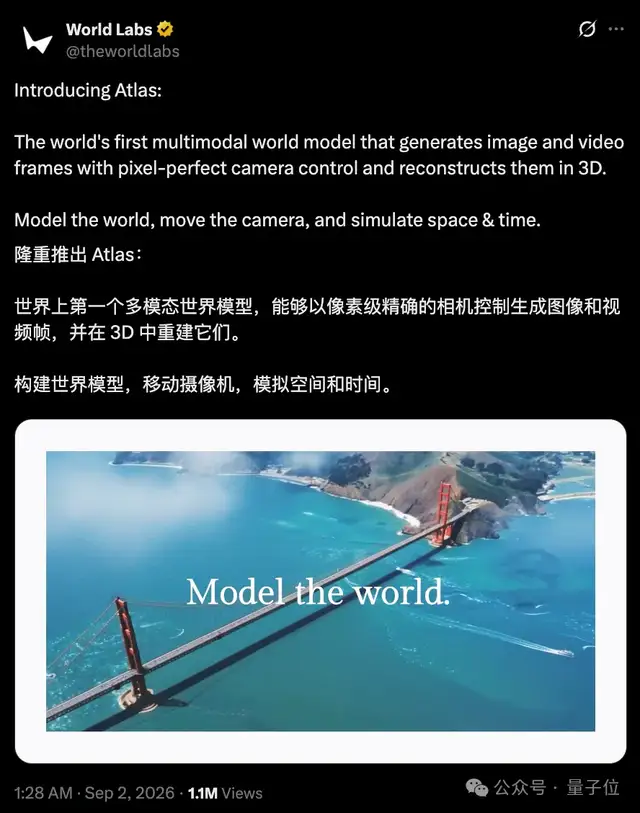
World Labs unveils Atlas, a multimodal world model with pixel-level camera control and 3D reconstruction
World Labs, founded by Fei-Fei Li, released Atlas, described as the world's first multimodal world model. It generates images and videos with pixel-level camera control, reconstructs 3D scenes from one to dozens of images, and supports spatiotemporal simulation for robotics and VFX. Atlas is trained from scratch on text, image, video, and 3D data, and is currently available to select partners, not open-sourced.
OpenAI launches GPT-6 Astra, first model to hit Critical cyber threshold
OpenAI announced GPT-6 Astra, its first model to reach the Critical cybersecurity capability threshold under its Preparedness Framework. The company plans to release a version publicly soon, but will limit advanced cyber capabilities to select partners. Reports indicate Astra uses 'recurrent depth' to improve cost and performance, though it obscures reasoning and may flag legitimate activity as misuse.
8 reports · 4 sources176 points · 101 comments

News updates every hour. Subscribe in your RSS reader to get new stories automatically.
Subscribe