RSI Arena launches to test AI self-improvement beyond benchmarks
Bake AI, with Stanford, Hugging Face, Notre Dame, and the University of Washington, launched RSI Arena, a live-streamed experiment where AI agents autonomously post-train models without fixed benchmarks, using broad tasks and human blind voting. The study introduces the RSIHF framework, arguing that model popularity and safety must be evaluated separately, as optimizing for popularity can lead to reward hacking and safety declines.
Coverage timeline
机器之心机器之心
在算力对等的前提下,单纯堆叠算力无法保证模型在自我提升过程中的胜率;模型针对「受欢迎程度」开展优化时,容易出现迎合人类的倾向,进而造成安全指标下滑;相关研究首次提出 RSIHF 框架,证实在 AI 自动训练 AI 的过程中,模型的「受欢迎程度」与「安全性」不能画等号,必须分开评估。 如果 AI 研究员把评测分数提高了,外界很难直接判断,相关操作到底是完成了模型本身的改进,还是找到了适配评测规则的捷径。目前部分已落地的自动化研究项目里,智能体只会围绕指定的 benchmark 或者固定评测流程做优化,这类流程得出的分数确实方便横向比较,却也可能催生针对评测的过拟合问题,甚至出现 reward hacking 情况,也就是智能体借助评测规则里的漏洞拉高得分,对应的实际能力却没有匹配分数的增长。 为了对上述问题作出更清晰的判断,总部位于美国硅谷的人工智能企业 Bake AI,联合 Hugging Face、斯坦福大学、圣母大学、华盛顿大学共同推出了一项名为「RSI Arena」的实验,全程直播。参与该实验的研究者没给智能体指定 benchmark,而是设置了较为宽泛的任务方向,要求其在有限资源内,把基础模型训练为能力尽可能强的模型。训练完成的模型除了要接受独立测试,还要交由真实用户参与盲测投票。 图 1 | RSI Arena 直播画面:AI 智能体自主开展模型后训练,实验过程、训练曲线与算力消耗实时可见。 论文:RSI Arena: Towards Recursive Self-Improvement with Human Feedback 论文地址: https://arxiv.org/pdf/2610.33624 项目网站:https://rsiarena.org/ 参与测试的用户提出的问题和需求覆盖范围较广,不存在一套固定的参考答案,故模型难以刻意迎合。「成为尽可能强的模型」这一任务设定,很难对应一个提前公开、可以反复开展针对性优化的单一评分指标。该实验的设计思路旨在通过宽泛的任务目标和开放的人类评价机制,提升智能体针对已知评分规则开展 reward hacking 的难度。 依托上述实验设计,共有 10 个前沿模型自主完成后训练流程,后续再结合用户反馈持续开展迭代。面对这类任务设定,AI 会如何定义「更好」的标准,又会将模型的优化方向引导至何处,是实验重点观察的

Related stories
MolRSI recursive self-improving AI agent boosts wet-lab hit rates in molecular discovery
Researchers proposed MolRSI, a recursive self-improving AI agent for molecular discovery, which autonomously optimizes screening workflows. In antibacterial molecule screening, it achieved a wet-lab hit rate of 15.9% versus 8.7% for a non-agent workflow, a relative improvement of about 82%. For pMHC-binding protein design, it obtained 8 binding hits meeting experimental specificity criteria on two targets, while the Claude Science control got 0.
1 reports · 1 sources

RSIGame framework lets AI agents self-improve in game development, beating one-shot GPT-5.5 output
Researchers from UC San Diego, ByteDance, and CMU propose RSIGame, an agentic framework that turns game development into a recursive self-improvement process, where agents playtest, diagnose, fix, and validate games iteratively. Experiments show RSIGame improves game quality scores from 50.26 to 64 starting from GPT-5.5-generated games, and accumulated experience can further train the underlying model.

BAAI AREX-2: 27B model beats larger rivals on ML, algorithm benchmarks
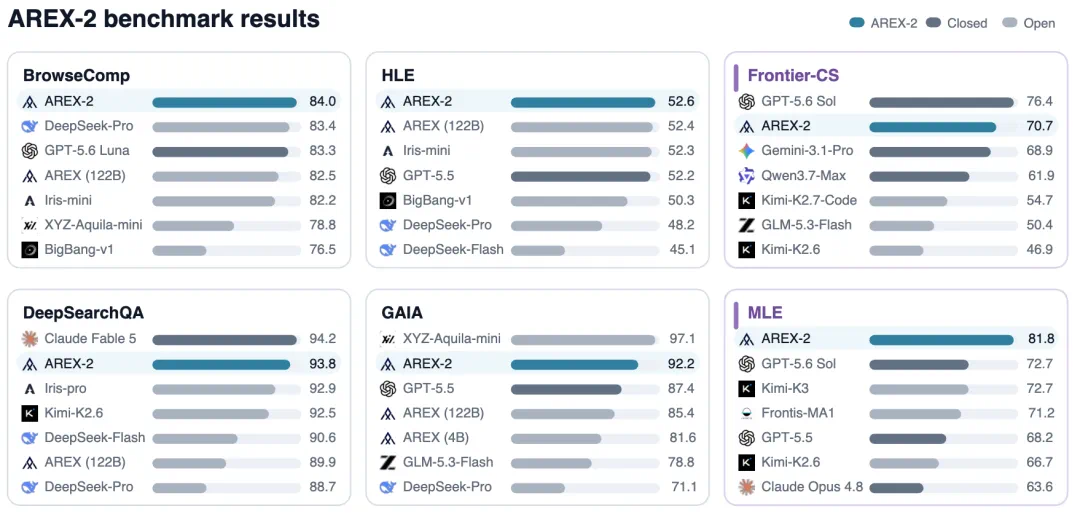
The AREX research group, involving BAAI, USTC, and Renmin University, released AREX-2, a 27B-parameter model built on Qwen3.8-27B and trained on long-horizon reflection data for machine learning and algorithm programming. It outperforms larger models on MLE-bench Lite and Frontier-CS, and sets open-weight records on BrowseComp and HLE, suggesting that long-horizon reflection training can foster cross-domain self-improvement capabilities.
UCSB and Microsoft Propose ScholarEvolve for AI Agents to Read Papers and Self-Modify Code
Researchers from UC Santa Barbara and Microsoft introduced ScholarEvolve, a method that automates the research process of reading literature, implementing algorithms, and evaluating results to enable AI agents to evolve their harness code without modifying underlying model parameters. The approach addresses the limitation of prior coding-agent-based harness optimization, which relied on the agent's existing knowledge and observed failures, by allowing agents to draw on the latest academic findings. The paper and code are publicly available.

News updates every hour. Subscribe in your RSS reader to get new stories automatically.
Subscribe